हिंदी में पढ़ें —JantaScope हिंदी
AI NEWS

US Public Health Agencies to Pilot OpenAI and Anthropic AI Models in New National Initiative

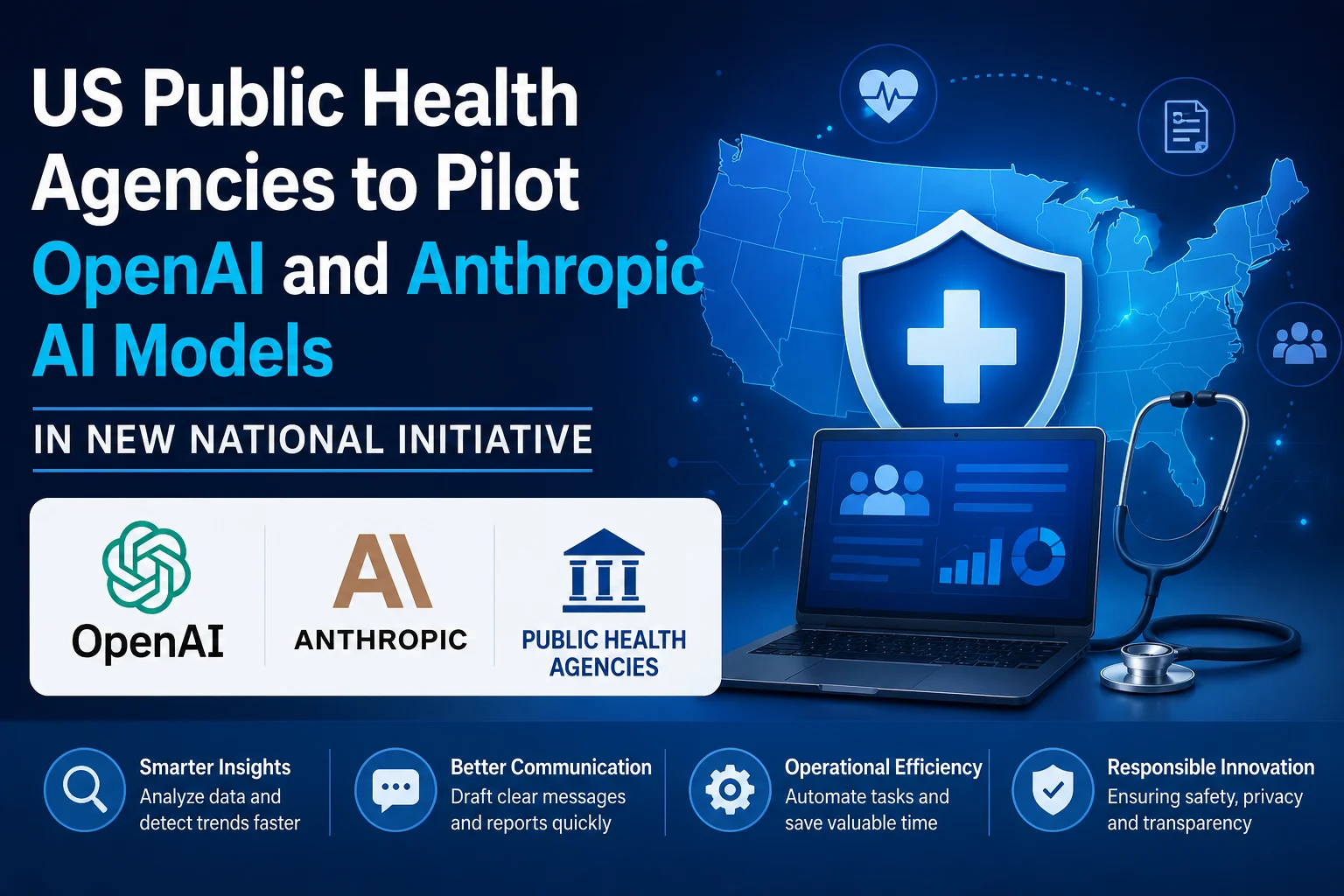
Public health agencies across the United States are preparing to evaluate enterprise artificial intelligence tools from OpenAI and Anthropic through a new pilot initiative designed to explore how generative AI can improve public health operations. The program aims to help health departments test practical AI applications while developing guidance for broader adoption across government agencies.

US Public Health Agencies to Pilot OpenAI and Anthropic AI Models in New National Initiative

By Jeet Nirmal

Source: Janta Scope

Public Health Agencies Begin Testing Advanced AI Tools

A nationwide pilot program will give selected public health agencies access to enterprise AI platforms developed by OpenAI and Anthropic, marking another step in the integration of artificial intelligence into public sector healthcare operations.

The initiative, known as the Public Health Use Case and Learning Scaling Engine (PULSE), is being coordinated by the Coalition for Health AI (CHAI) in partnership with OpenAI, Anthropic, and Accenture. Ten state, local, tribal, or territorial public health organizations will participate in the first phase of testing.


How the Pilot Program Will Work

Under the program, OpenAI and Anthropic will provide enterprise AI licenses that can support up to 2,000 public health professionals participating in the pilot.

Accenture will oversee onboarding, technical support, and documentation while helping create implementation guides based on lessons learned during the trials. Organizers expect the program to produce practical recommendations for other public health agencies considering AI adoption.

The organizers have not publicly specified which AI models or configurations will be deployed during the pilot.

Potential Benefits for Public Health

Public health departments manage enormous volumes of information ranging from disease surveillance and outbreak monitoring to community health reporting and emergency preparedness.

Generative AI could assist agencies by:

  • Summarizing large public health reports

  • Supporting data analysis

  • Drafting communications and public advisories

  • Improving administrative efficiency

  • Helping staff access information more quickly

The pilot is intended to evaluate these types of real-world use cases before wider deployment.


Why This Initiative Matters

Artificial intelligence is becoming an increasingly important technology across healthcare, biomedical research, and government services.

While hospitals and private healthcare organizations have experimented with AI for several years, public health agencies have generally adopted these tools more cautiously because of concerns involving privacy, security, transparency, and regulatory compliance.

By conducting structured pilot programs, agencies hope to better understand where AI delivers measurable benefits while identifying potential risks before broader implementation.


Part of a Broader Government AI Strategy

The initiative comes as the U.S. government expands investment in artificial intelligence across scientific research and public services.

Federal officials have recently announced multi-agency efforts to accelerate AI-driven scientific discovery, including health research, by combining advanced computing resources with government datasets. These initiatives reflect growing confidence that AI can help address complex public policy and research challenges.


Balanced Analysis

Supporters argue that generative AI could significantly reduce administrative workloads, improve knowledge sharing, and help public health professionals respond more efficiently during disease outbreaks and other emergencies.

However, experts also caution that AI-generated information must remain subject to human oversight. Public health decisions often involve sensitive medical, legal, and ethical considerations, making accuracy, transparency, and privacy essential requirements for any AI-assisted workflow.

The pilot's outcomes are expected to provide valuable evidence on both the opportunities and limitations of deploying generative AI within government health agencies.


Conclusion

The PULSE initiative represents an important experiment in bringing advanced AI technologies into public health practice. By allowing agencies to evaluate OpenAI and Anthropic's enterprise platforms in real operational settings, the program seeks to establish best practices for responsible AI adoption while improving the efficiency and effectiveness of public health services. If successful, the project could serve as a model for broader AI deployment across government healthcare systems.


Related

More stories

Fake ChatGPT, Claude and Gemini Apps Are Spreading Malware — Users Warned About AI Impersonation Threats

Cybercriminals are increasingly disguising malicious software as popular AI services such as ChatGPT, Claude and Gemini. Kaspersky says its security systems detected more than 92,000 attacks involving malware or potentially unwanted applications masquerading as AI services between January and early May 2026, highlighting the growing security risks surrounding the rapid adoption of artificial intelligence.

AI NEWS

Fake ChatGPT, Claude and Gemini Apps Are Spreading Malware — Users Warned About AI Impersonation Threats

IIT Madras Builds AI Platform With 185,000 Alloy Records, Targets Faster Discovery of Greener Materials

Researchers at IIT Madras have developed an artificial intelligence-driven platform designed to accelerate the discovery of sustainable, high-performance metallic alloys. The project has produced two databases containing more than 185,000 structured records, extracted from over 10,000 scientific papers, with potential applications spanning electric vehicles, aerospace, renewable energy and marine infrastructure.

AI NEWS

IIT Madras Builds AI Platform With 185,000 Alloy Records, Targets Faster Discovery of Greener Materials

Meta Hires OpenAI Veteran Luke Metz for Superintelligence Labs in Major AI Talent Push

Meta has hired prominent artificial intelligence researcher Luke Metz to join its Superintelligence Labs. Metz, who previously worked at OpenAI and Mira Murati’s Thinking Machines Lab, is expected to report to Alexandr Wang as Meta continues strengthening its team in the intensifying race to develop advanced AI systems.

AI NEWS

Meta Hires OpenAI Veteran Luke Metz for Superintelligence Labs in Major AI Talent Push

Nvidia Is No Longer Just an AI Chip Giant — Its Push Into AI Models Is Getting Much Bigger

Nvidia is expanding beyond the hardware that powered the generative-AI boom and strengthening its position in AI models, particularly through its Nemotron family and a major deal involving AI startup Poolside. The strategy could give Nvidia greater influence across the entire AI technology stack—from computing infrastructure to the models and agents running on top of it.

AI NEWS

Nvidia Is No Longer Just an AI Chip Giant — Its Push Into AI Models Is Getting Much Bigger

Anthropic’s $2 Trillion IPO Dream Could Rewrite Wall Street Records — Here’s Why Investors Are Watching

Artificial intelligence company Anthropic is moving closer to a potential stock-market debut that could become one of the largest IPOs ever. Investors are reportedly discussing a valuation of around $2 trillion or more, highlighting extraordinary expectations surrounding the company behind the Claude AI models.

AI NEWS

Anthropic’s $2 Trillion IPO Dream Could Rewrite Wall Street Records — Here’s Why Investors Are Watching

Meta’s AI Talent War Heats Up Again as OpenAI Veteran Luke Metz Makes the Switch

The battle for the world’s most sought-after artificial intelligence researchers is intensifying again. Meta has hired veteran AI researcher Luke Metz, adding another former OpenAI talent to its expanding Superintelligence Labs operation. The move highlights how competition between leading AI companies is increasingly being fought not only through bigger models and computing infrastructure, but also through the recruitment of a relatively small group of researchers with experience building front

AI NEWS

Meta’s AI Talent War Heats Up Again as OpenAI Veteran Luke Metz Makes the Switch