Four Districts Dominate Uttarakhand’s Deletion Requests
The numbers emerging from Uttarakhand’s Special Intensive Revision of electoral rolls are drawing attention not simply because of how many deletion requests have been filed, but because of where they have come from.
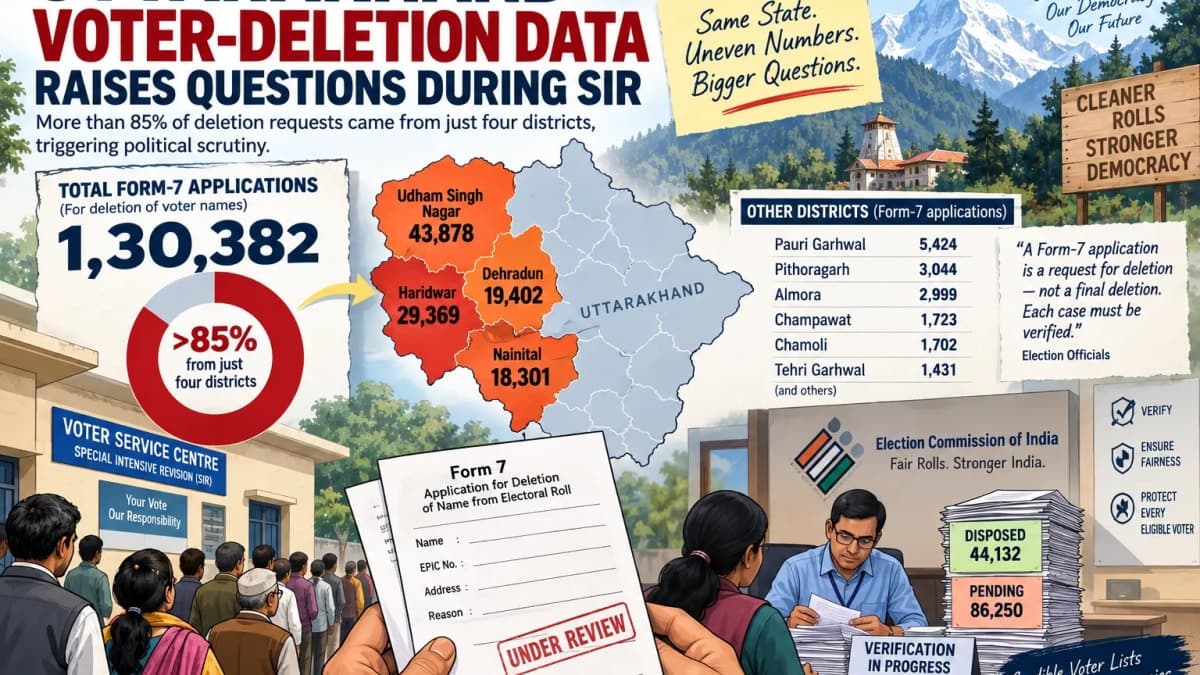
Official data reported by The Indian Express show that 1,30,382 Form-7 applications seeking deletion of voter names were received across Uttarakhand during the claims-and-objections period. More than 85% came from only four districts: Udham Singh Nagar, Haridwar, Dehradun and Nainital.
The distribution is striking. Udham Singh Nagar accounted for 43,878 applications, Haridwar for 29,369, Dehradun for 19,402 and Nainital for 18,301. Together, the four plains districts generated the overwhelming majority of the state's requests for names to be removed.
That concentration has become the latest point of contention surrounding the SIR, with opposition parties questioning the pattern and the BJP offering demographic and migration-related explanations.
A Form-7 application, however, is a request for deletion — not a completed deletion. Election officials must examine the objection before a name can be removed.
Plains and Hill Districts Show a Sharp Contrast
The four-district concentration becomes clearer when compared with Uttarakhand's hill districts.
Reported figures show 5,424 Form-7 applications in Pauri Garhwal, 3,044 in Pithoragarh, 2,999 in Almora, 1,723 in Champawat, 1,702 in Chamoli and 1,431 in Tehri Garhwal.
Population size is part of the explanation. The four districts producing the largest numbers are among Uttarakhand's more populous and urbanised areas and experience substantial movement of residents.
BJP leaders have pointed to those characteristics in explaining why deletion requests would be more numerous there. The party's position is that the plains have greater population mobility, including movement across state borders, making changes in voter registration more common.
The raw numbers alone therefore do not establish improper deletions or discriminatory intent.
They do, however, make the verification process consequential. When such a large share of objections is concentrated geographically, the reasons behind individual applications and the safeguards used before removing voters become particularly important.
Most Form-7 Cases Were Still Pending
The workload facing election officials is substantial.
Of the 1,30,382 Form-7 applications received statewide between July 14 and August 13, only 44,132 had been disposed of, according to CEO office data reported as of September 7.
Another 86,250 remained under process.
The imbalance was particularly visible in Udham Singh Nagar. Of its 43,878 applications, only 8,975 had been disposed of by September 7. Haridwar had processed 11,815 of 29,369; Nainital 6,803 of 18,301; and Dehradun 8,140 of 19,402.
Those pending cases are important because filing Form 7 does not, by itself, remove an elector.
An Electoral Registration Officer must examine the objection and give the affected voter an opportunity to respond before passing an order. Booth Level Officers are also required to conduct field verification.
Draft Roll Had Already Fallen by 8.25 Lakh
The Form-7 figures are arriving after an unusually large change in Uttarakhand's draft electorate.
The draft roll published on July 14 contained 71,33,785 voters, around 8.25 lakh fewer than the 79.58 lakh electors recorded in the final roll for the 2022 Assembly election.
Officials stressed at the time that the draft was not the final electoral roll and could change as claims, objections and verification cases were resolved.
The SIR also identified discrepancies involving approximately 19.04 lakh voter records. Earlier in the door-to-door enumeration exercise, the Election Commission had identified about 8.32 lakh electors in the ASD category, covering voters classified as absent, shifted or dead.
The CEO's office ordered fresh booth-level checks in such cases, with officials saying the objective was to prevent eligible electors from being wrongly excluded.
Congress Alleges Targeted Deletions
The unusual pattern has also become a political issue.
Congress has alleged irregularities in the SIR and raised concerns that genuine voters could be targeted through bulk Form-7 objections. A party delegation led by Uttarakhand in-charge Kumari Selja approached the Election Commission in August seeking intervention.
The party has alleged that some individuals submitted unusually large numbers of objections and questioned whether affected voters were receiving the required notices and opportunity to respond.
Those are political allegations, not established findings of wrongdoing.
More recent Congress criticism has gone further, alleging that Muslims, poorer voters and members of Scheduled Caste and Scheduled Tribe communities are being disproportionately targeted. BJP representatives have rejected that interpretation, pointing instead to population size and mobility in the plains districts.
The available statewide Form-7 totals show a strong geographic concentration. On their own, however, they cannot establish the identity of every voter affected, the validity of individual objections or the motivation behind them.
Bulk Objections Add Another Layer of Scrutiny
Concerns over Form-7 applications are not based solely on district totals.
In Kichha, in Udham Singh Nagar district, nearly 9,300 objections had been reported by late August. Of these, 1,707 concerned voters identified as permanently shifted and 7,589 related to alleged duplicate registrations.
A BJP booth-level agent, Rajesh Tiwari, had filed 6,412 objections relating to alleged duplicate registrations, according to the Times of India.
Separate reporting has identified other instances in which individuals submitted hundreds or thousands of objections. Such filings have contributed to opposition demands for greater scrutiny of the identities of objectors and the evidence accompanying deletion requests.
Large-volume objections are not proof that the underlying challenges are invalid. They do, however, increase the importance of case-by-case verification before any electoral entry is removed.
Election Commission Extends the Timeline
The scale of unresolved work has already affected the SIR schedule.
The claims-and-objections disposal period has been extended until September 28, while publication of Uttarakhand's final electoral roll has been shifted from September 15 to October 3, 2026.
Chief Electoral Officer BVRC Purushottam said that hearings had been completed in 99.96% of the 24,30,387 notices generated during the exercise.
At the same time, officials still have a considerable volume of claims and objections to process. In addition to the pending deletion applications, more than one lakh applications for inclusion and tens of thousands seeking corrections were also being dealt with.
The Final Roll Will Provide the More Meaningful Test
The current data needs to be read carefully.
A Form-7 filing represents an objection to an electoral entry, not proof that the voter is ineligible. Likewise, the concentration of applications in four districts is a pattern requiring explanation and scrutiny, but it does not by itself demonstrate manipulation.
The more consequential figures will emerge after election officials complete verification: how many objections were accepted, how many were rejected, why voters were removed and whether affected electors received the procedural protections required under the revision process.
Until then, Uttarakhand's SIR presents two facts that sit alongside the political argument.
More than 1.30 lakh deletion requests have been submitted, and more than 85% of them came from four districts.
Whether that concentration primarily reflects population movement and roll-cleaning requirements, as the BJP argues, or reveals deeper problems in the objection process, as the opposition alleges, will require evidence from the cases themselves rather than the headline numbers alone.