Rumi Darwaza Viral Video Prompts Police Probe After Youths Enter Restricted Area
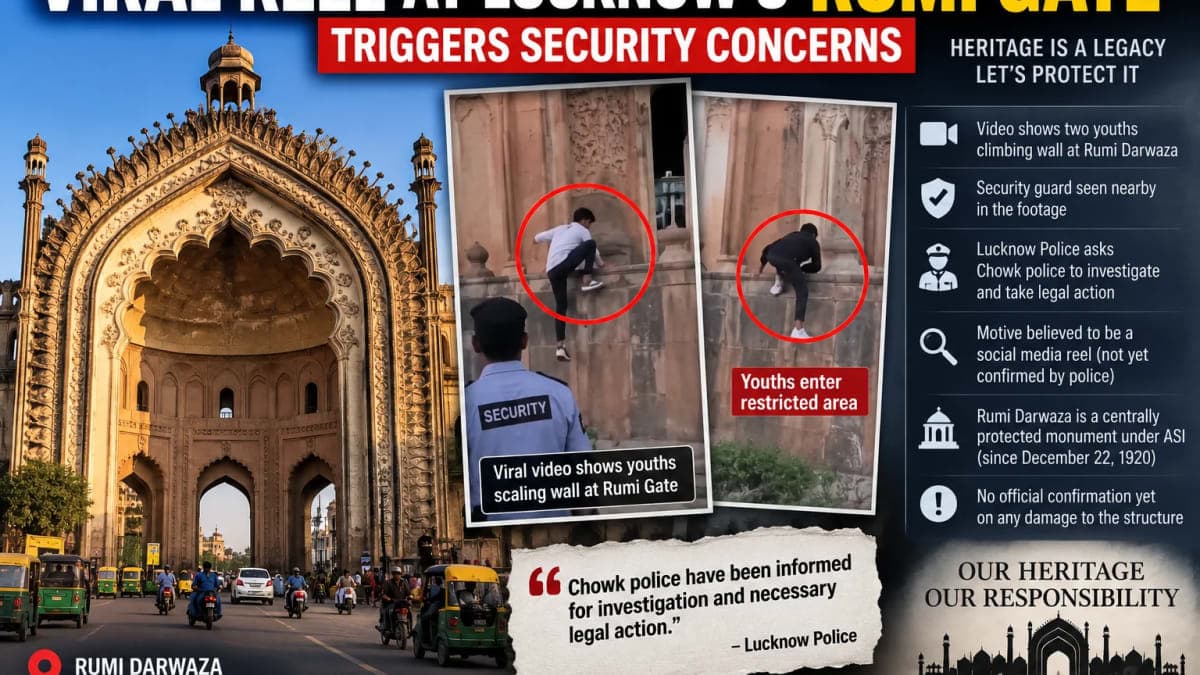
A short social-media video has drawn police attention to security at Lucknow's Rumi Darwaza after two youths were seen apparently climbing a wall to enter a section of the historic gateway that is not open to visitors.
The footage circulated widely on Tuesday and appears to show a security guard nearby as the pair make their way over the barrier. That detail has turned what might otherwise have been treated as a reckless social-media stunt into a broader question about access control at one of the city's most recognisable protected monuments.
Reports have linked the episode to the making of a social-media reel. Police have yet to establish the motive publicly, however, and there is no confirmed finding that the monument was damaged.
Chowk Police Asked to Investigate
Lucknow Police responded after the footage gained attention online.
“Chowk police have been informed for investigation and necessary legal action,” police said.
The investigation is expected to establish who the people in the video are, how they entered the restricted section and whether any offence was committed.
At the time of reporting, police had not announced arrests or publicly identified the youths.
There was also no official confirmation of physical damage to Rumi Darwaza. That distinction matters because the available footage raises a clear access issue but does not, by itself, establish vandalism.
The Guard in the Video Adds Another Question
The apparent presence of security personnel has become one of the more significant details in the footage.
Rumi Darwaza is a protected heritage site, and some parts of the structure are kept off limits to visitors. Preventing people from climbing or entering those areas is intended not only to protect the monument but also to reduce the risk of injury.
If investigators confirm that the youths crossed into a restricted area while a guard was present, authorities may have to examine how the breach occurred and whether existing security arrangements were properly enforced.
The episode is therefore about more than the conduct of two visitors. It also raises a practical question for those responsible for the monument: whether vulnerable access points are adequately monitored.
Why Rumi Darwaza Requires Careful Protection
Rumi Darwaza occupies a prominent place in Lucknow's architectural history.
The approximately 60-foot-high gateway dates to the Nawabi era and is associated with the reign of Nawab Asaf-ud-Daula. Its distinctive arch, floral ornamentation and upper octagonal chhatri have made it one of the enduring visual symbols of the city.
Official records say the structure was built using thin burnt-clay bricks and lime-crushed brick aggregate mortar, construction techniques associated with 18th-century Awadhi architecture.
It was declared a centrally protected monument on December 22, 1920.
The Archaeological Survey of India has undertaken conservation work at the site, where the age of the structure and its decorative features make controlling physical access particularly important.
A Gateway Tied to Lucknow’s Nawabi History
The monument also belongs to a larger historical landscape surrounding the nearby Asafi Imambara.
Government accounts connect the construction of Rumi Darwaza and the imambara with public works undertaken during a severe famine in the late 18th century. The projects provided employment to people struggling during the crisis.
Over time, the gateway became one of the most recognisable examples of Lucknow's Nawabi-era architecture.
Its popularity now presents a modern conservation challenge. Rumi Darwaza is not simply an archaeological structure separated from everyday city life; it is also a highly visible landmark photographed and filmed by large numbers of visitors.
That combination makes clear boundaries between public viewing areas and restricted sections especially important.
Reel Culture Creates a Different Kind of Enforcement Problem
The incident also fits into a wider problem confronting authorities at popular public locations.
Short-form video platforms reward unusual settings, dramatic viewpoints and attention-grabbing footage. At heritage sites, that can create an incentive for some visitors to go beyond ordinary photography and seek locations that are closed or difficult to reach.
The issue is not photography itself. Rumi Darwaza is routinely photographed from authorised public spaces.
The problem begins when creating content involves crossing barriers, climbing structures or entering areas that have been closed for conservation or safety reasons.
At an ageing monument, even activity that does not appear destructive on camera can create avoidable risks. Historic surfaces and structural elements were not designed to function as platforms for visitors seeking a better camera angle.
Police Probe Will Establish What Actually Happened
Several important facts still need to be established.
Investigators will have to identify the people shown in the video, determine whether they were attempting to make a reel, establish exactly which part of the monument they entered and assess whether their actions caused any damage.
They may also need to examine the circumstances surrounding the apparent presence of security personnel.
Until those findings are available, the incident should not be described as confirmed vandalism or deliberate damage.
What the video does show is an apparent breach of a restricted section at a monument that has been under formal protection for more than a century.
The police investigation will determine whether legal action follows. For the agencies responsible for Rumi Darwaza, the more immediate question is whether access controls need to be strengthened so that another visitor cannot repeat the same climb for the next viral clip.