HDFC Bank in Focus as Blue-Chip Buying Supports Dalal Street
HDFC Bank returned to the spotlight on Monday as investors showed renewed interest in some of India’s biggest blue-chip companies, providing support to the broader equity market.
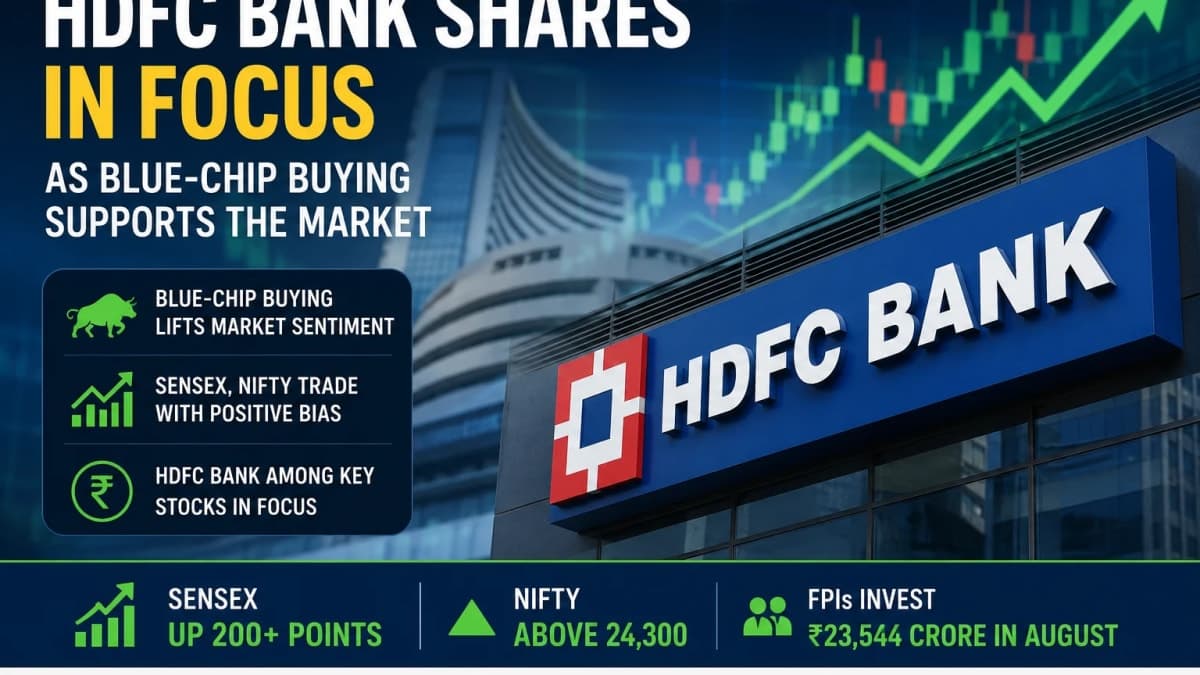
Indian benchmark indices opened higher, with buying in heavyweight stocks including HDFC Bank and Infosys contributing to the early positive momentum. The Sensex gained around 200 points during early trade, while the Nifty moved above the 24,300 level.
The move was significant because heavyweight companies can have an outsized influence on benchmark indices. When large constituents such as HDFC Bank attract buying interest, their movements can provide meaningful support to the Sensex and Nifty even when sentiment across the wider market remains cautious.
HDFC Bank Shares See a Volatile Session
Despite being among the stocks attracting attention early in the session, HDFC Bank shares did not maintain a strong upward move throughout the day.
At around 2:29 pm IST, the stock was quoted near ₹726.40, marginally below the previous closing level, according to market data available during the session. Earlier, it had traded higher, illustrating the intraday volatility surrounding the stock.
The price action suggests that while investors were willing to buy large-cap names at attractive levels, conviction remained limited as broader global uncertainties continued to influence trading decisions.
HDFC Bank had also slightly outperformed the broader market in the previous session on Friday, when its shares gained around 0.14%.
Why Blue-Chip Buying Matters for the Market
The renewed interest in heavyweight stocks comes after a difficult period for Indian benchmark indices.
The Nifty and Sensex had declined roughly 0.5% during the previous week as higher crude oil prices, rising global bond yields and concerns surrounding the prolonged US-Iran conflict weighed on risk appetite.
That backdrop makes buying in companies such as HDFC Bank particularly important. Investors often turn toward established large-cap companies during uncertain periods because of their scale, liquidity and importance within benchmark indices.
However, blue-chip buying alone does not necessarily signal the beginning of a sustained market rally. Broader participation, institutional flows, corporate earnings and global developments are also likely to determine whether the market can maintain its recovery.
Oil Prices and Iran Tensions Remain Key Risks
Global developments remain an important part of the market equation.
Indian equities traded cautiously on Monday as investors awaited developments surrounding potential new US sanctions on Iran. Concerns about energy supplies have kept crude prices elevated, with Brent crude trading around $93 per barrel during the period.
Higher crude prices are particularly relevant for India because the country relies heavily on imported energy. A prolonged increase can add pressure to inflation, corporate costs and the broader macroeconomic outlook.
Any meaningful easing in oil prices could therefore improve sentiment toward Indian equities, while another sharp rise could limit the benefits of domestic blue-chip buying.
Foreign Investors Show Renewed Interest in Indian Equities
Another supportive factor has been improving foreign investor activity.
Foreign portfolio investors had invested approximately ₹23,544 crore in Indian equities during August 2026, supported by factors including corporate earnings, currency stability and the economic outlook.
Sustained institutional inflows could strengthen market sentiment, particularly if they are accompanied by buying in heavyweight banking and technology companies.
What Investors May Watch Next
HDFC Bank’s movement will remain important not only for shareholders but also for traders tracking the direction of the broader market.
Investors are likely to watch whether buying in large-cap banking stocks can broaden into a more sustained rally. The Nifty has also been approaching an important technical area, with analysts identifying roughly 24,350–24,400 as a key resistance zone for stronger upside momentum.
Global crude prices, developments involving Iran, foreign institutional flows and signals from the US Federal Reserve are likely to remain important near-term triggers.
Balanced Analysis
HDFC Bank attracting buying interest can be interpreted as a constructive sign because heavyweight financial stocks often play a major role in determining overall market direction. Renewed demand for established large-cap companies may indicate that investors are finding value after recent weakness.
At the same time, Monday’s intraday movement shows why the development should not automatically be viewed as a decisive bullish signal. HDFC Bank gave up its earlier gains during the session, while Indian equities continued to face uncertainty from geopolitical risks, oil prices and global interest-rate expectations.
The more important question is therefore whether blue-chip buying becomes sustained and broad-based rather than remaining a short-term response to lower valuations.
This article is based on reporting published by Rediff.