The global contest over artificial intelligence is increasingly becoming about more than who can build the most powerful model. It is also becoming a contest over who controls the infrastructure, standards and ecosystems through which AI reaches the rest of the world.
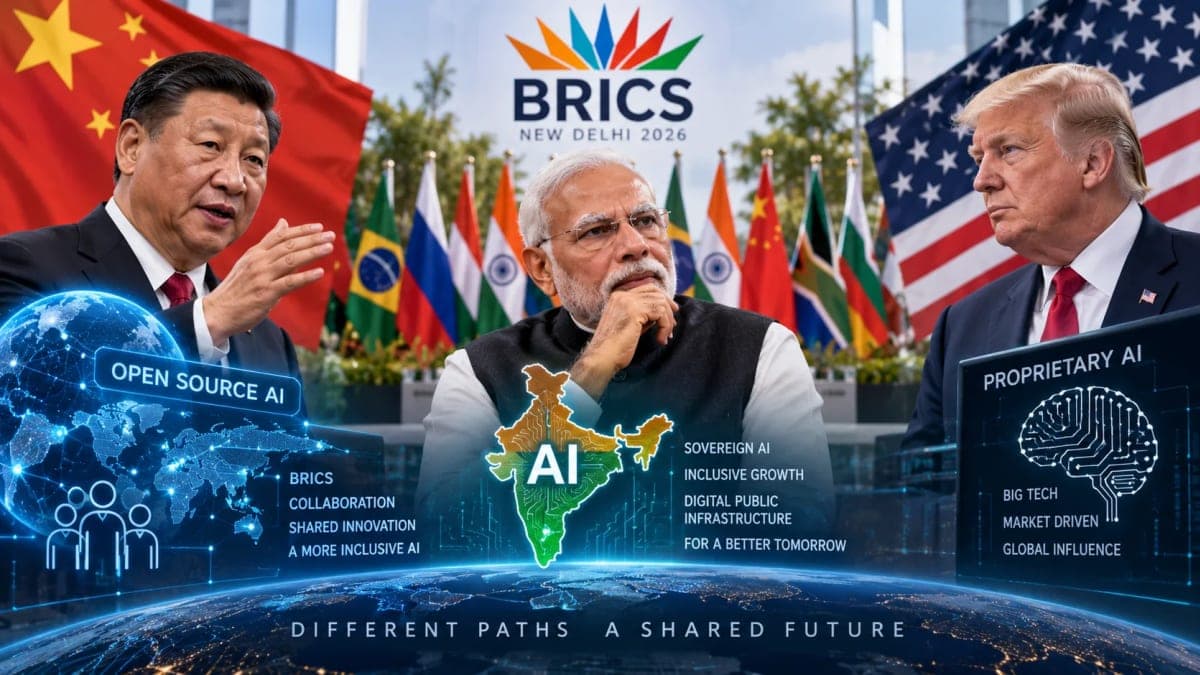
That debate came into sharper focus at the 2026 BRICS Summit in New Delhi, where Chinese President Xi Jinping proposed a BRICS open-source artificial intelligence community, with China taking a leading role in its development.
The proposal is designed to deepen cooperation among BRICS countries in areas including AI models, training and digital infrastructure, while offering an alternative to proprietary AI ecosystems dominated by major American technology companies.
For India, however, the choice is unlikely to be as simple as picking between Washington and Beijing.
India has increasingly promoted an AI strategy centred on democratisation, sovereign capability, multilingual technology, digital public infrastructure and responsible innovation.
That combination is drawing attention as a potential "third way" in the global AI race.
What Exactly Did Xi Jinping Propose?
Xi used the BRICS gathering to advocate deeper technological cooperation among emerging economies.
His broader proposals included economic integration and cooperation on trade, supply chains and technology. On artificial intelligence, China proposed taking the lead in establishing an open-source AI community for BRICS countries.
The idea could facilitate cooperation around large language models and shared AI infrastructure.
Strategically, the proposal also fits China's broader push to establish an alternative to AI ecosystems dominated by US companies.
That distinction matters because much of the world's most commercially influential frontier AI technology has emerged from American companies, while China has increasingly promoted open models and domestic AI infrastructure as an alternative route.
Why India Is in a Unique Position
India sits in an unusual position within this competition.
It maintains extensive technology and commercial relationships with American companies while simultaneously participating in BRICS alongside China, Russia, Brazil, South Africa and the bloc's newer members.
At the same time, New Delhi is attempting to develop more of its own AI capabilities.
India's strategy therefore does not fit neatly into either a purely US-led proprietary ecosystem or a China-centred open-source framework.
Instead, government policy increasingly emphasises building domestic capacity while keeping AI accessible to startups, researchers and citizens.
India's official AI Governance Guidelines describe the country's strategy as rooted in democratisation, scale and inclusion, with an ambition to build capabilities across the AI stack rather than allow AI resources to remain concentrated among a small number of companies or countries.
What Does India's 'Third Way' Actually Mean?
The phrase "third way" is an analytical description rather than the formal title of an Indian government programme.
At its core, it describes the possibility that India could build an AI ecosystem around three overlapping goals:
Sovereignty: India wants greater control over critical AI capabilities, data and infrastructure.
Democratisation: Compute, models and AI services should become available beyond a handful of powerful technology companies.
Public-interest deployment: AI should address practical needs in areas such as government services, healthcare, education, agriculture and Indian-language access.
This philosophy builds partly on India's experience with digital public infrastructure, where population-scale technology systems have been used for identity, payments and public services.
The important question is whether India can extend that philosophy into AI without becoming heavily dependent on either American Big Tech infrastructure or Chinese technology ecosystems.
India Is Already Building Its Own AI Stack
This strategy is not merely theoretical.
The government-backed IndiaAI Mission, approved with an outlay of roughly ₹10,372 crore, is intended to build a broader domestic AI ecosystem.
By February 2026, the government said more than 38,000 GPUs had been onboarded for a common compute facility designed to give Indian startups and academic institutions access to computing resources at affordable rates.
It also said 12 teams had been shortlisted to develop indigenous foundation models or large language models.
The government's July update said the IndiaAI initiative had identified 762 AI use cases across 62 ministries, while 58 AI Centres of Excellence and 543 Data & AI Labs had been approved.
Together, these initiatives indicate that India is trying to develop capability across compute, models, applications, skills and governance rather than focusing exclusively on building one flagship chatbot.
Open Source Is Already Part of India's Strategy
India's position should also not be misunderstood as opposition to open-source AI.
Open technologies already form an important part of the country's AI ecosystem.
For example, the government's BHASHINI language technology initiative has made open-sourced Sarvam models available through its platform. The government says BHASHINI operates an ecosystem containing more than 350 optimised models and uses vendor- and cloud-agnostic infrastructure.
India has also supported an open-source, multilingual, voice-first AI reference device capable of operating with limited or no internet connectivity.
Developed through collaboration involving the Digital India BHASHINI Division, Current AI and Kalpa Impact, the project demonstrates how open-source AI can be combined with local languages, edge computing and privacy-preserving deployment.
The distinction, therefore, is not simply open versus closed AI.
For India, the more consequential question may be who controls the infrastructure underneath an open ecosystem.
Why Xi's Proposal Creates a Strategic Question for Delhi
China's proposal potentially offers BRICS countries access to a larger collaborative AI ecosystem.
For emerging economies facing the enormous cost of training frontier models, shared infrastructure and open models could be attractive.
But India would also have strategic considerations.
AI infrastructure increasingly touches sensitive areas including data sovereignty, cybersecurity, cloud infrastructure, government systems and critical technologies.
Prime Minister Narendra Modi, speaking during the BRICS summit, separately warned against the "weaponisation" of technology and critical minerals and argued for technology that supports inclusive development.
India has not, based on the verified material reviewed for this article, announced that it will simply adopt China's proposed AI framework.
That distinction should be maintained when interpreting Xi's announcement.
US Model vs China Model vs India's Emerging Approach
The emerging competition can be simplified—but only cautiously.
The US ecosystem is heavily driven by private technology companies and commercially developed frontier models.
China is increasingly promoting open-source models and shared technological ecosystems, including Xi's latest BRICS proposal.
India appears to be pursuing something different: combining private innovation and international partnerships with public digital infrastructure, domestic compute, indigenous models, multilingual AI and sovereign governance.
That is where the idea of an Indian "third way" becomes significant.
It does not necessarily require India to isolate itself from either ecosystem.
Instead, India could try to remain interoperable with global technology while reducing strategic dependence on any single country or group of companies.
The Global South Could Be the Bigger Prize
The significance extends well beyond India.
Many developing economies do not have the financial resources required to train enormous frontier AI models or build hyperscale computing infrastructure independently.
That makes access to affordable models, compute and public-interest AI infrastructure increasingly important.
India has explicitly sought to position its AI agenda around the needs of the Global South and around democratising access to AI resources.
The India AI Impact Summit earlier this year emphasised international cooperation while respecting national sovereignty, reflecting this attempt to balance global collaboration with domestic control.
If India can turn its digital-public-infrastructure experience into a credible AI model, it could potentially offer developing countries another option beyond dependence on US commercial platforms or Chinese-led technology infrastructure.
But India's 'Third Way' Faces a Major Test
There is also a gap between ambition and execution.
Building globally competitive AI requires enormous quantities of computing power, capital, high-quality data, semiconductor access and specialised talent.
India has considerable engineering talent and a massive domestic digital market, but the frontier AI infrastructure landscape remains concentrated among a relatively small number of global technology companies and countries.
Critics of the "third way" concept have also questioned whether public-interest rhetoric can translate into genuine technological independence when foundational infrastructure remains dependent on major technology companies.
That makes India's challenge much harder than simply announcing another AI model.
It must demonstrate that its approach can operate at scale while remaining affordable, innovative, secure and genuinely accessible.
Why This Matters
Xi Jinping's BRICS proposal illustrates how quickly AI is becoming part of geopolitical competition.
The battle is no longer confined to ChatGPT-style products or benchmark scores.
Countries are increasingly competing over:
AI models and compute infrastructure,
technical standards,
data sovereignty,
open-source ecosystems,
semiconductor supply chains,
and the rules governing AI deployment.
India's importance comes from its ability to engage with multiple sides while building an increasingly large domestic technology ecosystem of its own.
Whether that ultimately becomes a genuine "third way" will depend on execution.
But Xi's latest open-source pitch has made the strategic question harder to ignore.
Conclusion
China's proposal for a BRICS open-source AI community creates both an opportunity and a strategic dilemma for India.
New Delhi supports broader access to AI and already uses open-source technology extensively. At the same time, its policies emphasise domestic capability, sovereignty, multilingual inclusion and public-interest applications.
That means India's emerging AI strategy cannot accurately be reduced to being either pro-US or pro-China, closed or open.
Its bigger ambition appears to be retaining the flexibility to work with global technology ecosystems while developing enough domestic infrastructure to avoid becoming dependent on any one of them.
If India succeeds, its biggest contribution to the AI race may not simply be another frontier model.
It could be demonstrating whether a large emerging economy can build an AI ecosystem around access, sovereignty and public infrastructure at the same time.