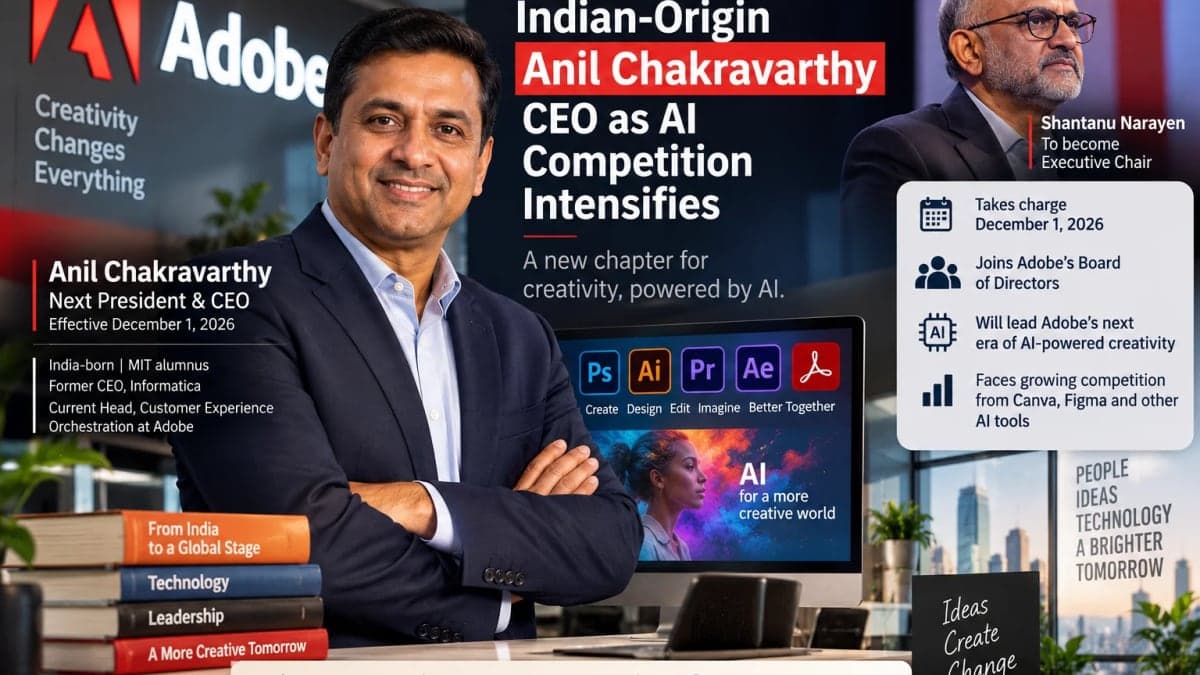
Adobe Names Indian-Origin Anil Chakravarthy CEO as AI Competition Intensifies
Adobe has chosen veteran technology executive Anil Chakravarthy as its next president and chief executive officer, setting up a major leadership transition at one of the world's most influential creative software companies as artificial intelligence rapidly changes how digital content is created.
Chakravarthy will formally take charge on December 1, 2026, and will also join Adobe's Board of Directors. He succeeds Shantanu Narayen, who has led Adobe for more than 18 years and will transition to the role of executive chair.
The appointment puts another India-born technology leader at the helm of Adobe, but it also arrives at a consequential moment for the company.
Generative AI is lowering barriers to creating images, videos, designs and other digital content, while competitors including Canva and Figma are challenging Adobe in parts of the creative software market.
For Chakravarthy, the assignment is therefore larger than managing a leadership succession. He will be responsible for demonstrating that Adobe can turn the AI transformation into a new source of sustainable growth.
Anil Chakravarthy to Take Charge on December 1
Adobe announced the leadership change on September 3, 2026, following a selection process overseen by a special committee of its Board.
The Board unanimously selected Chakravarthy, according to Adobe.
He currently serves as president of Adobe's Customer Experience Orchestration business and worldwide field operations, giving him responsibility for a major enterprise-facing part of the company's operations.
Adobe said Chakravarthy has helped expand that business while overseeing innovation, talent development and global customer operations.
Lead Independent Director Frank Calderoni, who led the special committee overseeing the selection process, described Chakravarthy as the right leader for Adobe's next phase.
The appointment therefore represents an internal succession rather than bringing in an executive from outside the company.
Shantanu Narayen to Become Executive Chair
The transition also marks the end of an era for Adobe.
Shantanu Narayen has served as CEO for more than 18 years and oversaw one of the most consequential transformations in Adobe's history: its shift from selling packaged software toward cloud-based subscription services.
Under the new arrangement, Narayen will become executive chair and work with Chakravarthy during the transition.
Narayen said Chakravarthy has the experience and understanding of Adobe needed to guide the company through the AI era.
“Anil is an experienced transformational leader who leads with values, integrity and a deep knowledge of our business,” Narayen said.
He added that he was confident Chakravarthy was the right person to lead Adobe's growth in an AI-driven era.
The continued presence of Narayen as executive chair could provide continuity while transferring day-to-day leadership to Chakravarthy.
Who Is Anil Chakravarthy?
Chakravarthy brings decades of technology and enterprise software experience to Adobe's top job.
He joined Adobe in January 2020 as executive vice president and general manager of its Digital Experience business.
Later that year, he took on additional responsibility for Adobe's worldwide field operations, including its enterprise customer operations.
In December 2021, he was promoted to president of Digital Experience and worldwide field operations.
His responsibilities have since evolved into leadership of Adobe's Customer Experience Orchestration business.
Before joining Adobe, Chakravarthy spent four years as CEO of Informatica, the enterprise cloud data management company.
Earlier in his career, he held executive or leadership positions at Symantec, VeriSign and McKinsey & Company.
From Varanasi to MIT and Adobe
Chakravarthy's educational background stretches from India to the United States.
He earned a Bachelor of Technology in Computer Science and Engineering from the Institute of Technology, Varanasi, India.
He later attended the Massachusetts Institute of Technology (MIT), where he earned a Master of Science and a Ph.D.
His elevation means Adobe will move from one India-born CEO to another, with Chakravarthy succeeding Hyderabad-born Narayen.
However, Chakravarthy's appointment is particularly notable for his background in enterprise software and large-scale business transformation—experience Adobe may find valuable as AI changes both creative applications and enterprise customer-experience platforms.
Chakravarthy Has Already Been Working on Adobe's AI Strategy
Chakravarthy will not be entering Adobe's AI transition as an outsider.
Under his leadership, Adobe says its Customer Experience Orchestration business has developed products including Adobe CX Enterprise, GenStudio and Brand Visibility.
He has also been involved in scaling Adobe Experience Platform and introducing products including CX Enterprise Coworker.
These products increasingly incorporate AI into marketing, content creation, customer engagement and enterprise workflows.
Chakravarthy also championed Adobe's acquisitions and integration of Workfront and Semrush, according to the company.
That track record helps explain why Adobe's Board selected an executive from its customer-experience operation at a time when the company increasingly needs to connect content creation, marketing and AI-powered enterprise workflows.
‘Pivotal Moment’ for Adobe
Chakravarthy acknowledged the significance of the timing in his statement following the announcement.
“I am deeply honored to have been chosen to lead Adobe during this pivotal moment,” he said.
He said he was energized by the opportunity to drive Adobe's position in what he called the next era of “agentic software for creativity, productivity and customer experience.”
That phrase is important because it signals where Adobe believes software is heading.
Generative AI initially focused heavily on producing content from prompts. Agentic AI is increasingly aimed at systems capable of performing multi-step tasks and workflows with greater autonomy.
For Adobe, that could mean AI moving beyond generating an image or editing a document toward coordinating broader creative, productivity and marketing workflows.
Why AI Competition Is Adobe's Biggest Challenge
Chakravarthy's appointment arrives as Adobe faces growing questions about how generative AI will affect its traditional competitive advantages.
Adobe remains deeply established in professional creative software through products such as Photoshop, Illustrator, Premiere Pro and Acrobat.
But AI has made sophisticated content creation accessible through a rapidly expanding group of competing products.
Platforms including Canva and Figma have expanded their capabilities, while a wider ecosystem of generative AI services can now create or manipulate images, video, text and design assets.
Adobe has responded by embedding its Firefly generative AI technology across its ecosystem and developing AI-powered capabilities for both individual creators and businesses.
The strategic question is whether these innovations will strengthen Adobe's established product ecosystem quickly enough to counter the disruption created by new AI-native tools.
Investors Have Been Watching Adobe's AI Transition Closely
The competitive pressure has also been reflected in investor sentiment.
Reuters reported that Adobe shares had fallen approximately 18% during 2026 by the time of the CEO announcement, following a 21% decline in 2025.
Those movements have occurred amid investor concerns about the potential impact of AI on Adobe's business.
At the same time, there are signs that AI could become a growth opportunity rather than simply a competitive threat.
Adobe raised its annual profit forecast in June amid demand for its AI-powered products.
The two developments illustrate the tension surrounding the company: investors are concerned that generative AI could weaken traditional software advantages, while Adobe is simultaneously trying to monetise the same technological shift through its own products.
Adobe shares fell about 1.7% in after-hours trading following the leadership announcement, Reuters reported.
Market movements immediately following an announcement can reflect multiple factors, so the decline should not automatically be attributed solely to Chakravarthy's appointment.
Adobe's AI Strategy Will Define Chakravarthy's Tenure
The leadership change matters because Chakravarthy will inherit a fundamentally different competitive environment from the one Adobe faced when Narayen became CEO.
Narayen's defining strategic challenge was transforming Adobe from traditional packaged software into a subscription and cloud-based business.
Chakravarthy's challenge could be the next transformation: turning Adobe from a company primarily known for powerful creative applications into a platform where AI is embedded throughout creation, productivity, marketing and customer experience.
His enterprise background may become especially relevant here.
Adobe increasingly serves not only individual designers and creators but also companies trying to generate content, personalise customer experiences and automate marketing operations at enormous scale.
Connecting those businesses could become one of Chakravarthy's biggest opportunities.
What Happens Next
Chakravarthy does not officially become CEO until December 1, 2026, giving Adobe nearly three months to manage the leadership transition.
Narayen's move to executive chair should provide continuity while the new CEO assumes responsibility for the company's operations and long-term strategy.
Investors will get another important look at Adobe's performance sooner than that.
The company is scheduled to hold its third-quarter fiscal 2026 earnings call on September 10.
For Chakravarthy, however, the longer-term test will be clear: prove that Adobe can remain indispensable to creators and businesses even as AI dramatically expands the number of ways digital content can be produced.
After helping transform Adobe's enterprise customer-experience business, he will now be responsible for guiding the entire company through that transition.