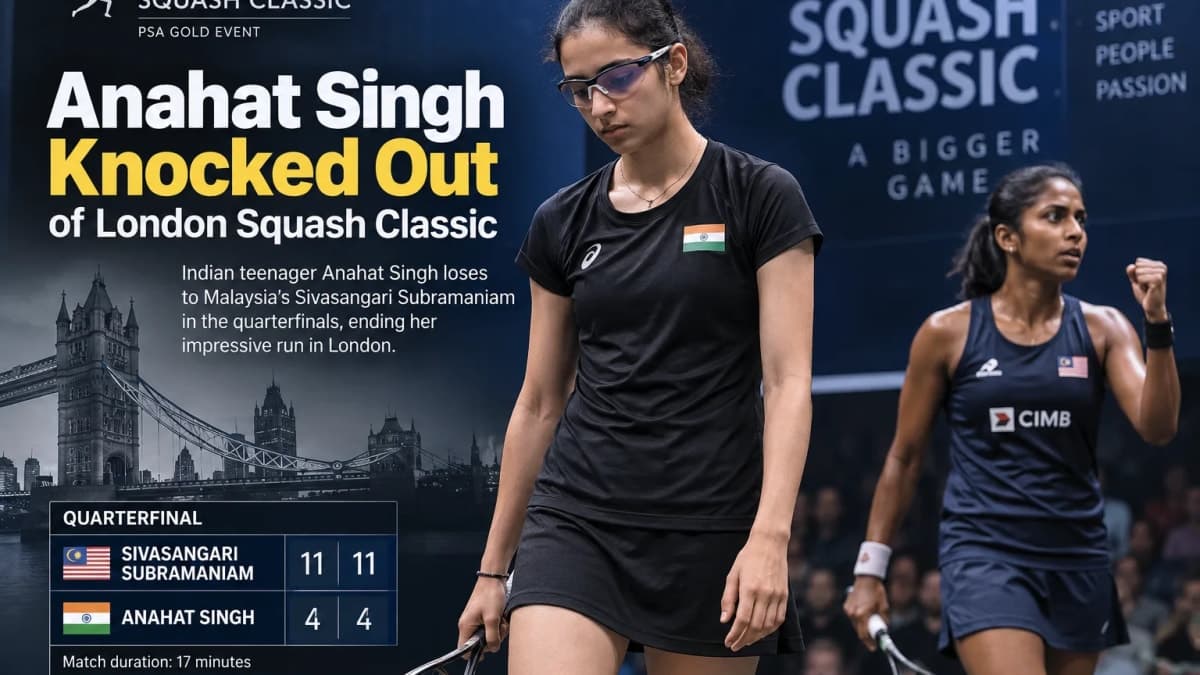
Anahat Singh Knocked Out of London Squash Classic by World No. 5 Sivasangari
Indian teenager Anahat Singh’s breakthrough week at the London Squash Classic came to an end on Friday, with Malaysia’s Sivasangari Subramaniam proving too strong in the quarterfinals.
Sivasangari, the world No. 5 and third seed, beat the 18-year-old Indian 11-4, 11-4 in 17 minutes to advance to the semifinals of the PSA Gold event.
For Singh, the defeat brought a sharp conclusion to an otherwise encouraging tournament. The world No. 20 had arrived in the last eight after beating Belgium’s Nele Gilis, a result that marked another step in her transition from junior success to the demands of the senior tour.
Sivasangari Gives Singh Little Room
The quarterfinal was controlled by Sivasangari from the outset.
The Malaysian took the opening game 11-4 and did not allow Singh to establish the kind of rhythm that had carried her through the previous round. The second followed the same scoreline, with Sivasangari completing the match in less than 20 minutes.
The result reinforced the difference in experience between the two players. Sivasangari, the 2024 London Classic champion, entered the tournament among the leading players in the women’s game and as Asia’s highest-ranked woman.
She will face Egypt’s Amina Orfi, the second seed and reigning world champion, in the semifinals.
Win Over Nele Gilis Was Singh’s Standout Result
Singh’s quarterfinal defeat should not obscure what she achieved earlier in London.
Her most significant result came against Gilis, whom she defeated 13-11, 4-11, 11-8 in a 39-minute second-round contest. After taking a tight opening game and losing the second, Singh recovered to win the deciding game and secure her first quarterfinal appearance at PSA Gold level.
She became the first Indian since Joshna Chinappa in 2021 to reach the last eight of a tournament at that level.
Singh had made a much quicker start to the competition. She needed only 11 minutes to beat Egypt’s Mariam Metwally 11-3, 11-2 in her opening match.
Those two victories offered different tests. Metwally was dispatched quickly, while Gilis forced Singh into a longer, more demanding contest. Together, the performances provided a useful measure of the Indian teenager’s growing ability to compete deeper into senior events.
Junior Success Meets Senior Competition
Singh has moved into senior squash carrying considerable expectations after becoming the first Indian to win the World Junior Squash Championships title in July 2026.
The step up, however, inevitably brings matches against opponents who have spent years competing near the top of the professional rankings. Sivasangari presented exactly that challenge in London.
Singh’s victory over Gilis showed she can trouble established players at this level. The quarterfinal demonstrated the other side of that transition: the precision and consistency required when facing a top-five opponent.
At 18, Singh still has considerable room to develop, but her rise to world No. 20 and first PSA Gold quarterfinal have already placed her firmly in the senior international picture.
Asian Games Add Importance to Sivasangari Meeting
The London encounter also offered a preview of competition Singh could face closer to home on the Asian stage.
Both Singh and Sivasangari are expected to be prominent players at the Asian Games in Japan later this month. Sivasangari’s position as the highest-ranked Asian woman makes her one of the leading contenders, while Singh enters the event after a year in which her standing has risen considerably.
There is an additional incentive attached to the women’s singles competition. The Asian Games gold medallist is set to secure qualification for the Los Angeles 2028 Olympics, where squash will make its Olympic debut.
That gives Singh’s progression on the senior tour greater relevance. Matches against opponents such as Sivasangari provide experience against the level of competition she will need to overcome in major continental and global events.
Qatar Classic Comes Next
Singh’s schedule offers little downtime after London.
She is due to compete at the Qatar Classic from September 12, providing another high-level test before the Asian Games begin in Japan on September 19.
The London Squash Classic ultimately produced two contrasting signals about where Singh stands. Her loss to Sivasangari showed the distance still separating her from one of the world’s top five players. Her route to that quarterfinal, particularly the victory over Gilis, showed why her progress through the senior rankings is attracting attention.
For an 18-year-old only months removed from a historic junior world title, the latter may prove the more useful measure of her week in London.


