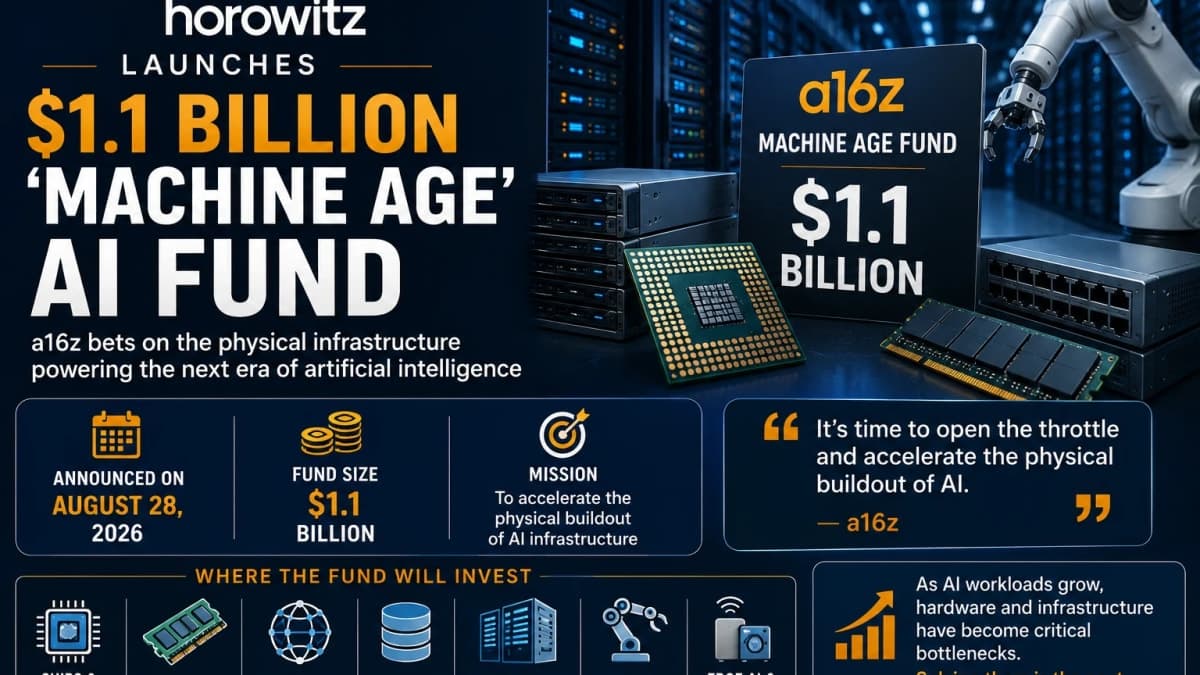
Andreessen Horowitz is making a major new bet on the hardware behind artificial intelligence, raising $1.1 billion for a dedicated investment vehicle called the Machine Age Fund.
Announced on August 28, 2026, the fund is designed to invest across the physical computing infrastructure required to develop and operate increasingly powerful AI systems — including processors, memory, networking, storage, data centers, robotics and AI-enabled devices.
The strategy represents an important expansion for Andreessen Horowitz, commonly known as a16z, which built much of its reputation around software and internet companies.
Rather than focusing primarily on the AI models and applications attracting much of Silicon Valley's attention, the Machine Age Fund is targeting a more fundamental question: what physical infrastructure will be required if demand for AI computing continues to increase rapidly?
What Is the $1.1 Billion Machine Age Fund?
Andreessen Horowitz describes the Machine Age Fund as a vehicle for accelerating the physical expansion of artificial intelligence.
The firm said:
“It’s time to open the throttle and accelerate the physical buildout of AI.”
The $1.1 billion fund will target several layers of the infrastructure stack:
Chips and processors
Memory
Networking technology
Data storage
Data centers
Robotics
Edge AI systems
AI-powered home appliances
The scope means a16z is looking beyond individual semiconductor companies.
Its investment thesis extends from the components inside AI computers to the large-scale systems and physical machines that ultimately use artificial intelligence.
Why a16z Thinks AI Has a Hardware Problem
The rationale behind the fund comes from a growing imbalance between improvements in AI software and the physical infrastructure required to support them.
AI workloads have moved beyond relatively simple chatbot interactions toward reasoning, software development, autonomous agents and increasingly complex forms of knowledge work.
These tasks can require considerably more computing resources.
Andreessen Horowitz argues that as both the quantity and computational intensity of AI workloads increase, existing infrastructure faces pressure across multiple layers — including memory bandwidth, networking, energy consumption, cooling and manufacturing capacity.
In other words, better AI models alone cannot solve every limitation.
Those models still need chips to perform calculations, memory to handle data, networks to connect enormous computing clusters and electricity and cooling systems to keep the infrastructure operating.
The Machine Age Fund is designed to invest where those physical constraints create opportunities for new companies.
From ‘Software Is Eating the World’ to Hardware
The move is particularly notable because Andreessen Horowitz has long been associated with the software revolution.
The firm's co-founder Marc Andreessen famously argued in 2011 that “software is eating the world,” a phrase that became closely associated with Silicon Valley's shift toward software-driven businesses.
The Machine Age Fund does not necessarily contradict that thesis.
Instead, it reflects a16z's argument that the rapid development of AI software is now creating extraordinary demand for physical infrastructure.
The firm described the launch as making hardware an official investment motion for a16z.
That represents a meaningful strategic signal: some of the biggest opportunities created by AI may increasingly sit underneath the applications users interact with.
Chips, Memory and Networking Become Critical Targets
Semiconductors are an obvious component of the strategy, but a16z's thesis extends well beyond processors.
Modern AI systems depend on enormous quantities of memory and extremely fast connections between chips, servers and computing clusters.
As AI models grow and workloads become more computationally demanding, moving information efficiently can become almost as important as performing the calculations themselves.
Andreessen Horowitz says the industry needs faster and more efficient systems, cheaper high-bandwidth memory and more scalable interconnects.
That creates investment opportunities across a much wider infrastructure ecosystem than the companies designing the most visible AI accelerators.
Storage, networking, packaging, systems software and other supporting technologies could all become increasingly important if AI infrastructure continues scaling.
AI Data Centers Are Becoming More Power-Hungry
One of the most striking elements of the infrastructure challenge is the increasing computing density inside data centers.
According to figures cited by Andreessen Horowitz, compute density per rack has increased 28-fold from an Nvidia H100 rack to a Rubin rack.
Power requirements are rising alongside that density.
The firm says rack power has moved from approximately 5–10 kilowatts to 100–250 kilowatts for current systems and could reach 1 megawatt over the next three years.
Those figures illustrate why AI infrastructure investment increasingly extends beyond chips.
More powerful computing clusters require additional electrical infrastructure, cooling systems, materials and physical real estate.
The companies capable of solving those constraints could therefore become important beneficiaries of the AI investment cycle.
Robotics Brings AI Into the Physical World
The Machine Age Fund also extends beyond traditional data centers.
Robotics is explicitly included within its investment mandate.
That matters because advances in AI increasingly allow software intelligence to interact with physical environments.
Instead of AI being limited to generating text, images or software on a screen, robotics creates the possibility of intelligent systems performing tasks in factories, warehouses, homes and other real-world settings.
Andreessen Horowitz has already built experience investing in companies operating at the intersection of advanced software and physical systems.
The firm led Skydio's Series A in 2016, invested in SpaceX, made its first investment in Anduril in 2019 and was among the early venture investors participating in Waymo's 2020 fundraising.
The new fund formalizes that interest into a dedicated hardware strategy.
Hardware Startups Are Becoming a Bigger Part of a16z’s Pipeline
The creation of a dedicated fund also reflects changes in the companies approaching venture investors.
Andreessen Horowitz says hardware startups have increased from a relatively small portion of its deal flow to more than 20% over the past couple of years.
That suggests entrepreneurs are increasingly targeting infrastructure problems created by the AI boom rather than concentrating exclusively on software applications.
The firm's recent hardware investments include companies such as Unconventional AI, Nexthop, Volta, Atoms, Heron Power and Mind Robotics.
Those investments span different parts of the infrastructure and physical-AI ecosystem.
Machine Age Fund Is New Capital
The $1.1 billion fund is also notable in the context of Andreessen Horowitz's broader fundraising.
According to Bloomberg reporting, a16z managing partner Raghu Raghuram said the Machine Age Fund represents new capital rather than money carved out of the firm's $15 billion fundraising announced earlier in 2026.
That distinction indicates that the hardware initiative represents additional investment capacity rather than simply relabeling part of an existing pool of capital.
The size of the fund also demonstrates the scale at which venture firms increasingly expect AI infrastructure companies to operate.
Hardware businesses can require considerably more upfront capital than conventional software startups because they may need manufacturing, engineering facilities, physical inventory, specialized components and extensive testing before reaching commercial scale.
Why the Fund Matters for the Wider AI Boom
The launch highlights a broader shift taking place across artificial intelligence investment.
The first phase of the generative AI boom concentrated heavily on foundation models, chatbots and software applications.
The next stage is increasingly exposing the physical requirements underneath those products.
Every AI query ultimately depends on physical machines.
As AI usage increases, the industry needs more processors, more memory, faster networks, additional storage, more electricity and more efficient cooling.
That creates a chain of potential bottlenecks.
Andreessen Horowitz's investment thesis is essentially that solving those bottlenecks could produce some of the next generation of major technology companies.
A Big Opportunity — With Significant Risks
The infrastructure opportunity does not eliminate the risks associated with the AI investment boom.
Hardware companies typically face challenges that many software startups can avoid.
Manufacturing can require large amounts of capital. Supply chains can be complicated. Development cycles can be longer, and competing against established semiconductor and infrastructure companies requires significant technical expertise.
There is also continuing debate about whether current levels of AI infrastructure spending can generate sufficient long-term economic returns.
The Machine Age Fund therefore represents a substantial bet on continued growth in AI computing demand.
If AI workloads expand as a16z expects, infrastructure constraints could create enormous opportunities.
If demand grows more slowly, however, companies building expensive capacity could face greater pressure.
That makes the fund not simply a bet on AI, but on the durability and scale of AI's future computing requirements.
Who Is Behind the Machine Age Fund?
Andreessen Horowitz's official announcement was authored by Ben Horowitz, Martin Casado, Raghu Raghuram, David Ulevitch and David George.
The firm highlighted the hardware and infrastructure experience across its investment team.
Raghuram and Casado have spent decades working around data-center technologies and systems software, while other members of the team have invested across silicon, networking, computing platforms, hardware and U.S. manufacturing.
By combining those capabilities with a dedicated $1.1 billion capital pool, a16z is positioning itself to compete for startups across the increasingly important physical layer of artificial intelligence.
The Bigger Picture: AI Is Becoming an Infrastructure Story
The Machine Age Fund illustrates how dramatically the AI investment narrative is expanding.
The industry's most visible competition remains centered around increasingly capable models and applications. But those products depend on a vast physical foundation that is becoming more expensive and technically demanding to build.
Andreessen Horowitz is betting that chips, memory, networking, storage, power systems, data centers and robotics will therefore become as strategically important to the next phase of AI as software was to the previous era of technology.
The $1.1 billion Machine Age Fund turns that thesis into a dedicated investment strategy.
If the firm is correct, some of the biggest winners from the AI boom may not be the companies creating the chatbot consumers use.
They may be the companies building the machines underneath it.