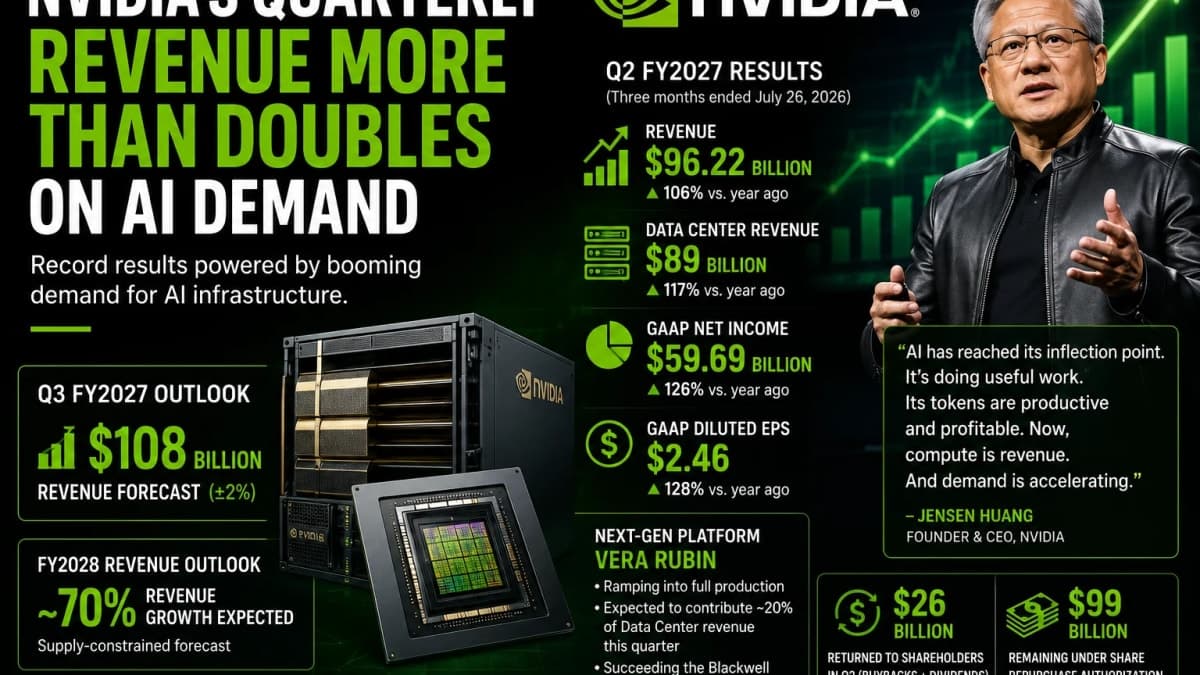
Nvidia’s Quarterly Revenue More Than Doubles to $96.2 Billion as AI Demand Powers Record Growth
SANTA CLARA, California: Nvidia has delivered another blockbuster quarter, with revenue more than doubling from a year earlier as spending on artificial intelligence infrastructure continues to drive demand for the company’s computing platforms.
The semiconductor giant reported record revenue of $96.22 billion for the second quarter of fiscal 2027, covering the three months ended July 26, 2026.
Revenue increased 106% from $46.74 billion a year earlier and climbed 18% from the preceding quarter.
The biggest engine remained Nvidia’s Data Center business, which generated a record $89 billion, up 117% year over year.
The numbers reinforce Nvidia’s central position in the global race to build the computing infrastructure required for generative AI, AI agents, cloud services and increasingly sophisticated artificial intelligence models.
Nvidia’s Q2 Revenue Jumps 106%
Nvidia’s second-quarter performance exceeded the already elevated expectations surrounding one of the world’s most closely watched technology companies.
Key fiscal Q2 2027 figures included:
Revenue: $96.22 billion, up 106% year over year
Data Center revenue: $89 billion, up 117%
GAAP net income: $59.69 billion, up 126%
GAAP diluted EPS: $2.46, up 128%
Non-GAAP diluted EPS: $2.22, up 120%
GAAP gross margin: 75%
Nvidia also reported GAAP operating income of $63.73 billion, representing a 124% increase from the same period last year.
The scale of those gains illustrates how quickly Nvidia has expanded as AI infrastructure spending has moved from experimental deployments toward large-scale commercial investment.
Jensen Huang: ‘AI Has Reached Its Inflection Point’
Nvidia founder and CEO Jensen Huang presented the results as evidence that artificial intelligence is moving into a new economic phase.
“AI has reached its inflection point. It’s doing useful work. Its tokens are productive and profitable. Now, compute is revenue,” Huang said.
“And demand is accelerating.”
Huang argued that the market has broadened substantially. While individual AI laboratories previously played an outsized role in infrastructure expansion, Nvidia now sees demand emerging from multiple frontier labs, startups, open-model developers, enterprises and physical-AI applications.
“The AI infrastructure buildout is at full steam,” Huang said.
That claim is supported by Nvidia’s current sales trajectory, although future growth will still depend on customers continuing to commit enormous amounts of capital to AI infrastructure.
Data Center Revenue Hits $89 Billion
The most important number in Nvidia’s earnings may be its $89 billion in Data Center revenue.
That business grew 117% from a year earlier and 18% sequentially.
Data Center now represents more than 90% of Nvidia’s overall quarterly revenue, demonstrating just how dramatically the company’s business has shifted toward AI infrastructure.
Demand is coming from a broad group of customers, including major cloud platforms, AI companies, enterprises and governments building sovereign AI capacity.
The results suggest that spending on AI computing infrastructure has not yet reached a plateau despite growing debate over whether technology companies can generate adequate returns from their enormous capital investments.
Nvidia Forecasts $108 Billion for Current Quarter
Nvidia expects the growth to continue.
For its third quarter of fiscal 2027, the company forecasts revenue of approximately $108 billion, plus or minus 2%.
The company expects both GAAP and non-GAAP gross margins of approximately 74%, plus or minus 50 basis points.
One important caveat accompanies that forecast: Nvidia said it is not assuming any Data Center compute revenue from China in its Q3 outlook.
China therefore remains an important uncertainty for the business as Nvidia navigates export restrictions and changing rules governing the sale of advanced AI processors.
Nvidia Makes Rare Long-Term Growth Forecast
Perhaps one of the most consequential disclosures came beyond the immediate quarterly outlook.
Nvidia management said it expects revenue to grow by approximately 70% in fiscal 2028.
That is an unusually long-range forecast for the company.
Before the announcement, analysts on average had been projecting growth of around 44% for that fiscal year, according to LSEG data reported by Reuters.
The projection signals Nvidia’s belief that AI infrastructure spending has considerable room to expand rather than approaching an immediate peak.
However, management also described that forecast as supply-constrained, meaning Nvidia believes its ability to satisfy demand may be limited by how much hardware it can produce and obtain from suppliers.
Vera Rubin Becomes Nvidia’s Next Growth Engine
The next stage of Nvidia’s AI expansion increasingly centres on its Vera Rubin platform.
Nvidia said Vera Rubin is ramping into full production, with infrastructure being deployed through partners including major cloud and AI-computing providers.
Rubin succeeds Nvidia’s Blackwell generation and forms an important part of the company’s strategy to keep increasing AI computing performance as workloads become larger and more complex.
The transition is particularly important because Nvidia must continually demonstrate that customers have a reason to upgrade from existing AI hardware.
Management expects Vera Rubin to account for about one-fifth of overall Data Center revenue during the current quarter, according to Reuters.
If that ramp proceeds as expected, it could provide Nvidia with another major product cycle even as Blackwell systems continue shipping.
AI Demand Is Broadening Beyond Big Tech
Another important development is the changing composition of Nvidia’s customer base.
The first phase of the generative AI boom was dominated by enormous investments from hyperscale cloud companies and a relatively small group of leading AI laboratories.
Nvidia now says demand is expanding across AI-native companies, enterprises, sovereign customers and emerging AI cloud providers.
Management expects AI labs to account for roughly one-quarter of the company’s overall business next year.
Nvidia has also expanded its relationship with Amazon Web Services. The companies announced plans to deploy 2 million additional Nvidia GPUs across Amazon’s global infrastructure during 2027 and 2028.
This diversification matters because Nvidia’s long-term growth would be more resilient if demand comes from many industries and customer types rather than depending overwhelmingly on a handful of technology giants.
Supply Constraints Remain a Challenge
Explosive demand also presents a problem: producing enough advanced computing systems.
Nvidia says it remains supply constrained.
Memory shortages and rising component costs could restrict the speed at which the company expands and put pressure on margins.
Its regulatory filing also highlights the complexity of securing manufacturing capacity and components required to produce Data Center systems at enormous scale.
To support future demand, Nvidia has entered significant manufacturing and supply commitments while expanding its supplier base.
These constraints mean demand alone does not determine Nvidia’s growth. Its ability to secure advanced memory, semiconductor manufacturing capacity, networking components and other infrastructure is increasingly important.
Nvidia Returned $26 Billion to Shareholders
Nvidia’s extraordinary profitability is also generating significant cash for shareholders.
During fiscal Q2, the company returned approximately $26 billion through share repurchases and cash dividends.
At the end of the quarter, Nvidia still had approximately $99 billion remaining under its share-repurchase authorization.
The company also announced a quarterly cash dividend of $0.25 per share, payable October 1, 2026, to shareholders of record as of September 10.
Why Nvidia’s Earnings Matter Beyond One Company
Nvidia’s earnings have become an important indicator for the broader AI industry.
Major technology companies are spending vast amounts on data centres, GPUs, networking equipment, electricity and other infrastructure required to build and operate AI systems.
Because Nvidia supplies a substantial portion of the computing technology supporting those investments, its revenue provides one measure of how aggressively the infrastructure buildout is progressing.
The latest quarter indicates that spending remains exceptionally strong.
But the next stage brings a different question.
Investors increasingly want evidence that customers purchasing billions of dollars of AI infrastructure can turn those investments into sustainable revenue and profits.
Nvidia’s results demonstrate strong demand for the infrastructure. They do not, by themselves, resolve the debate over the ultimate returns generated across the wider AI industry.
What Comes Next for Nvidia
Three factors are likely to dominate attention in the coming quarters: the Vera Rubin production ramp, supply constraints and the sustainability of AI capital expenditure.
China is another significant variable because Nvidia has excluded China Data Center compute revenue from its current-quarter guidance.
At the same time, expanding adoption among enterprises, governments, AI laboratories and specialised cloud providers could reduce Nvidia’s dependence on traditional hyperscale customers.
The company’s forecast of approximately 70% revenue growth in fiscal 2028 represents an unusually confident signal that management expects the AI infrastructure cycle to continue.
Conclusion
Nvidia’s fiscal second-quarter results show that the global AI infrastructure boom is still translating into extraordinary financial growth.
Revenue reached a record $96.2 billion, up 106% year over year, while Data Center sales climbed 117% to $89 billion. GAAP net income more than doubled to nearly $60 billion.
More importantly, Nvidia expects the momentum to continue, forecasting approximately $108 billion in third-quarter revenue and roughly 70% revenue growth in fiscal 2028.
The numbers strengthen the case that AI computing demand remains exceptionally powerful. But they also shift attention toward the next challenge: whether Nvidia can secure enough supply to meet that demand—and whether the enormous global investment in AI infrastructure ultimately produces returns capable of sustaining the cycle.