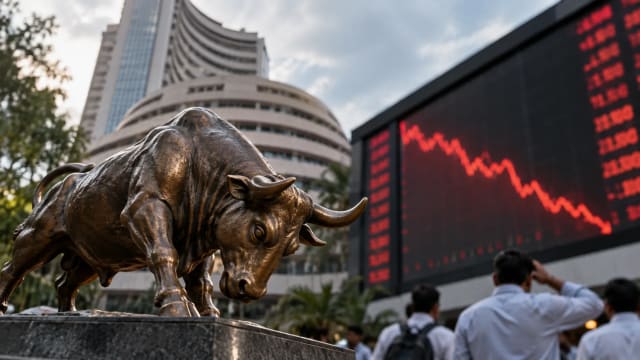
Foreign investors have sold Indian stocks aggressively in 2026.
That much is undeniable.
Foreign portfolio investors (FPIs) had withdrawn a record $24.6 billion from Indian equities in 2026 through August, according to National Securities Depository data reported by Reuters.
September has brought renewed selling after a brief recovery, adding to the impression that overseas investors are abandoning India.
But there is a problem with that conclusion.
Selling Indian listed equities is not the same thing as foreign investors “leaving India.”
The evidence instead points to a more complicated shift: global portfolio managers have sharply reduced their exposure to Indian stocks during parts of 2026, while remaining willing to return when valuations and global conditions become more attractive.
August provides perhaps the strongest evidence against the simple “foreigners are leaving India” narrative.
The number causing concern: $24.6 billion
Foreign portfolio investors had withdrawn $24.6 billion from Indian stocks during 2026 through August, a record amount, according to NSDL data cited by Reuters.
That is significant.
It means overseas portfolio investors have materially reduced their exposure to Indian listed equities this year.
The selling has also coincided with a difficult year for India's benchmark indices. By the end of August, Reuters reported that the Nifty 50 was down 7.8% for 2026 and the Sensex had fallen 9.7%.
But those figures answer a narrower question:
Have FPIs been pulling money out of Indian equities?
Yes.
They don't automatically answer:
Have foreign investors lost confidence in India as an investment destination?
That requires considerably more evidence.
August produced the opposite signal
If foreign portfolio investors were executing a one-way strategic exit from India, August would be difficult to explain.
FPIs invested approximately $3.1 billion in Indian equities during August, according to NSDL data.
It was their strongest monthly inflow in almost two years.
Foreign investors had already begun returning in July after four consecutive months of selling.
The sequence therefore looked like this:
Heavy selling → return of buying in July → $3.1 billion inflow in August → renewed selling in September.
That's not the typical pattern of investors permanently abandoning a market.
It looks more like global capital responding rapidly to changes in valuation, currency, interest rates, oil prices, earnings expectations and opportunities elsewhere.
That distinction is crucial.
So why did foreign investors sell so much in 2026?
One explanation lies outside India.
A substantial amount of international capital has been attracted toward Asian markets positioned more directly around the artificial-intelligence investment boom.
Reuters reported that foreign investors shifted money toward Taiwan and South Korea, where semiconductor and AI-related companies offered exposure to the global technology cycle.
That changes how India's outflows should be interpreted.
Foreign fund managers aren't necessarily asking:
“Is India a good economy?”
They may instead be asking:
“Where can this dollar generate the best risk-adjusted return right now?”
Those are different questions.
A global portfolio has limited capital.
Increasing exposure to Taiwan, South Korea or U.S. technology stocks can therefore mean reducing India even if the manager remains positive about India's long-term economy.
India's valuation premium matters
India has historically commanded relatively rich valuations compared with several emerging-market peers.
That premium can be justified when investors expect stronger earnings growth, economic expansion and policy stability.
But expensive markets are vulnerable when alternatives suddenly become more attractive.
If a foreign investor sees stronger earnings momentum elsewhere—or can earn substantially higher yields from global bonds—the hurdle for buying an expensive Indian stock rises.
This helps explain why strong Indian GDP growth and FPI selling can coexist.
A good economy does not automatically mean every stock is attractively priced.
September brought another major change: oil
The global environment has deteriorated again in September.
Brent crude rose to around $107.7 per barrel on September 15, after gaining nearly 20% during the month amid geopolitical and supply concerns.
For India, that's particularly important.
India imports most of the crude oil it consumes. Higher oil prices can therefore increase the import bill, add to inflation pressure, affect corporate margins and put downward pressure on the rupee.
That makes expensive oil a much bigger macroeconomic issue for India than for major oil-exporting economies.
And September's oil shock arrived at the same time as another problem.
Global bond yields are climbing
U.S. Treasury yields have risen sharply as markets price stronger inflation and higher interest rates.
Reuters reported on September 15 that U.S. Treasury yields had reached their highest levels since 2007, against a backdrop of oil above $100 and changing Federal Reserve expectations.
This affects foreign flows into India through relative returns.
When yields available on U.S. government debt increase substantially, investors can earn more without accepting the equity-market and currency risks associated with emerging markets.
Indian stocks therefore have to offer a more compelling expected return.
Again, that doesn't mean India suddenly became fundamentally unattractive.
The alternative investments became more attractive.
Then there is the rupee
The rupee weakened to approximately ₹95.92 per U.S. dollar on September 15, its weakest level in more than a month.
High oil prices and expectations for higher U.S. rates were among the pressures cited by market participants.
Currency risk matters enormously to FPIs.
Consider a simplified example.
A U.S. investor puts $1 million into Indian shares.
The stocks rise 8% in rupee terms.
But during the same period, the rupee weakens substantially against the dollar.
When the investor converts the proceeds back into dollars, part of that 8% equity gain disappears.
So foreign investors evaluate:
stock return + currency movement + relative global returns + risk.
Indian retail investors generally don't face that currency calculation when buying domestic stocks.
FPIs do.
The most important distinction: FPI is not FDI
This is where headlines saying “foreign investors are leaving India” can become misleading.
There are fundamentally different forms of foreign investment.
FPI — Foreign Portfolio Investment
FPIs buy financial assets such as:
listed shares,
government bonds,
corporate debt,
and other securities.
Portfolio capital is relatively liquid.
A global fund can reduce exposure quickly.
FDI — Foreign Direct Investment
FDI involves longer-term business investment, such as:
manufacturing facilities,
subsidiaries,
factories,
logistics infrastructure,
data centres,
business acquisitions,
and expansion of operating businesses.
The two forms of capital respond to different incentives and operate over very different time horizons.
Therefore:
Large FPI equity outflows do not prove that foreign companies are withdrawing long-term investment from India.
India continues to actively court FDI, and the government has stated an ambition to raise annual FDI inflows toward $100 billion, compared with a five-year average above $70 billion.
The government also approved FDI-policy changes in July aimed at facilitating investment from countries sharing a land border with India, particularly where investment can support manufacturing, including electronic components and capital goods.
Those developments do not negate the FPI sell-off. They simply demonstrate why portfolio-market flows cannot be used as a complete measure of foreign confidence in India.
Domestic investors have changed the equation
Another major structural change is occurring inside India's stock market.
Domestic institutional investors—especially mutual funds—have become a much larger source of capital.
This matters because historically large FPI withdrawals could create intense pressure on Indian equities when there wasn't enough domestic institutional money to absorb the selling.
That relationship has weakened.
Research reported in July showed domestic institutional inflows reaching approximately $162 billion between October 2024 and June 2026, highlighting the scale of India's expanding domestic investor base.
This doesn't make foreign investors irrelevant.
FPIs remain enormously important for:
large-cap valuations,
liquidity,
the rupee,
market sentiment,
and India's integration with global capital markets.
But India is becoming less dependent on foreign portfolio capital as the sole marginal buyer of equities.
There may be a structural problem underneath the FPI numbers
There is another, less obvious explanation for persistent foreign selling.
India's stock market may simply not offer enough additional supply of large, liquid companies to absorb the enormous amount of domestic money entering equities.
Axis Capital has argued that accelerated government stake sales in public-sector companies could help address an imbalance between the growing domestic capital pool and available equity supply.
Its analysis suggests potential PSU divestments could add roughly ₹6.6 lakh crore of equity supply and potentially improve market liquidity and foreign-investor participation.
That raises an interesting possibility.
Some FPI outflows may reflect not only a negative view of India, but a broader change in market structure as domestic investors increasingly influence valuations.
What August tells us about foreign confidence
August may be the most useful test of the “foreigners are leaving” thesis.
FPIs didn't merely stop selling.
They bought approximately $3.1 billion of Indian equities, their strongest monthly investment in almost two years.
Why?
Reuters reported that improving corporate earnings and greater rupee stability helped support foreign demand.
That suggests foreign capital remains interested in India—but at the right combination of price, earnings outlook, currency stability and global opportunity cost.
September's oil and bond-market shock altered that equation again.
What would actually indicate foreigners are abandoning India?
Investors should be careful about drawing structural conclusions from monthly portfolio flows.
A genuinely worrying long-term signal would look considerably broader.
For example:
Persistent multi-year FPI equity outflows
combined with
weakening FDI
combined with
foreign companies reducing or cancelling Indian investment
combined with
declining earnings expectations
combined with
India consistently losing investment to competing economies.
That would provide much stronger evidence of structural disengagement.
The current evidence does not establish that scenario.
What it establishes is substantial foreign selling of Indian listed equities during 2026.
That's important—but it's not the same claim.
What investors should watch now
The next few months will help distinguish between tactical selling and a deeper reallocation.
Four indicators matter particularly.
FPI flows: Does foreign buying return when global conditions stabilise?
Crude oil: Sustained oil above $100 would remain a major challenge for India.
USD/INR: Currency stability can improve the risk-return equation for foreign investors.
Relative earnings and valuations: If Indian earnings improve while valuations become more attractive, overseas investors may reconsider allocations.
There is also a fifth indicator that receives less attention:
Where foreign money goes instead.
If India experiences outflows while Taiwan, South Korea or U.S. technology stocks attract strong foreign investment, the story is partly about global asset allocation.
If investors retreat from emerging markets broadly, it is more likely a global risk-off event.
If India alone consistently underperforms comparable markets, India-specific factors deserve greater attention.
That comparison is often more informative than the headline FPI number itself.
So, are foreign investors leaving India?
The most accurate answer today is:
Foreign portfolio investors have significantly reduced their exposure to Indian equities in 2026—but the evidence does not support saying foreign investors as a whole are abandoning India.
The distinction matters.
Record FPI equity selling is real.
So was August's $3.1 billion buying surge.
India remains exposed to expensive oil, rising global yields, currency pressure and competition for international capital.
But foreign investors demonstrated only weeks ago that they were willing to return when conditions became more favourable.
The better question therefore isn't:
“Are foreigners leaving India?”
It is:
“What would make foreign portfolio investors increase India exposure again?”
Right now, the answer appears to involve some combination of lower oil prices, currency stability, attractive valuations, stronger relative earnings and a less hostile global interest-rate environment.
That is a much more useful way to understand the foreign-investor story than treating every month of FPI selling as a referendum on India's long-term economic future.