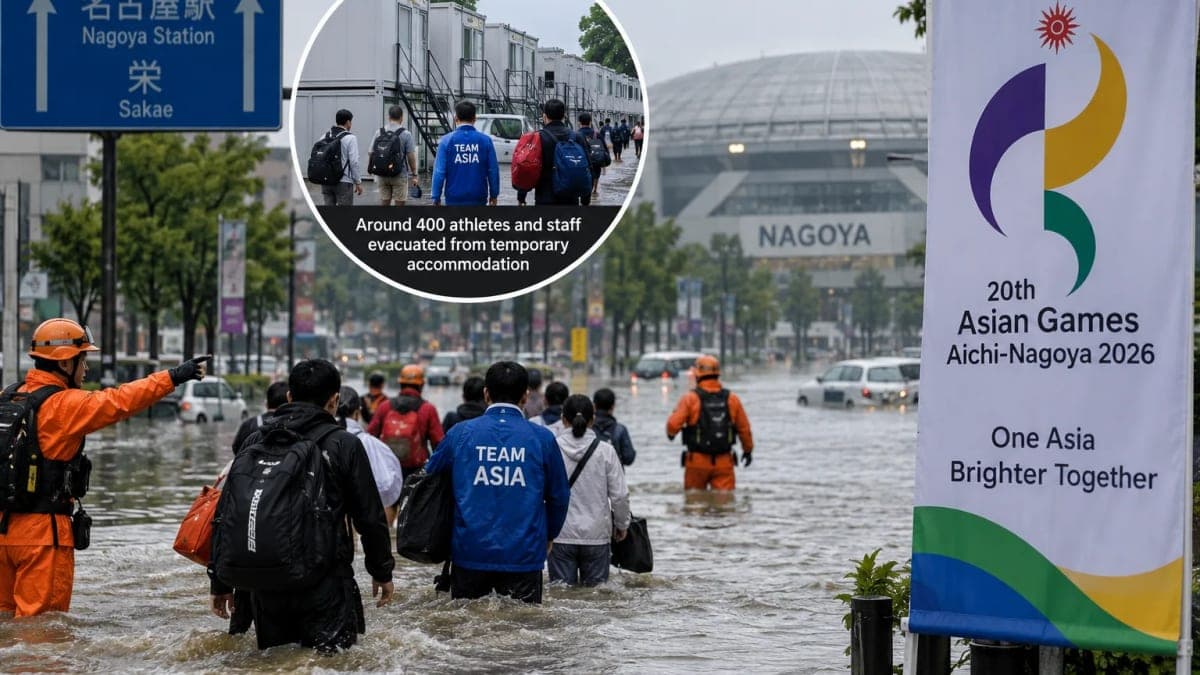
Asian Games Stay on Schedule Despite Nagoya Flooding and Evacuation of Around 400 Athletes and Staff
Record rainfall has complicated the final preparations for the 2026 Asian Games in Japan, flooding parts of Nagoya and forcing around 400 athletes and staff members from their accommodation. But with the opening ceremony approaching, local officials say the disruption is not expected to delay the event.
The Games are scheduled to officially run from September 19 to October 4 across Nagoya and surrounding areas. Some competitions will begin before the opening ceremony.
Nagoya Mayor Ichiro Hirosawa said Wednesday that damage identified so far was not serious enough to put the Games at risk.
Athletes Return After Precautionary Evacuation
The most immediate concern involved around 400 athletes and staff staying in temporary container-style accommodation.
As heavy rain intensified, they were moved to higher ground as a precaution. Officials later allowed them to return, and no injuries were reported.
The evacuation came during an exceptional burst of rain. Nagoya recorded 104.5 millimetres in a single hour on September 8, which local authorities described as the highest hourly rainfall ever recorded in the city.
The consequences spread well beyond Games-related facilities. Floodwater entered homes and covered roads, while bus and subway services were temporarily suspended. Around 3,500 people sought shelter at emergency evacuation centres during the severe weather.
Those figures describe two different groups: the roughly 400 people evacuated from Asian Games accommodation and the approximately 3,500 people who sought emergency shelter more broadly.
Venue Damage Assessed Ahead of Opening
Some competition facilities were also affected.
Water entered several venues and roof leaks were reported, adding repair and inspection work to an already busy final stretch of preparations. Authorities, however, have not identified structural damage serious enough to prevent the Games from opening as scheduled.
“The situation is not severe enough to jeopardise the opening of the Games on the 19th,” Hirosawa said.
His assessment provides reassurance for organisers, although it does not amount to a complete picture of the storm's impact. The mayor said authorities had not yet fully assessed conditions outside Nagoya.
That leaves organisers with practical work to complete before September 19, particularly at facilities touched by floodwater and in areas where the effects of the rainfall are still being evaluated.
Accommodation Plan Faces an Early Test
The evacuation also put one of the more unusual features of the Aichi-Nagoya Games under scrutiny.
Rather than housing competitors in a single purpose-built athletes' village, organisers are relying on several forms of accommodation, including hotels, a cruise ship and temporary container-style units.
It was occupants of those temporary units who were moved during the flooding.
The arrangement had already attracted attention ahead of the Games. The severe weather has now provided an unexpected test of the evacuation procedures surrounding those facilities before the full competition programme gets underway.
More Than 11,000 Athletes Expected in Japan
More than 11,000 athletes representing 45 countries and regions are registered for the Asian Games, according to Associated Press reporting.
That makes the event comparable in participant numbers with the world's largest international sporting competitions. The Paris 2024 Summer Olympics, for example, featured approximately 10,700 athletes.
With thousands of competitors and support staff arriving in the region, organisers now have a narrow window to complete inspections and address the effects of the flooding without disrupting preparations.
For the moment, the official position is clear: the September 19 opening remains on schedule, and the damage assessed in Nagoya has not given authorities grounds to postpone the Games.


