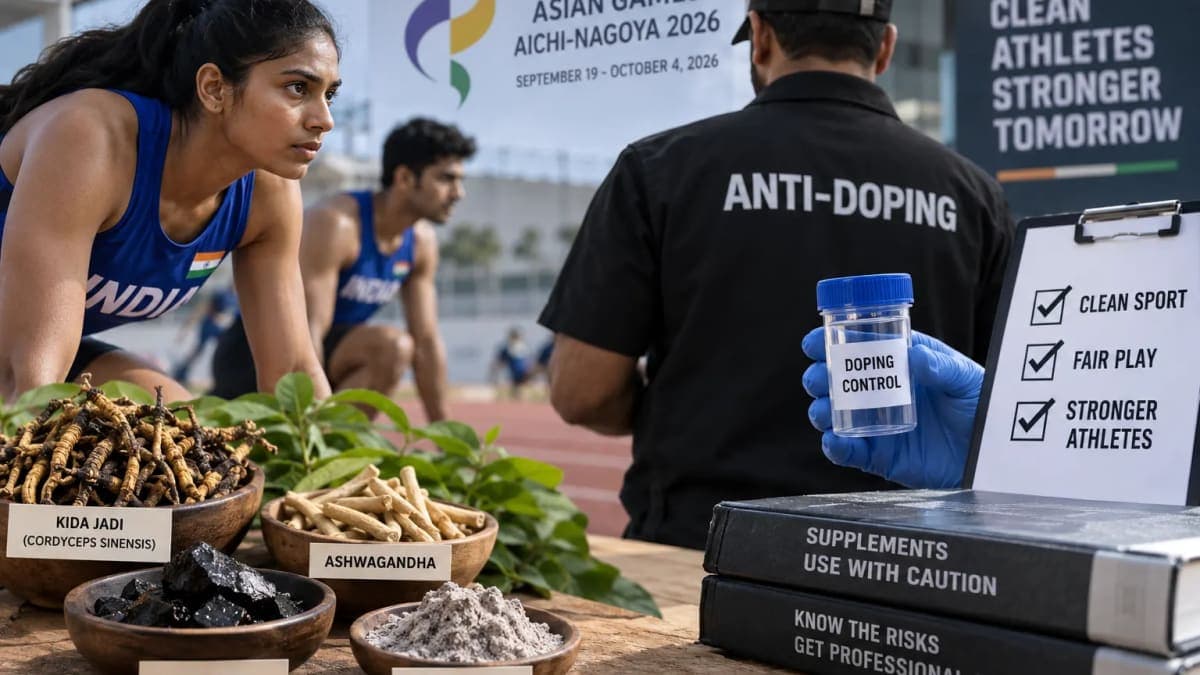
Indian Athletes Under Closer Doping Watch as Herbal Supplement Risks Draw Attention
Indian athletes preparing for the Aichi-Nagoya Asian Games are facing a more demanding anti-doping environment, with surprise tests at major training centres coinciding with fresh concern over the supplements some competitors use.
Officials from the Athletics Integrity Unit (AIU) have conducted unannounced testing at training bases in Bhubaneswar, Bengaluru and Patiala. The increased scrutiny comes as India's doping record remains a source of concern for international athletics authorities.
But the issue confronting athletes is broader than conventional performance-enhancing drugs. Sports nutrition experts are also drawing attention to herbal preparations, including kida jadi, ashwagandha, shilajit and bhasmas, because products sold as natural or traditional remedies are not automatically free from anti-doping risk.
The concern is contamination and incomplete labelling. A supplement may contain a prohibited substance that does not appear on its packaging, leaving an athlete vulnerable to an adverse test even without deliberate doping.
Surprise testing reaches major training centres
AIU officials have carried out targeted checks at several locations where leading Indian athletes have been preparing for international competition.
Recent visits included the national coaching camp in Bhubaneswar as well as the Anju Bobby Sports Foundation and the Sports Authority of India's South Centre in Bengaluru. Athletes in Patiala have also been subjected to testing.
Current and former coaches cited in reports described the level of pre-Games scrutiny as unusually extensive.
The timing is significant. The Aichi-Nagoya Asian Games are scheduled to take place in Japan from September 19 to October 4, 2026, putting athletes in the final phase of preparation for one of the continent's biggest sporting events.
For Indian athletics, those preparations are unfolding against an uncomfortable backdrop.
India's doping record raises the stakes
In July, India had 162 names on the AIU's list of doping offenders, more than Kenya's 148 and Russia's 60.
The Athletics Federation of India has also moved from Category B to Category A under the AIU's risk classification system. That places Indian athletics in the highest-risk category and helps explain the sharper international focus on testing.
AIU chair David Howman has previously criticised the imbalance between the country's doping risk and its domestic response.
“Unfortunately, the quality of the domestic anti-doping programme is simply not proportionate to the doping risk.”
The current testing drive therefore cannot be viewed solely as a pre-Asian Games exercise. It sits within a wider effort to address persistent concerns about doping in Indian athletics.
Herbal products present a different problem
The attention on supplements introduces a more complicated issue because the products in question are not necessarily prohibited in themselves.
Reports have identified kida jadi, also known as Cordyceps sinensis, alongside ashwagandha, shilajit and bhasmas among herbal preparations used by some athletes.
Kida jadi is particularly expensive. Reported prices range between ₹16 lakh and ₹20 lakh per kilogram, while 100 grams has been listed online for around ₹1.66 lakh. Some athletes are reported to spend close to ₹1 lakh on a month-long course.
There is no confirmed evidence in the reporting that kida jadi itself is a banned substance, nor has contamination been established in the specific products cited. Indian athletes have reportedly consumed it for years without returning a positive doping test linked to its use.
The concern lies elsewhere: what else could be present in an inadequately tested product?
Herbal or dietary supplements can contain undeclared ingredients or become contaminated during manufacturing. That distinction matters because calling the remedies themselves “doping substances” would go beyond the available evidence.
A natural label does not guarantee anti-doping safety
India's National Anti-Doping Agency (NADA) advises athletes that supplements cannot be regarded as entirely risk-free.
Ingredient lists alone may not provide sufficient protection. Manufacturing standards vary, contamination can occur, and labels do not always accurately reflect everything contained in a product.
For an elite athlete, the consequences can be severe because anti-doping rules apply the principle of strict liability. Competitors are responsible for prohibited substances detected in their bodies regardless of whether they intended to gain an advantage.
That makes inadvertent exposure a serious professional risk.
An athlete who believes a herbal preparation is harmless could still face an adverse analytical finding if the product contains an undeclared prohibited substance.
NADA therefore recommends a food-first approach where possible and advises athletes who use supplements to seek qualified nutritional guidance and choose products subjected to credible third-party batch testing.
Athletes need to know what they are taking
Mihira Khopkar, who served as lead nutritionist for the Indian contingent at the Paris Olympics, has emphasised the importance of independent testing when athletes choose supplements.
“In elite sport, it is almost non-negotiable that high-performing athletes choose supplements that are not only evidence-based but also third-party tested.”
That advice is especially relevant when athletes buy expensive herbal products independently rather than through a tightly controlled sports nutrition programme.
Reports have also raised concerns that competitors do not always disclose herbal preparations when recording the supplements they consume. In an environment of frequent out-of-competition testing, incomplete disclosure can make it harder for athletes and their support teams to identify potential sources of exposure.
Third-party testing cannot make every product completely risk-free, but it can reduce uncertainty and give athletes a stronger basis for deciding what they consume.
Asian Games preparations now extend beyond training
India's athletes will arrive in Japan focused on performances, medals and qualification standards. Their preparations, however, increasingly require the same discipline away from the track and field.
The intensified AIU testing reflects the scrutiny Indian athletics currently faces. The questions around herbal products add another layer: athletes must consider not only whether an ingredient is prohibited, but whether they can trust the product containing it.
For competitors operating under strict liability, “natural” is not a meaningful guarantee of safety.
Careful disclosure, professional nutritional advice and independently tested products have consequently become practical parts of elite preparation, particularly for a team heading to a major Games under closer anti-doping observation than usual.


