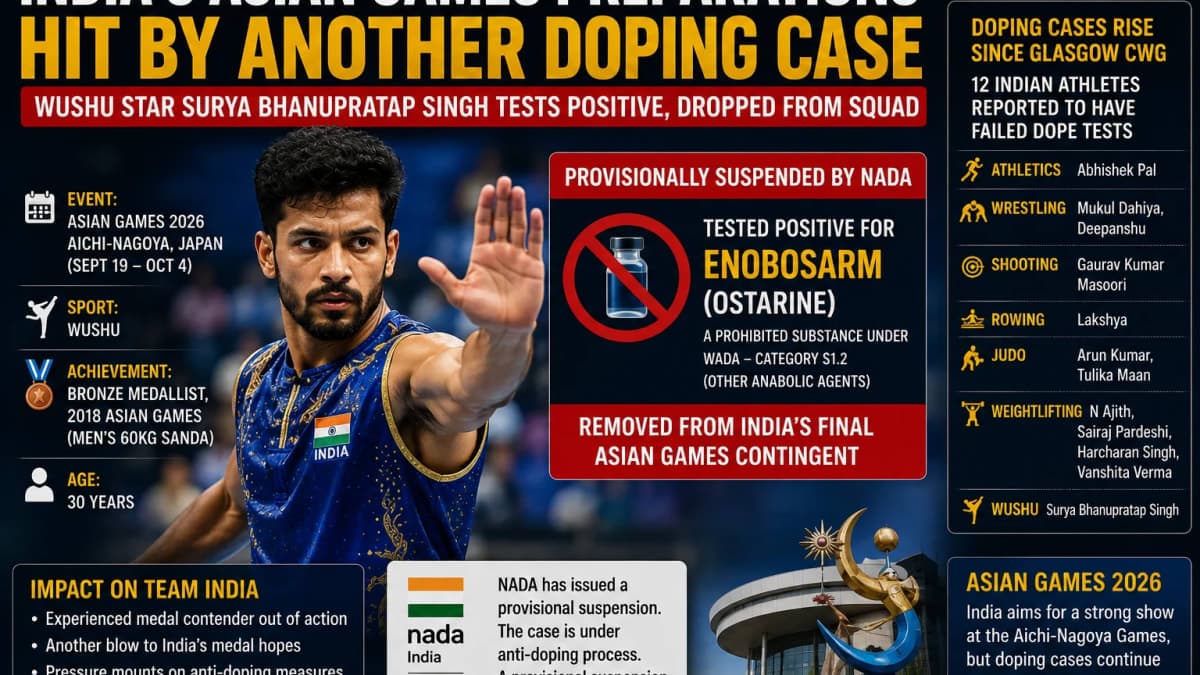
India’s Asian Games Campaign Suffers Another Doping Setback
India’s final preparations for the 2026 Asian Games in Aichi-Nagoya, Japan, have been disrupted by another anti-doping case, this time involving an experienced athlete who had been considered a medal prospect.
Surya Bhanupratap Singh, a 30-year-old wushu athlete from Jammu and Kashmir, has tested positive for the prohibited substance Enobosarm, also known as Ostarine, according to reports published on September 2.
The National Anti-Doping Agency (NADA) has provisionally suspended Bhanupratap following the positive test.
More immediately for India's Asian Games campaign, his name has been removed from the government-approved final contingent.
The development means India is set to enter the Games without one of its experienced wushu competitors only weeks before competition begins.
Who Is Surya Bhanupratap Singh?
Bhanupratap is not a newcomer to the Asian Games.
He won a bronze medal in the men's 60kg Sanda event at the 2018 Asian Games in Jakarta, giving him previous experience of competing—and succeeding—at the continental multi-sport event.
That record had made him one of India's noteworthy prospects in wushu for Aichi-Nagoya.
His removal therefore represents more than a routine change to the team. India has lost an athlete with an established Asian Games medal record.
Bhanupratap Tests Positive for Ostarine
The prohibited substance detected in Bhanupratap's test has been identified as Enobosarm, commonly called Ostarine.
Ostarine is a Selective Androgen Receptor Modulator (SARM) associated with effects on muscle and bone development.
It is classified by the World Anti-Doping Agency (WADA) under S1.2 — Other Anabolic Agents and is prohibited at all times.
Following the positive result, NADA provisionally suspended Bhanupratap.
It is important, however, to distinguish that action from a completed anti-doping proceeding.
A provisional suspension does not by itself constitute a final adjudication of an anti-doping rule violation. The athlete remains entitled to the applicable anti-doping process, including opportunities to challenge findings where permitted under the rules.
For India's Asian Games preparations, however, the immediate consequence has already arrived: Bhanupratap has been dropped from the squad.
Reported Doping Cases Rise to 12 Since Glasgow Commonwealth Games
Bhanupratap's case has attracted greater attention because it does not stand alone.
According to current reports, 12 Indian athletes have now failed doping tests since the recent Glasgow Commonwealth Games, affecting athletes across several sports.
The reported list includes:
Wushu athlete Surya Bhanupratap Singh
Distance runner Abhishek Pal
Wrestlers Mukul Dahiya and Deepanshu
Shooter Gaurav Kumar Masoori
Rower Lakshya
Judokas Arun Kumar and Tulika Maan
Weightlifters N Ajith, Sairaj Pardeshi, Harcharan Singh and Vanshita Verma
The status and circumstances of these cases are not identical.
Some athletes have been provisionally suspended or removed from squads, while other cases are at different stages of the anti-doping process.
They should therefore not automatically be treated as 12 identical or finally adjudicated violations.
Nevertheless, the concentration of cases in the period surrounding two major multi-sport competitions has created an increasingly difficult backdrop for Indian sport.
Abhishek Pal Case Had Already Put Athletics Under Scrutiny
Before Bhanupratap's case emerged, Asian Games-bound distance runner Abhishek Pal had received a NADA notice after a prohibited substance was detected in his sample.
Pal's situation differs from Bhanupratap's in one crucial respect: reports indicated that Pal had not been provisionally suspended at that stage.
That left his Asian Games participation unresolved rather than immediately terminated.
Pal had been selected to compete in both the 5,000 metres and 10,000 metres.
He won the 10,000m and finished second in the 5,000m at the National Inter-State Championships in June and previously won 10,000m bronze at the 2023 Asian Championships.
The timing of his case therefore introduced uncertainty into India's distance-running plans shortly before the Games.
Wrestling Has Already Lost Asian Games Places
The consequences have been more concrete in wrestling.
Mukul Dahiya, selected in men's freestyle 86kg, was provisionally suspended after testing positive for the stimulant Mephentermine.
Dahiya had won a silver medal at the 2026 Asian Championships, making his absence a significant competitive loss.
India is expected to have no representative in his Asian Games weight category.
Another wrestler, Deepanshu, who competed in the Greco-Roman 130kg division, also tested positive in an out-of-competition test.
Reports identified Stanozolol in his case.
The two cases have directly affected India's wrestling contingent, turning doping from an administrative issue into a sporting one: competition places have been lost.
Shooting Squad Also Changed After Doping Case
Shooting, traditionally one of India's stronger medal-producing disciplines at major multi-sport events, has also been affected.
Gaurav Kumar Masoori, a 10m air pistol shooter, was removed from the Asian Games squad following a doping case involving Propranolol.
His removal forced a change to the selected team.
Akash Bharadwaj was subsequently brought into the squad as his replacement.
That makes shooting another discipline where an anti-doping case has already altered India's final Asian Games plans.
Wushu Now Joins the List
Bhanupratap's provisional suspension brings wushu into that increasingly complicated picture.
His previous bronze medal at Jakarta 2018 meant India could reasonably regard him as an experienced contender rather than an athlete travelling to the Asian Games simply for exposure.
His absence removes that experience from India's wushu campaign.
More broadly, it demonstrates how the recent cases are spreading across disciplines rather than remaining concentrated within one sport.
Weightlifting, judo, wrestling, shooting, rowing, athletics and now wushu have all appeared in the recent doping conversation surrounding Indian athletes.
WFI Responds With Anti-Doping Advisory
The growing number of cases has also prompted action from sports administrators.
The Wrestling Federation of India (WFI) has issued an anti-doping advisory to athletes and support staff, urging them to exercise greater caution over medicines and supplements.
The federation has also indicated plans for additional anti-doping education and awareness programmes.
The issue is especially important because anti-doping regulations generally operate on the principle of athlete responsibility for prohibited substances detected in their bodies.
That does not mean every positive result establishes intentional doping.
Cases can involve disputes concerning medication, supplements, contamination and other circumstances, which is why anti-doping systems include formal adjudication and appeal procedures.
But it does mean athletes and their support teams need to exercise considerable care over substances consumed during training and recovery.
India Faces Wider Doping Concerns
The recent Asian Games cases come against an already challenging background for Indian sport.
Earlier in 2026, the Athletics Integrity Unit (AIU) placed India in an “extremely high” doping-risk category.
India had ranked among the countries with the largest numbers of anti-doping rule violations in athletics during the period assessed by the AIU.
That classification carries practical consequences, including greater scrutiny and testing requirements for athletes.
The latest cluster of cases across multiple sports will therefore intensify questions about anti-doping education, testing, athlete support systems and the monitoring of supplements and medications.
Asian Games Begin September 19
The timing leaves little room for disruption.
The 2026 Asian Games are scheduled to run from September 19 to October 4 in Aichi-Nagoya, Japan.
India is entering the final weeks of preparation, when team composition would ordinarily be largely settled and attention shifting toward performance, recovery and competition strategy.
Instead, several disciplines have had to deal with removals, replacements or uncertainty over athletes' eligibility.
The effect is not merely reputational.
When a selected athlete is removed after replacement deadlines or quota procedures have passed, India can potentially lose representation in an event entirely.
That means a doping case involving one competitor can have consequences for the country's overall medal prospects.
Why Bhanupratap’s Case Matters
Surya Bhanupratap Singh's case is significant for three reasons.
First, he is a former Asian Games medallist, making his removal a direct setback to India's wushu ambitions.
Second, his case extends the recent doping problem into yet another sport.
And third, it arrives less than three weeks before the opening of the Asian Games.
The legal and disciplinary process surrounding his positive test must still run its course, and a provisional suspension should not be confused with a final finding.
But for India's sporting preparations, the immediate reality is already clear.
An experienced medal contender has been removed from the team, the reported number of recent Indian doping cases has risen to 12, and anti-doping concerns have become an increasingly prominent part of India's countdown to Aichi-Nagoya.
The challenge for Indian sport is therefore no longer simply to resolve individual cases.
It is to determine why so many athletes across different disciplines are encountering anti-doping problems—and how to prevent the same pattern from undermining future international campaigns.


