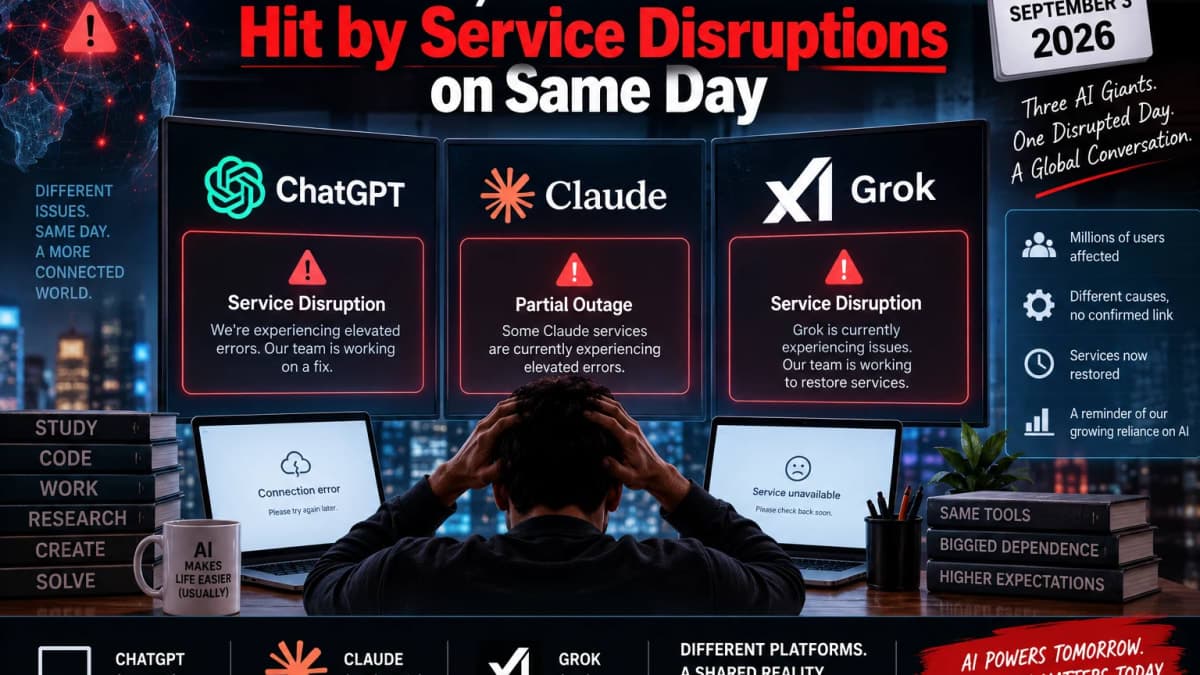
Major AI Platforms Experience Overlapping Outages
Three of the world's most prominent artificial intelligence platforms experienced service disruptions within hours of each other on September 3, temporarily interrupting access to tools that millions of people increasingly rely on for work, research, coding and everyday tasks.
OpenAI's ChatGPT, Anthropic's Claude and xAI's Grok all encountered problems during an unusual period of overlapping downtime.
Users reported failed requests, errors and difficulty accessing various AI-powered features as engineers at the respective companies worked to restore services.
The close timing immediately raised an obvious question: Were the outages connected?
So far, there is no confirmed evidence establishing a single common cause.
What Happened to ChatGPT?
OpenAI acknowledged elevated errors affecting ChatGPT and Codex during the September 3 incident.
The disruption affected multiple ChatGPT functions, with users reporting problems involving logins and other features.
OpenAI's status updates said the company investigated the elevated errors, implemented mitigation measures and monitored recovery before ultimately marking the incident as resolved.
The incident was relatively short-lived, but its overlap with disruptions at competing AI services made it considerably more notable than an isolated ChatGPT outage.
Claude Also Experiences Partial Outage
Anthropic's Claude encountered problems during approximately the same broader period.
Anthropic reported a partial outage involving elevated errors across Claude services. The disruption affected products including Claude.ai, Claude Code and the Claude API.
The company identified the cause, deployed a fix and subsequently reported recovery.
Anthropic described its problem as an infrastructure issue but did not publicly establish that it was connected with the disruption affecting OpenAI.
That distinction is important because simultaneous failures do not necessarily mean the platforms share the same underlying technical problem.
Grok Goes Down During Same Window
xAI's Grok also experienced service problems during the same morning.
The disruption affected users across Grok's platforms, including web and mobile services.
Reporting following the incident said the Grok problem was associated with an outage at xAI's Memphis compute centre.
The service subsequently recovered.
With Grok, Claude and ChatGPT all encountering problems within a relatively narrow period, users were left with fewer alternatives than during a typical single-provider outage.
Were the Three AI Outages Connected?
The timing naturally encouraged speculation about a common infrastructure failure.
Major AI services depend on complex technology stacks involving data centres, networking systems, cloud infrastructure and numerous supporting services. A sufficiently important shared dependency could theoretically affect several providers.
However, no evidence available so far confirms that this happened on September 3.
OpenAI's incident was associated with a routing problem, Anthropic described an infrastructure issue, while the Grok disruption was linked to xAI's Memphis compute centre.
Major infrastructure providers also did not identify a single widespread failure that conclusively explained all three incidents.
Therefore, describing the event as a confirmed single "global AI outage" would go beyond the available evidence.
The more accurate description is that several major AI services suffered rare, overlapping disruptions.
Why Simultaneous AI Downtime Matters
A few years ago, an unavailable chatbot might have been little more than an inconvenience.
That is increasingly no longer the case.
Generative AI systems are now embedded in software development, research, writing, customer service, document analysis, education and other professional workflows.
ChatGPT and Claude also offer dedicated coding tools, while AI capabilities are increasingly integrated into enterprise software and automated workflows.
That means outages can affect more than people casually asking a chatbot questions.
Developers may lose access to coding assistants. Businesses can temporarily lose AI-powered workflow tools. Researchers and content teams may have to switch platforms or revert to conventional tools.
The September 3 disruptions demonstrated another potential vulnerability: switching providers is less useful when multiple alternatives are unavailable simultaneously.
Outage Reports Surge as Users Encounter Errors
Third-party outage tracker Downdetector recorded a sharp increase in reports as the problems developed.
Such figures are useful for identifying sudden spikes in user-reported problems, but they should not be interpreted as an exact count of everyone affected.
Downdetector reports represent submissions from users and therefore measure reported disruption rather than the complete scale of an outage.
Official company status pages remain the stronger source for determining whether a provider has acknowledged an incident.
In this case, the service problems were acknowledged through provider status information and subsequent reporting.
Google Gemini Adds Another Twist
Reports concerning Google's Gemini were less consistent.
Some users and reports indicated problems with Gemini during the broader period of AI instability, while other reporting said Google's service remained operational.
Without equivalent confirmation establishing a major Gemini outage during the same window, it is safer to distinguish those user reports from the confirmed disruptions affecting ChatGPT, Claude and Grok.
That distinction also demonstrates why outage reporting requires caution: a spike in complaints does not necessarily mean every user—or every component of a service—is offline.
All Three Services Recover
By later on September 3, reporting indicated that ChatGPT, Claude and Grok had returned to normal operation.
The restoration brought the unusual period of overlapping disruption to an end, but questions about the coincidence remained.
At present, there is no confirmed evidence that the three providers were hit by the same technical failure.
Unless additional technical details emerge, the outages should therefore be treated as separate incidents whose timing happened to overlap rather than as a proven common infrastructure collapse.
ChatGPT Faces Another Issue in APAC on September 4
The story gained an additional development the following day.
On September 4, OpenAI reported that users in the Asia-Pacific region could experience increased errors involving ChatGPT, Work, image generation, file uploads, Voice and Codex Cloud.
OpenAI said it was investigating the issue.
This September 4 APAC incident is separate from the September 3 multi-platform disruption and should not automatically be treated as a continuation of the earlier outage.
AI Reliability Is Becoming a Business Issue
The bigger significance of the September 3 disruption goes beyond whether three technical failures happened at approximately the same time.
AI services are becoming infrastructure.
Businesses are increasingly designing workflows around the assumption that AI assistants, APIs and coding agents will remain available when needed.
As that dependence grows, reliability becomes almost as important as model intelligence.
For organisations heavily dependent on generative AI, the incident highlights the value of contingency planning: critical processes should ideally not depend entirely on uninterrupted access to a single cloud-based AI system.
Using multiple providers can reduce that risk—but September 3 also demonstrated the limits of that strategy when several leading platforms experience problems simultaneously.
A Rare Coincidence With a Bigger Message
ChatGPT, Claude and Grok ultimately recovered from their respective disruptions.
What remains noteworthy is not simply that AI services went offline—online platforms inevitably experience technical failures—but that several leading competitors encountered problems during such a narrow period.
There is currently no evidence proving a shared cause, making claims of a single coordinated or infrastructure-wide failure premature.
But the episode offered a glimpse of a challenge that will become increasingly important as AI becomes embedded deeper into everyday computing:
The more people and businesses depend on AI platforms, the more consequential even relatively short periods of downtime become.