Congress Raises US Pressure Allegation After NIA Leaves UAPA Out of VanDyke Chargesheet
The National Investigation Agency's first chargesheet against seven foreign nationals accused in a case involving alleged drone training in Myanmar has opened a fresh political dispute, largely because of what the filing does not contain.
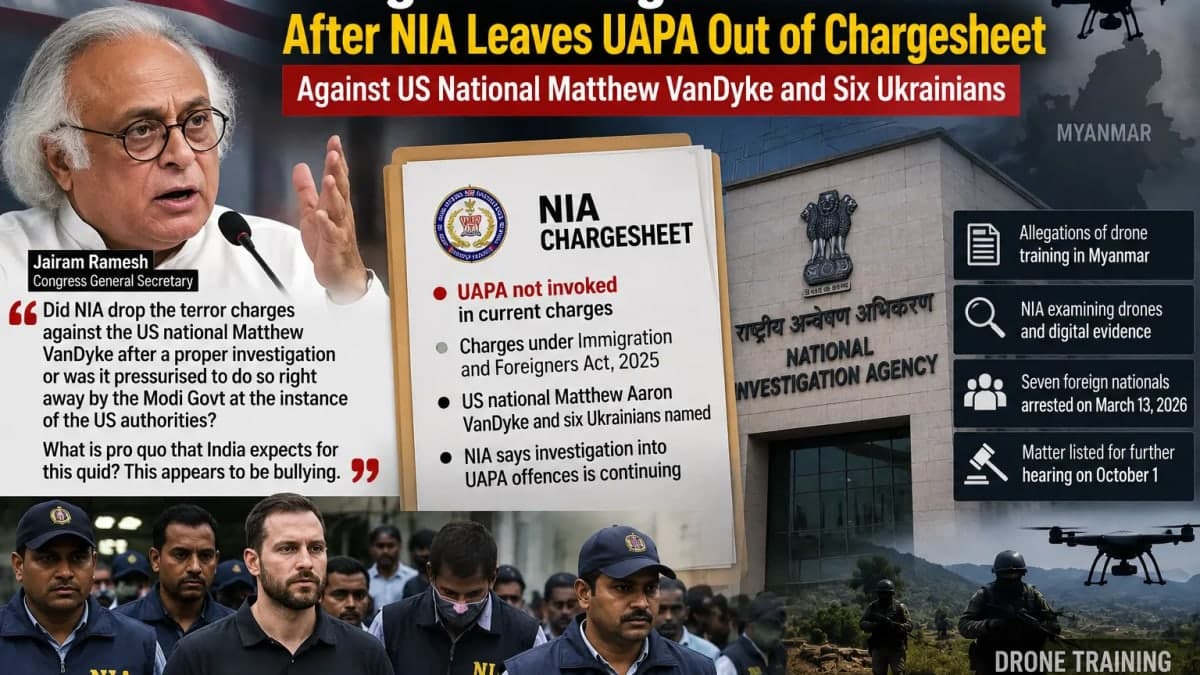
American national Matthew Aaron VanDyke and six Ukrainian citizens have been charged under India's immigration law. The NIA has not, at this stage, invoked the Unlawful Activities (Prevention) Act against them, even though the investigation initially included Section 18 of the anti-terror law.
Congress has responded by asking whether pressure from Washington influenced that decision.
There is no publicly established evidence of US intervention. The NIA, meanwhile, has told the court that its investigation into possible UAPA offences is not over and that further charges could follow if the evidence supports them.
Jairam Ramesh Raises Questions Over Change in Charges
Congress general secretary in-charge of communications Jairam Ramesh focused his criticism on the difference between the original investigation and the charges now before the court.
“Did NIA drop the terror charges against the US national Matthew VanDyke after a proper investigation or was it pressurised to do so right away by the Modi Govt at the instance of the US authorities?” Ramesh asked.
He followed that with another question: “What is pro quo that India expects for this quid? This appears to be bullying.”
The comments amount to a political allegation rather than an established account of how the NIA reached its decision. No evidence has emerged publicly showing that US authorities asked India to remove UAPA provisions from the current chargesheet.
The legal position is also more complicated than the suggestion that the terror case has simply been dropped.
Seven Accused Currently Face Immigration Charges
The NIA filed the chargesheet before a special court in Delhi against VanDyke and Ukrainian nationals Petro Hurba, Taras Slyviak, Ivan Sukmanovskyi, Marian Stefankiv, Maksim Honcharuk and Viktor Kaminskyi.
The agency has invoked Sections 21 and 23 of the Immigration and Foreigners Act, 2025.
Those charges relate to alleged violations of India's immigration and entry requirements. They are substantially different from an offence under Section 18 of the UAPA, which concerns conspiracy or attempts connected to terrorist acts.
For now, the prosecution is proceeding with the immigration offences it says it can support through the evidence gathered.
That does not settle the UAPA question.
Special Public Prosecutor Rahul Tyagi told the court that further investigation into potential offences under the anti-terror law remains underway. If investigators conclude that the evidence meets the legal threshold, the NIA could file a supplementary chargesheet.
The case is scheduled to return to court on October 1.
NIA Still Examining Drones and Digital Evidence
The agency has said it needs more time to determine the full nature of the alleged activities.
Investigators are examining the movement and recovery of large quantities of drones and related accessories through India, as well as digital devices seized during the investigation.
According to the NIA's position before the court, a substantial part of the investigation into possible UAPA offences has already been completed. Further inquiries are required to establish what it described as the “true and complete facts”.
The central question is whether the evidence establishes activity serious enough to fall within the anti-terror law, including conduct affecting India's unity, integrity, security or sovereignty.
Until that investigation is completed, the current chargesheet represents the offences the agency has chosen to prosecute at this stage rather than necessarily the final legal shape of the case.
Investigation Traces Alleged Journey From India to Myanmar
The case stems from the seven foreigners' movements through India and their alleged activities after crossing into Myanmar.
According to the NIA, the accused arrived in India on valid travel documents in December 2025 and subsequently travelled through Guwahati and Mizoram.
Investigators allege that they entered protected areas without obtaining the necessary permit before crossing the India-Myanmar border through unauthorised routes.
The group then allegedly travelled to Victoria Camp in Myanmar.
The NIA says some of the accused provided pre-arranged training to Myanmar-based ethnic armed groups in areas including drone warfare, drone operations, assembly and jamming technology.
Investigators are also examining allegations that drones originating in Europe were supplied to people and groups in Mizoram.
These are prosecution allegations. They have not been established by a court through conviction.
Arrests Took Place at Three Airports in March
The seven were arrested on March 13, 2026, at airports in Kolkata, Lucknow and Delhi.
VanDyke was detained at Kolkata airport. Petro Hurba, Taras Slyviak and Ivan Sukmanovskyi were arrested in Lucknow, while Marian Stefankiv, Maksim Honcharuk and Viktor Kaminskyi were taken into custody in Delhi.
The NIA initially investigated the case under Section 18 of the UAPA as well as provisions of the Bharatiya Nyaya Sanhita.
A court granted investigators 11 days of custody following the arrests. The accused were subsequently sent to judicial custody.
VanDyke, 46, describes himself as a combat specialist and founded Sons of Liberty International. His website says he participated in the 2011 Libyan civil war against Muammar Gaddafi.
That background forms part of the wider context around the investigation, but it does not itself establish the allegations in the present case.
Defence Points to Months Spent in Custody
VanDyke's defence has approached the current chargesheet from a different direction than Congress.
His lawyer, Rohit Dandriyal, has questioned why VanDyke remained in custody for months during an investigation involving terrorism allegations when the NIA's first chargesheet ultimately invoked immigration offences instead.
The defence disputes the basis of the terrorism allegations.
The NIA's response, in effect, is that the investigation has not reached that conclusion. Prosecutors have told the court they are continuing to examine whether the evidence supports UAPA charges.
That distinction will matter as the proceedings continue. A first chargesheet without UAPA provisions may strengthen the defence's argument that the original allegations require scrutiny, but it does not legally prevent investigators from bringing additional charges later if further evidence supports them.
Two Questions Now Surround the Case
The controversy has produced a political question and a legal one, and they should not be treated as interchangeable.
Congress wants the government to explain whether US pressure had any bearing on how the American accused was charged. That remains an allegation for which no public evidence has so far been produced.
The legal question is narrower: whether the NIA's continuing investigation will uncover sufficient evidence to prosecute VanDyke or the other accused under the UAPA.
At present, the agency has chosen to proceed with immigration-related charges while keeping the anti-terror investigation open.
What happens next will depend less on the political argument surrounding the first chargesheet than on whether the evidence still being examined can support additional offences under Indian law.