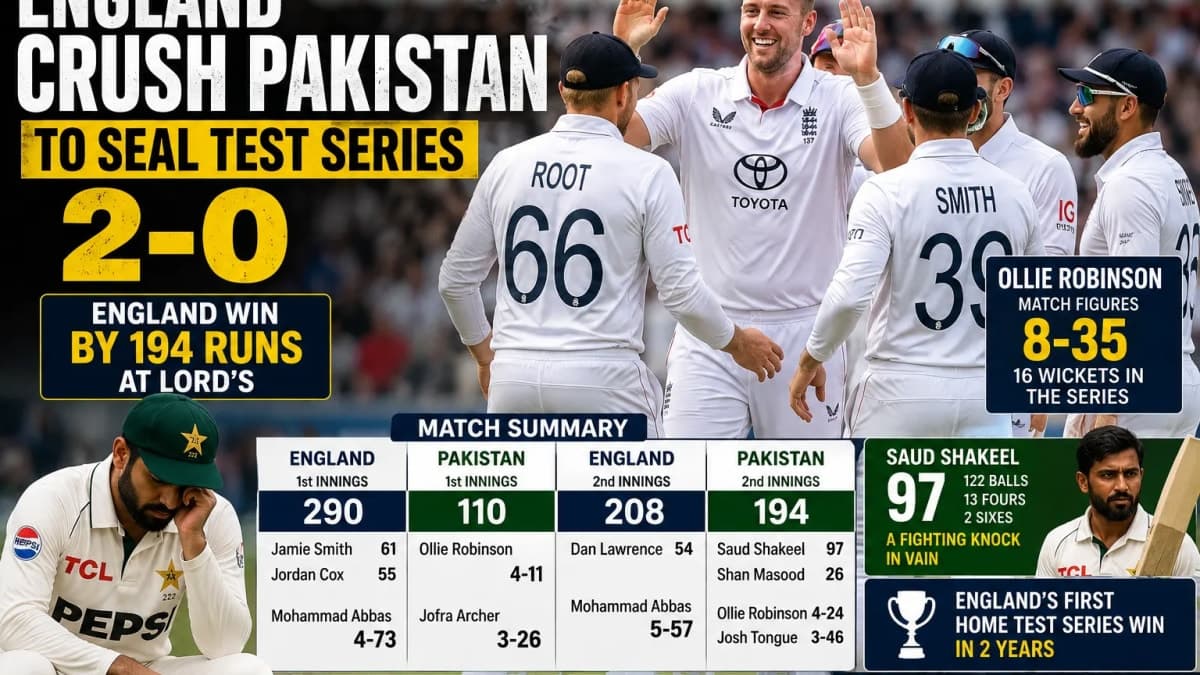
England wrapped up the Test series against Pakistan with a commanding 194-run victory at Lord’s, taking an unbeatable 2-0 lead with one match still to play.
Set a daunting 389-run target, Pakistan’s chase suffered an immediate collapse before Saud Shakeel produced a defiant 97 to delay England’s celebrations. His resistance ultimately proved insufficient as Pakistan were bowled out for 194 in 50.5 overs.
Ollie Robinson was at the heart of England’s victory, taking 4-24 in Pakistan’s second innings after claiming 4-11 in the first, completing outstanding match figures of 8-35.
The victory also gave England their first home Test series win in two years.
Robinson Leads England’s Ruthless Bowling Display
England’s seam attack once again exposed Pakistan’s batting vulnerabilities, and Robinson emerged as the central figure.
Pakistan had already been dismissed for only 110 in their first innings, with Robinson returning remarkable figures of 4-11 from 13 overs.
He followed that performance with another four-wicket haul during the final innings, finishing with 4-24 as Pakistan attempted to chase 389.
Robinson therefore ended the match with eight wickets while conceding just 35 runs.
His performances across the opening two Tests have been particularly significant for England. Robinson has now collected 16 wickets in the series with the final Test still to come.
Pakistan Collapse to 14-3 in Huge Run Chase
Pakistan began their fourth-innings chase needing 389 — already an imposing task against an England attack operating with a substantial cushion.
Any realistic hopes of an extraordinary comeback quickly faded.
Pakistan crashed to 14-3, putting England firmly on course for victory.
The early collapse continued a difficult batting series for the tourists, who have repeatedly struggled to build substantial innings against England’s pace attack.
But one batter refused to surrender easily.
Saud Shakeel’s 97 Delays England Victory
Saud Shakeel produced Pakistan’s strongest batting performance of the match.
Coming in with his team under severe pressure, the left-hander counter-attacked his way to 97 from 122 deliveries, striking 13 fours and two sixes.
Shakeel combined with Shan Masood, who made 26 from 72 balls, for a crucial 97-run fourth-wicket partnership from 139 deliveries after Pakistan had been reduced to 14-3.
The partnership restored some respectability to the innings but could not fundamentally change the direction of the match.
Shakeel eventually fell three runs short of what would have been his fifth Test century.
His dismissal effectively removed Pakistan’s final major source of resistance before England completed the victory.
Josh Tongue Finishes the Job
While Robinson was England’s leading wicket-taker in Pakistan’s second innings, Josh Tongue played an important role in shutting down the lower order.
Tongue finished with 3-46, including the wicket of Shakeel.
He then dismissed Mohammad Ali to complete Pakistan’s innings and confirm England’s 194-run victory.
England’s pace attack has emerged as one of the clearest differences between the teams across the opening two Tests.
England Set Up Victory With 180-Run First-Innings Lead
England’s dominance at Lord’s was established much earlier in the contest.
The hosts scored 290 in their first innings, with wicketkeeper Jamie Smith making 61 and Jordan Cox contributing 55.
Pakistan seamer Mohammad Abbas claimed 4-73, while Mohammad Ali took 3-86.
Pakistan’s response, however, changed the complexion of the Test.
The tourists were dismissed for just 110, handing England a huge 180-run first-innings advantage.
Robinson took 4-11, while Jofra Archer claimed 3-26.
That deficit left Pakistan needing an exceptional performance during the remainder of the Test to recover.
Mohammad Abbas Claims Five Wickets at Lord’s
Pakistan’s bowlers did manage to produce a stronger performance in England’s second innings.
England were dismissed for 208, with Dan Lawrence scoring 54.
Mohammad Abbas was Pakistan’s standout bowler, claiming 5-57 and earning a place on the prestigious Lord’s honours board.
His performance meant England could not completely bat Pakistan out of the match, but the enormous first-innings advantage still allowed the hosts to set a target of 389.
The contrast between Pakistan’s bowling and batting performances was telling: Abbas created opportunities with the ball, but Pakistan’s top order could not provide the platform required to exploit them.
England Seal Series After Dominant Headingley Victory
The Lord’s result follows another emphatic England performance in the opening Test at Headingley.
England won that contest by an innings and 103 runs, immediately putting Pakistan under pressure in the three-match series.
Victory at Lord’s means the hosts now hold an unassailable 2-0 advantage.
The scale of the two victories is also significant. Rather than relying on narrow margins or individual moments, England have controlled long periods of both Tests, particularly with the ball.
For England, the series triumph represents their first home Test series victory in two years and provides an encouraging result during Joe Root’s latest spell as captain.
Pakistan’s Batting Remains the Central Concern
Pakistan’s problems in England have been most visible with the bat.
At Lord’s, they managed only 110 and 194, despite Shakeel’s excellent second-innings effort.
Those failures meant strong individual bowling performances — particularly Abbas’ five-wicket haul — were unable to keep Pakistan genuinely competitive.
The repeated top-order collapses will leave Pakistan with significant questions to address before the final Test.
The challenge now extends beyond attempting to save face in the series. Pakistan must find a way to build longer partnerships and prevent England’s seamers from repeatedly taking control with clusters of wickets.
Pakistan Respond With Major Changes Ahead of Final Test
The consequences of the two heavy defeats have already extended beyond the scorecard.
Following the series loss, the Pakistan Cricket Board announced major changes to its touring group ahead of the third Test.
Head coach Sarfaraz Ahmed has been replaced by white-ball coach Mike Hesson, while bowling coach Umar Gul has also been replaced.
Seven players were sent home, including Mohammad Rizwan, Salman Ali Agha, Imam-ul-Haq, Ali Usman, Aamer Jamal, Awais Zafar and Khurram Shahzad.
The scale and timing of those changes underline the pressure created by Pakistan’s performances in the opening two Tests.
England vs Pakistan Second Test: Match Summary
England first innings: 290
Jamie Smith 61, Jordan Cox 55
Mohammad Abbas 4-73, Mohammad Ali 3-86
Pakistan first innings: 110
Ollie Robinson 4-11, Jofra Archer 3-26
England second innings: 208
Dan Lawrence 54
Mohammad Abbas 5-57
Pakistan second innings: 194
Saud Shakeel 97, Shan Masood 26
Ollie Robinson 4-24, Josh Tongue 3-46
Result: England won by 194 runs
Series: England lead 2-0
What’s Next for England and Pakistan?
The third and final Test is scheduled to begin at Edgbaston in Birmingham on September 9.
With the series already secured, England will have the opportunity to complete a 3-0 clean sweep.
Pakistan, meanwhile, will enter Birmingham with a substantially changed squad and coaching structure as they attempt to avoid a whitewash.
For England, another victory would complete a dominant series. For Pakistan, the final Test has become an opportunity to demonstrate that the sweeping changes made after Lord’s can produce an immediate response.


