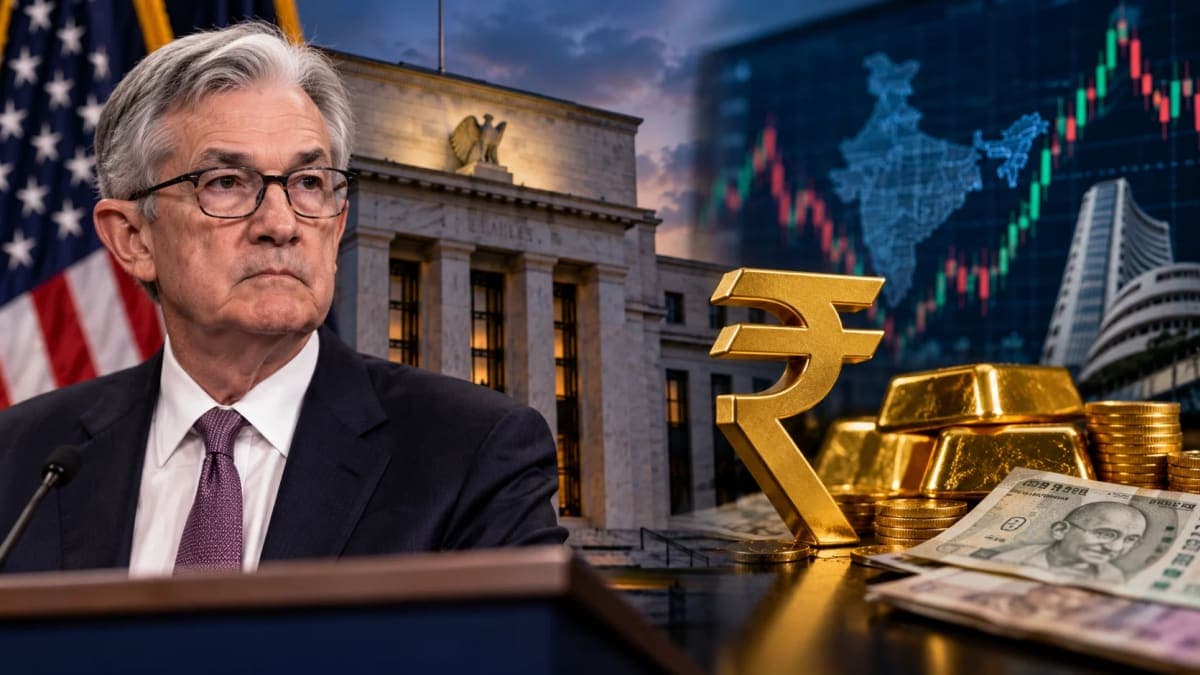
The US Federal Reserve delivers one of its most closely watched interest-rate decisions of 2026 tonight, and for Indian investors the consequences could stretch far beyond Wall Street.
The immediate questions are straightforward: Will the Fed raise interest rates? What will Chair Kevin Warsh signal about the next few meetings? And what will the Fed's new economic projections say about inflation?
But for Indians, there is another layer.
The decision could influence the rupee, gold prices, foreign investment flows, Indian government bonds and stock-market sentiment—at a time when expensive crude oil is already putting pressure on India's financial markets.
The Federal Open Market Committee's two-day September meeting concludes on Wednesday, September 16. The policy statement is scheduled for 2:00 p.m. US Eastern Time, or 11:30 p.m. IST, followed by Warsh's press conference 30 minutes later.
This meeting is especially important because the Fed will also release a fresh Summary of Economic Projections, including policymakers' interest-rate projections.
What is the Fed expected to do tonight?
The Federal Reserve currently has its benchmark federal funds target range at 3.50%-3.75%.
At its previous meeting on July 29, the Fed left rates unchanged. That decision was not unanimous: Beth Hammack, Neel Kashkari and Lorie Logan preferred a 25-basis-point increase.
Since then, the debate has changed considerably.
By September 16, financial markets were assigning a probability of more than 90% to at least a 25-basis-point increase, according to market pricing cited by Reuters.
A quarter-point increase would take the target range to 3.75%-4.00%.
That is the market expectation—not a confirmed decision.
The distinction matters because a large part of the immediate financial-market reaction may depend not simply on whether the Fed raises rates, but on whether its statement, projections and Warsh's comments suggest that more tightening is coming.
Why has the Fed suddenly become so important again?
Inflation and energy prices have returned to the centre of the debate.
Oil prices have climbed above $100 a barrel amid Middle East tensions, adding to concerns that energy costs could keep inflation elevated.
At the same time, US economic data have given the Fed less confidence that inflationary pressure is disappearing quickly.
That combination has pushed bond yields higher and dramatically increased expectations of another tightening cycle.
This creates an uncomfortable situation for India.
Higher US rates can strengthen the attraction of dollar-denominated assets, while expensive oil is negative for a major crude importer such as India.
The two pressures can therefore hit the rupee simultaneously.
1. Rupee: probably the most direct Indian exposure
The rupee enters tonight's decision from an already vulnerable position.
On September 16, it was trading near ₹95.93 per US dollar, close to the psychologically important ₹96 level.
Reuters reported that the Reserve Bank of India had been intervening in currency markets through state-run banks and using dollar-rupee swaps as it sought to moderate the currency's decline.
That does not mean the RBI is defending ₹96 as a fixed line. The evidence instead suggests an effort to control disorderly moves rather than guarantee any particular exchange rate.
Why can a Fed hike hurt the rupee?
Think of global capital as constantly comparing returns.
If US interest rates rise while Indian rates remain unchanged, the relative attractiveness of holding dollar assets can increase.
That can support the dollar and put emerging-market currencies under pressure.
India has an additional complication: oil.
Because India imports most of the crude oil it consumes, expensive oil increases demand for dollars from importers and can worsen inflation and external-balance concerns.
That means tonight's risk is not simply:
Fed hike → weaker rupee.
The more complete equation is:
Fed policy + US bond yields + dollar movement + oil prices + foreign capital flows + RBI intervention → rupee direction.
That is why predicting an exact rupee level from the Fed decision alone would be misleading.
2. Gold: the headline rate decision may not tell the whole story
Gold has also been volatile ahead of tonight's meeting.
Spot gold was around $4,326.83 an ounce on September 16, up roughly 0.8% during the session after recently touching a one-month low.
The relationship between gold and interest rates is important but frequently oversimplified.
Gold does not generate interest.
When interest rates and inflation-adjusted bond yields rise, investors can earn more by holding interest-bearing assets. That can increase the opportunity cost of owning gold.
So, all else equal:
Higher rates / higher real yields → potential pressure on gold.
But "all else equal" is doing a lot of work.
Gold is simultaneously affected by inflation expectations, geopolitical risk, central-bank demand, the dollar and investor demand for defensive assets.
That is particularly relevant now because the same geopolitical developments pushing oil and inflation higher can also create safe-haven demand for gold.
What should Indian gold buyers watch?
There are actually two prices involved.
International gold is generally priced in US dollars.
Indian buyers ultimately pay in rupees.
Therefore:
Indian gold price ≈ international gold price × USD/INR + taxes, duties and domestic premiums.
That produces an interesting scenario.
Suppose a hawkish Fed pressures international gold but also weakens the rupee.
The currency effect could offset part of the international gold decline for Indian buyers.
In other words, gold can fall in dollars without falling by the same percentage in India.
That distinction is particularly useful for Indian households watching jewellery, coins, bars, gold ETFs or other gold-linked investments.
3. Sensex and Nifty: the bigger issue may be yields and oil
Indian equities have entered the Fed decision under pressure.
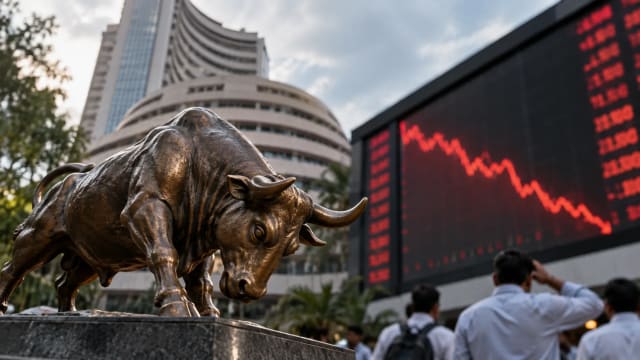
On September 15, the Nifty 50 fell 1.19% to 23,118.6, its lowest closing level in about five months.
The Sensex dropped 1.04% to 74,003.82.
On September 16, stocks recovered somewhat in early trading, but elevated crude prices and uncertainty surrounding the Fed continued to limit risk appetite.
The Fed matters to Indian stocks through several channels.
Foreign capital
Higher US bond yields can make US assets comparatively more attractive.
That can reduce investor appetite for emerging-market equities, including India.
Valuations
Higher global interest rates raise the discount rate investors use when valuing future corporate earnings.
Companies whose valuations depend heavily on profits expected far into the future can therefore become more sensitive to rising yields.
Currency
A weaker rupee does not affect every company equally.
Export-oriented businesses earning substantial revenue in dollars can receive some translation benefit from a weaker rupee.
Companies dependent on imported raw materials, energy or dollar-denominated costs can face the opposite pressure.
Oil
For India, this may be just as important as the Fed.
Expensive crude can increase costs for businesses, contribute to inflation and put pressure on India's external accounts.
So investors should be careful about attributing every Sensex or Nifty movement tomorrow solely to the Federal Reserve.
4. What could happen under three Fed scenarios?
Instead of trying to predict tomorrow's market direction, investors can think in scenarios.
Scenario A: 25-basis-point hike + signal of more hikes
This would be the more hawkish outcome.
US Treasury yields and the dollar could face upward pressure.
That combination could create additional pressure on the rupee and emerging-market assets.
Gold could initially struggle because of higher yields, although geopolitical demand and rupee depreciation could complicate the reaction for Indian gold prices.
Indian equities could face pressure particularly if foreign risk appetite deteriorates.
Scenario B: 25-basis-point hike + cautious message about future tightening
This is where markets could behave very differently.
Because a quarter-point hike is already heavily anticipated, investors may focus more on the dot plot and Warsh's press conference than on the hike itself.
If the Fed raises rates but signals that additional tightening is uncertain, markets could interpret the overall package as less hawkish than feared.
That is why markets sometimes rally after a rate hike.
The surprise relative to expectations matters more than the headline alone.
Scenario C: Fed unexpectedly leaves rates unchanged
Because markets have assigned a high probability to a hike, no change would be a significant surprise.
Bond yields and the dollar could react sharply.
But investors should not automatically interpret such an outcome as positive.
Markets would immediately ask why the Fed did not hike.
If the reason were increased concern about economic weakness or financial instability, the interpretation could be very different from a benign pause.
5. Will your home-loan or personal-loan EMI change tomorrow?
Probably not directly.
This is one area where Indian consumers should distinguish the Federal Reserve from the Reserve Bank of India.
The Fed controls US monetary policy.
The RBI determines India's key domestic policy rate.
The RBI's policy repo rate is currently 5.25%.
Indian floating-rate loans are generally linked to domestic benchmarks rather than directly to the US federal funds rate.
Therefore, a Fed rate hike tonight does not automatically increase an Indian borrower's EMI tomorrow.
The indirect transmission matters more.
If Fed tightening contributes to persistent rupee weakness, imported inflation or pressure on Indian financial conditions, it can influence the environment in which the RBI makes future policy decisions.
But that is a multi-step process, not an automatic one-for-one relationship.
6. What about fixed deposits?
Again, there is no automatic overnight connection.
Indian banks determine deposit rates based on factors including RBI policy, liquidity conditions, credit demand, competition for deposits and their own funding requirements.
A Fed hike does not require Indian banks to immediately increase FD rates.
If global tightening eventually affects RBI policy or domestic bond yields, however, the broader Indian interest-rate environment could change.
Consumers should therefore avoid assuming:
Fed hikes 25 bps → Indian FD rates rise 25 bps.
Monetary transmission does not work that mechanically.
7. Indian government bonds could be another important transmission channel
Indian bond markets are also watching the Fed closely.
Higher US Treasury yields can put upward pressure on global bond yields because investors compare returns across markets.
Meanwhile, expensive crude creates additional inflation concerns for India.
If Indian bond yields rise, existing bond prices generally fall.
This can matter not only to direct bond investors but also to debt mutual funds, banks and other financial institutions.
The impact varies substantially depending on the duration and composition of the portfolio.
What investors should watch after 11:30 p.m.
The headline interest-rate number will arrive first, but it may not be the most important information.
Five indicators deserve attention:
The rate decision: Does the Fed raise rates by 25 basis points as markets expect?
The dot plot: How many additional rate moves do policymakers project?
Inflation forecasts: Has the Fed revised its inflation expectations higher?
Kevin Warsh's language: Does he suggest tonight's move is precautionary, the start of further tightening or dependent entirely on incoming data?
US Treasury yields and the dollar: These may tell Indian investors more about how global markets interpreted the decision than the headline itself.
For India, add a sixth:
Crude oil.
A hawkish Fed combined with oil above $100 would create a different environment from a hawkish Fed accompanied by rapidly falling crude prices.
JantaScope Analysis: Don't trade only the headline
The biggest mistake investors can make tonight is reducing the event to:
Rate hike = markets down
or
No hike = markets up.
Markets trade expectations.
With investors already assigning more than a 90% probability to a quarter-point hike before the decision, much of that outcome may already be reflected in asset prices.
The bigger surprise could come from the Fed's projections.
If policymakers indicate significantly more tightening than investors currently expect, markets could react even if tonight's 25-basis-point hike itself surprises nobody.
Conversely, a hike accompanied by a relatively cautious future outlook could produce a less negative—or even positive—market response.
For Indian investors, the most useful framework is therefore not to guess whether the Sensex will rise or fall tomorrow morning.
Watch the chain:
Fed → US Treasury yields → Dollar → Rupee → Foreign flows → Indian bonds/equities.
And alongside it:
Middle East tensions → Crude oil → Rupee/inflation → Indian markets.
That second chain is particularly important because it means India's financial outlook is currently being shaped by two global shocks at the same time.
Bottom Line
Tonight's Federal Reserve decision matters to India, but it will not determine every Indian asset in the same way.
A hawkish Fed can put pressure on the rupee and emerging-market assets while increasing the oy, RBI intervention and currency movements can change those relationships.
For households, the most important point is simpler: your EMI, FD rate and Indian savings products do not change automatically because the Fed changes US interest rates.
The Fed's influence reaches your money indirectly—through currencies, capital flows, inflation, bond yields and eventually the policy environment facing the RBI.
And tonight, what the Fed says about the next interest-rate move may ultimately matter more than the move it makes now.pportunity cost of holding gold. Yet expensive oil, geopolitical uncertainty