Flipkart Minutes Could Add 1,000 Dark Stores by Mid-2027 as Quick-Commerce Push Deepens
Introduction
Flipkart Minutes has spent the past two years building the physical network needed to compete in quick commerce. Its next phase could be considerably larger.
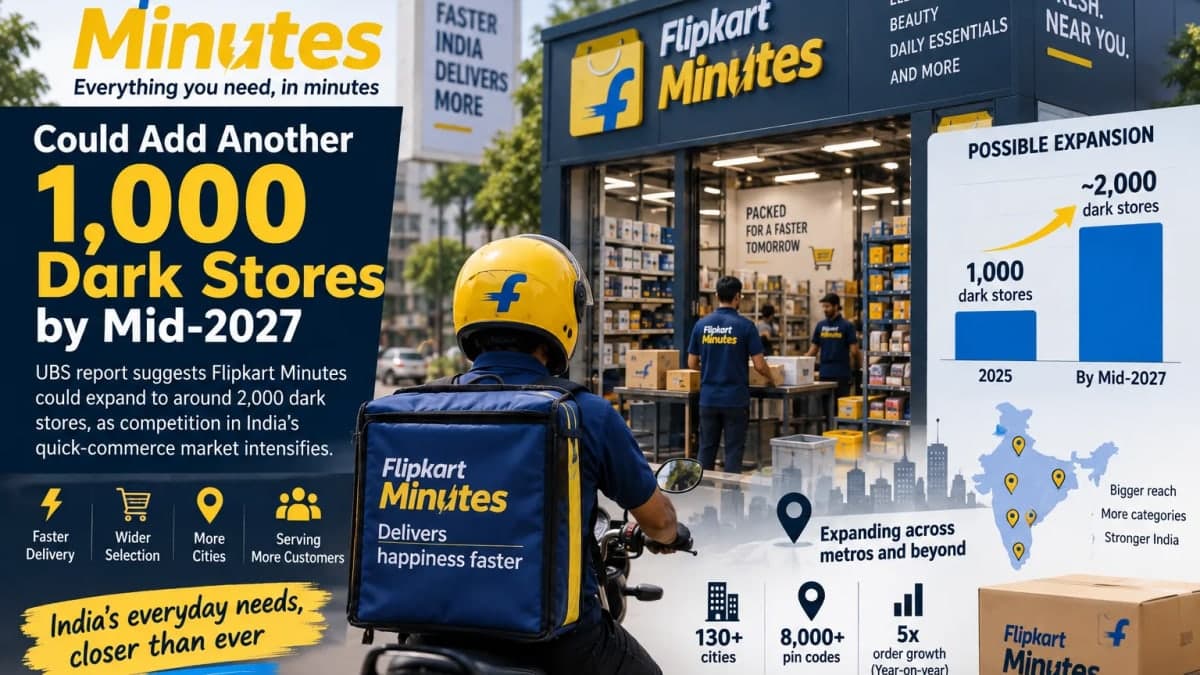
The rapid-delivery service may add around 1,000 dark stores by the middle of 2027, according to a UBS research note citing an industry expert. Such an expansion would take the network to roughly 2,000 locations and move Minutes closer to the scale of India's largest quick-commerce operators.
The estimate goes beyond Flipkart's previously stated plan to reach 1,500 micro-fulfilment centres across more than 180 cities.
It is not, however, a new target formally announced by Flipkart. The 1,000-store addition is an industry projection cited in UBS research, and the eventual pace of expansion is expected to depend on market performance and the availability of supporting infrastructure.
That distinction matters in a sector where opening stores quickly is relatively easy to measure, but making each one economically productive is much harder.
Minutes Has Already Built a 1,000-Store Network
Flipkart entered quick commerce relatively late, launching Minutes in August 2024 after Blinkit, Zepto and Swiggy Instamart had already established substantial operations.
It has since moved quickly.
Flipkart said in June that Minutes had crossed 1,000 micro-fulfilment centres in less than two years. The service was available across more than 130 cities and 8,000 pin codes, while orders had increased fivefold from the previous year.
Those numbers established Minutes as a significant quick-commerce operation rather than an extension confined to a handful of large cities.
UBS now sees scope for another expansion wave. The reported plan could coincide with Flipkart's Big Billion Days sale next year, although execution would depend partly on whether larger warehouses and backend systems are ready to support additional neighbourhood stores.
That infrastructure is easy to overlook. A dark store may be the part of quick commerce closest to the customer, but it depends on inventory replenishment, regional warehousing, software and delivery capacity behind it.
Adding another 1,000 locations therefore requires considerably more than securing 1,000 properties.
Older Stores Are Processing More Orders
The performance of existing Minutes locations offers some indication of what Flipkart will need from the next batch of stores.
According to UBS, an average dark store handles roughly 800 to 1,000 orders a day.
Stores that have been operating for five or six months can reach approximately 1,200 to 1,500 daily orders, according to reporting on the brokerage's findings. Other accounts of the same research place mature-store volumes at roughly 1,000 to 1,500 orders.
The direction is more important than the slight variation between reported ranges: established stores are handling materially more demand than newer ones.
That maturation curve has direct consequences for the economics of rapid expansion.
Every new dark store brings rent, staffing, inventory and operating costs before it reaches its expected order density. Opening stores faster can improve coverage and shorten delivery distances, but it also increases the number of young locations that have yet to reach mature volumes.
For Flipkart, the challenge is therefore not simply to double the network. It is to build stores in neighbourhoods where demand develops quickly enough to justify the investment.
Flipkart Has Something Its Rivals Had to Build: Existing Customers
Minutes enters that calculation with one significant advantage.
Flipkart already has a large e-commerce customer base.
Instead of acquiring every quick-commerce user through a separate app or entirely new relationship, the company can introduce Minutes to shoppers already using its marketplace.
UBS estimates that in markets where Minutes is available, roughly 40% to 45% of customers visiting Flipkart also use its quick-delivery service.
That overlap gives Flipkart several options.
Minutes can capture frequent purchases that might otherwise move to dedicated quick-commerce platforms, particularly in categories such as fresh food, beauty and personal care. At the same time, Flipkart can introduce its existing marketplace customers to rapid delivery without asking them to adopt an unfamiliar platform.
The strategic value of Minutes consequently extends beyond grocery delivery. It gives Flipkart a way to keep more shopping occasions inside its own ecosystem as consumer expectations shift toward faster fulfilment.
Electronics Could Be a More Important Advantage Than Groceries
Flipkart's history in mobiles and electronics also gives Minutes a different product mix from a traditional grocery-led delivery service.
According to UBS, Minutes has a net order value of about ₹500 to ₹530 when mobile phones are excluded. That is broadly comparable with Blinkit's ₹518 net order value in the first quarter of FY27.
When mobiles are included, Minutes moves ahead.
UBS linked that performance to Flipkart's longstanding position in smartphones and electronics, including its relationships with sellers and consumers in those categories.
That could become increasingly important as the definition of quick commerce changes.
The industry's first proposition was built around urgent household purchases: groceries, snacks and daily essentials delivered within minutes. Platforms are now stretching the model into beauty products, electronics, home goods, fashion and other categories where individual transactions can be considerably larger.
For Flipkart, those categories are familiar territory.
If customers become comfortable ordering higher-value products through Minutes, the company may be able to use quick commerce not simply as a defensive response to Blinkit and Zepto but as a faster distribution channel for parts of its existing e-commerce business.
Smaller Cities Are Becoming Part of the Expansion
India's major metropolitan areas still account for most Minutes demand.
UBS estimates that metros contribute around 60% to 65% of orders. North India represents slightly less than one-third of demand, while the service is expanding rapidly in southern markets. Kolkata and other parts of eastern India have also gained traction.
Flipkart is nevertheless pushing beyond the largest cities.
When announcing its 1,000-centre milestone, the company said its quick-commerce business in Tier-II and Tier-III markets was operating at 42 times the scale recorded a year earlier.
Smaller cities also allow a somewhat different operating model.
Customers outside the most intensely competitive metro markets may accept delivery windows of 25 to 30 minutes rather than expecting every order almost immediately. That can allow a single dark store to serve a wider area and potentially improve the economics of operating in places with lower population density.
Flipkart also has years of purchasing data from these markets. That gives it an indication of where customers already shop online, which categories they buy and where demand may be strong enough to support rapid delivery.
For a company deciding where to place hundreds of new fulfilment centres, that information has obvious value.
Rivals Are Building at the Same Time
Flipkart will not have the expansion race to itself.
Blinkit remains the largest dark-store operator among India's major quick-commerce companies, with recent industry estimates putting its network above 2,200 locations.
Zepto and Swiggy Instamart have also built networks exceeding 1,000 stores.
Amazon is expanding Amazon Now as well. UBS estimates that the service operates around 500 to 600 dark stores and handles approximately 400,000 to 500,000 orders each day. The brokerage believes Amazon Now could reach 1,000 stores by the end of 2026.
The numbers illustrate how quickly the competitive threshold has moved.
A network of 1,000 dark stores once represented substantial scale. As the largest platforms move toward much bigger footprints, it is increasingly becoming the base from which the next stage of competition begins.
The Harder Test Comes After a Store Opens
Scale alone will not decide the outcome.
UBS believes Minutes' gross margins are improving, although they remain below Blinkit's. Its cost per order has moved closer to Blinkit and Swiggy Instamart in many cities, but the service has not yet reached Blinkit's overall operating efficiency.
That makes the potential 2,000-store network a test of execution as much as ambition.
More locations can put inventory closer to customers and support faster delivery. They can also help Flipkart enter markets before competitors become entrenched. But each store must eventually generate enough orders, at sufficient margins, to support the cost of the network around it.
Flipkart's advantage is that it is not entering those markets without information or customers. Its marketplace already provides both.
The question for Minutes is whether that foundation can translate into a quick-commerce network that performs efficiently at twice its current size.
If it can, the next 1,000 dark stores would represent more than a geographic expansion. They would bring Flipkart closer to combining two businesses that Indian consumers increasingly treat as part of the same shopping experience: traditional e-commerce and near-immediate delivery.