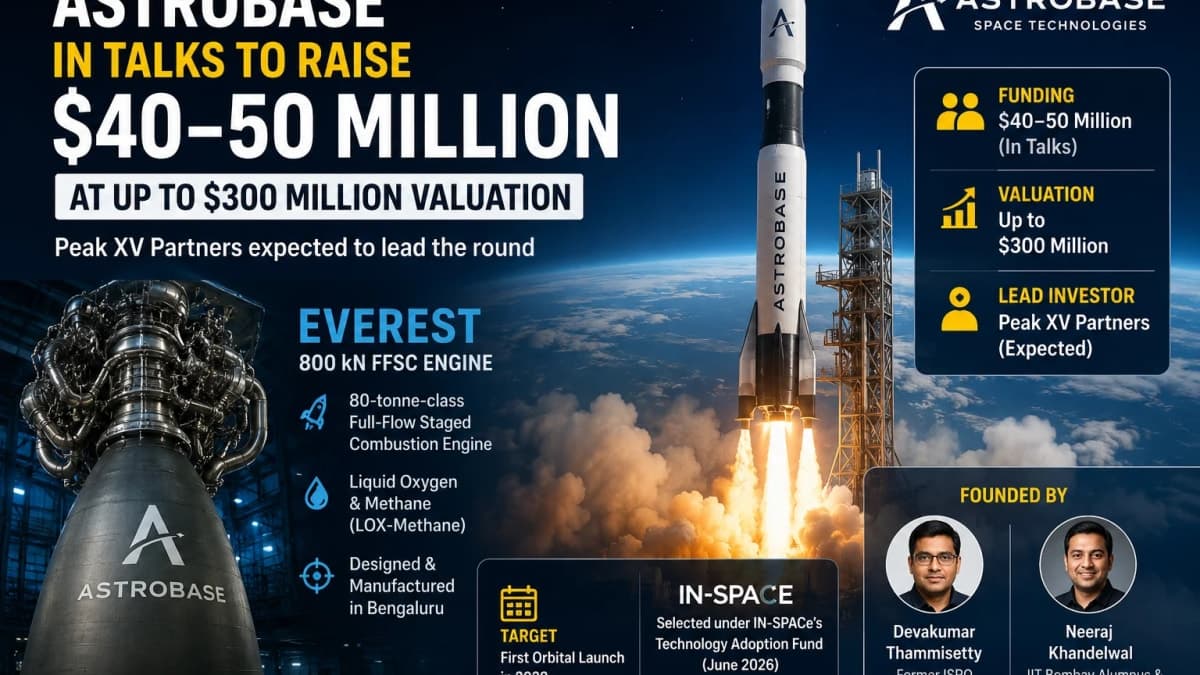
Bengaluru-based space technology startup Astrobase is reportedly in talks to raise between $40 million and $50 million in a new funding round that could value the company at as much as $300 million, highlighting growing investor interest in India's private space sector.
Peak XV Partners is expected to lead the proposed financing, according to people familiar with the discussions. The reported valuation range is approximately $250 million to $300 million.
The transaction has not been announced as completed. The figures therefore represent reported funding discussions and could change before any deal is finalised.
The fundraising talks arrive at a crucial stage for Astrobase as it develops reusable launch vehicles and works toward its first orbital launch, currently targeted for 2028.
Peak XV Expected to Lead Proposed Funding Round
The proposed $40–50 million financing would provide Astrobase with significant additional capital as it moves deeper into the costly development and testing phases associated with launch vehicles and advanced rocket propulsion.
Peak XV Partners is reportedly positioned to lead the round. A successful transaction at the upper end of the reported valuation range would value Astrobase at approximately $300 million.
For a young spacetech company, such a valuation would reflect investor expectations not simply around a single rocket engine but around Astrobase's broader ambition to develop reusable launch infrastructure in India.
However, because negotiations remain ongoing, the final amount raised, valuation and investor participation should not be treated as confirmed until formally announced.
Astrobase Is Building Reusable Rockets for 3–10 Tonne Payloads
Astrobase is developing two-stage reusable launch vehicles designed to carry payloads ranging from approximately three tonnes to 10 tonnes.
The company has said it is targeting its first orbital launch in 2028.
Reusable launch systems are intended to allow major rocket components to be flown more than once rather than discarded after every mission. If successfully developed and operated at scale, this approach can potentially improve launch economics and increase flight frequency.
For Astrobase, achieving that goal will require progress not only in propulsion but also in vehicle integration, testing, manufacturing and eventually orbital flight operations.
Everest Engine Becomes Key Part of Astrobase's Technology Push
The funding discussions follow Astrobase's unveiling of Everest, an 80-tonne-class, 800 kN Full-Flow Staged Combustion (FFSC) rocket engine.
The company has described Everest as India's first FFSC rocket engine.
Astrobase says the engine was designed and manufactured in Bengaluru and uses liquid oxygen and methane (LOX-methane) as propellants. It is being developed as part of the company's reusable launch vehicle ambitions.
Full-flow staged combustion is an advanced liquid-propellant engine architecture in which both the fuel and oxidiser streams are routed through preburners before reaching the main combustion chamber.
The architecture is technically demanding, making Astrobase's ability to progress from engine development to extensive testing and eventually operational flight an important milestone to watch.
IN-SPACe Support Adds Momentum to Engine Development
Astrobase's propulsion programme has also received institutional support.
In June 2026, the company was selected under the Indian National Space Promotion and Authorisation Centre's (IN-SPACe) Technology Adoption Fund for development of its indigenous 800 kN LOX-methane Full-Flow Staged Combustion engine.
Astrobase was among the first group of Indian non-government entities selected for support under the programme.
The Technology Adoption Fund is designed to help private companies develop technologies that can strengthen India's domestic space capabilities and reduce dependence on imported systems.
That support is particularly relevant for Astrobase because high-performance propulsion is one of the most technically demanding and capital-intensive components of building an orbital launch system.
Founded by Deep-Tech and Technology Entrepreneurs
Astrobase was founded in 2024.
Its founders include Devakumar Thammisetty, a former ISRO propulsion scientist, and Neeraj Khandelwal, an IIT Bombay alumnus and co-founder of cryptocurrency exchange CoinDCX.
The combination of propulsion engineering expertise and technology entrepreneurship reflects the broader evolution of India's commercial space ecosystem, where privately funded companies are increasingly attempting projects previously associated primarily with national space programmes and major aerospace contractors.
Why the Proposed Funding Matters
Rocket development requires substantial upfront investment long before a company can generate meaningful revenue from commercial launches.
Engines must undergo extensive testing, manufacturing systems need to be established, launch vehicles must be integrated and validated, and multiple technical and regulatory milestones have to be completed before orbital operations can begin.
That makes access to long-term capital particularly important for companies pursuing reusable launch vehicles.
A $40–50 million round, if completed, could therefore provide Astrobase with additional resources as it works toward its 2028 orbital-launch target.
The proposed valuation also indicates that investors are showing willingness to consider larger bets on India's capital-intensive space infrastructure sector rather than concentrating exclusively on satellite software, analytics and other relatively asset-light businesses.
India's Private Space Ecosystem Is Expanding
Astrobase's fundraising discussions come amid wider efforts to increase private-sector participation in India's space industry.
Government initiatives led by IN-SPACe have created mechanisms for private companies to develop technologies, access infrastructure and participate more directly in the country's space economy.
The Technology Adoption Fund is one such initiative, with Astrobase, SatSure Analytics India and TM2SPACE Technologies selected among its initial recipients in June 2026.
For companies developing launch vehicles, however, technological demonstrations remain only part of the challenge. Turning advanced propulsion systems into reliable commercial launch services requires successful testing, flight qualification, regulatory approvals and repeatable operations.
What Comes Next for Astrobase?
Two developments will now be particularly important.
The first is whether Astrobase successfully closes the reported $40–50 million financing round and at what final valuation.
The second is technological execution.
Everest represents an important step in the company's propulsion roadmap, but Astrobase still faces the considerably larger challenge of integrating its engine technology into a complete launch vehicle and ultimately demonstrating orbital capability.
With an initial orbital launch targeted for 2028, the next phase of testing and vehicle development will determine whether Astrobase can translate its advanced propulsion ambitions—and potentially substantial new funding—into an operational reusable launch system.