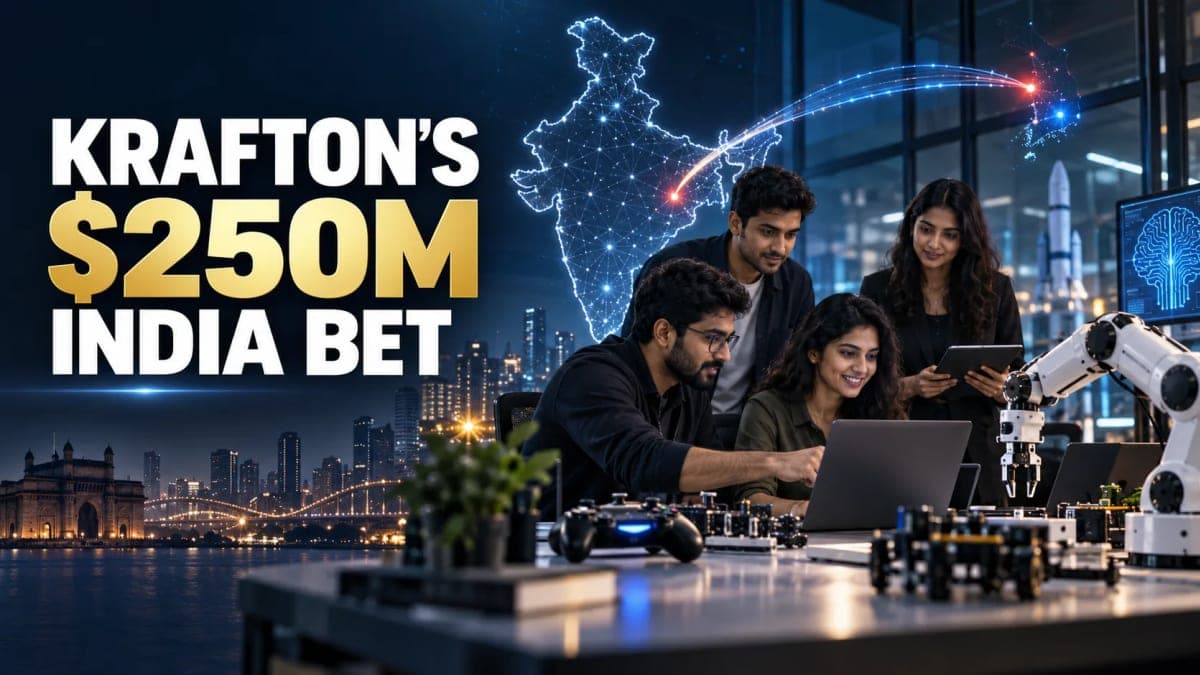
KRAFTON is significantly expanding its India strategy with a commitment to invest an additional $250 million over the next three to four years. The fresh capital will support Indian startups and locally developed intellectual property, with the South Korean company looking beyond its traditional gaming business toward artificial intelligence, robotics and deep technology.
The announcement takes KRAFTON’s planned direct investment in India to approximately $500 million. The company says it has already deployed more than $250 million in the country since 2021.
New capital broadens KRAFTON’s India strategy
Best known in India as the publisher of Battlegrounds Mobile India, or BGMI, KRAFTON has steadily developed a wider investment portfolio spanning gaming, esports, digital entertainment and consumer technology.
Its next phase will retain that connection to interactive entertainment while widening the search for opportunities. According to the company, the additional funding will support India’s gaming ecosystem, domestic intellectual property and startups working in emerging areas such as AI, robotics and deep tech.
KRAFTON has not disclosed how the $250 million will be divided among these sectors, nor has it announced individual cheque sizes or a list of prospective recipients. The commitment therefore establishes the scale and direction of its investment plan, while specific transactions will be revealed separately.
Chairman Byung Gyu Chang described India as a market with “exceptional talent across gaming, technology and innovation,” reflecting the company’s long-term confidence in the country’s digital economy. KRAFTON statement carried by PTI
Announcement follows meeting with Prime Minister Modi
The investment plan was disclosed after Chang met Prime Minister Narendra Modi in New Delhi on September 4. KRAFTON said their discussion covered opportunities for closer India–South Korea cooperation in gaming, innovation and emerging technologies.
The company linked its expansion to India’s ambition to become a global centre for creating games, digital experiences and technology-led intellectual property. That positioning is important: KRAFTON is presenting India not simply as a large market for its products, but as a development and investment base capable of producing technology for international audiences.
The meeting itself confirms high-level engagement between the company and the Indian government. It should not, however, be interpreted as an announcement of government funding, regulatory approval for future deals or guarantees about investment outcomes.
Separate $670 million growth fund adds another layer
The new $250 million commitment is separate from the India-focused growth fund established with South Korean internet company Naver and financial group Mirae Asset, KRAFTON confirmed to TechCrunch.
That fund has a target size of about $670 million. When it was announced in December 2025, KRAFTON was expected to contribute approximately $137 million at its first close. The vehicle was designed to pursue larger, growth-stage technology opportunities, while KRAFTON’s direct investments give the company another route to back businesses aligned with its strategic priorities. TechCrunch
Keeping the two pools of capital distinct matters. The latest pledge raises KRAFTON’s own planned India investment to roughly $500 million; it does not mean that the entire $670 million growth fund belongs to KRAFTON.
Existing portfolio extends well beyond game studios
KRAFTON has backed about 18 Indian companies, including four or five gaming studios, according to information the company provided to TechCrunch. Its portfolio includes esports company Nodwin Gaming, streaming platform Loco, storytelling business Pratilipi, audio platform Kuku FM and influencer-marketing company One Impression.
These investments show that KRAFTON’s diversification beyond games began before the latest announcement. Many of its portfolio companies operate in adjacent areas such as content, communities, creators and digital distribution—businesses that can benefit from some of the same consumer behaviour and mobile adoption that support gaming.
Its deeper operating presence includes Pune-based Nautilus Mobile, developer of the Real Cricket franchise. KRAFTON acquired the studio in 2025, giving it direct ownership of an Indian-developed sports-gaming property.
Talent development accompanies the investment push
Capital is only one part of KRAFTON’s local strategy. The company recently introduced KIGI Academy, an industry-academia programme intended to develop skills in game production and digital creation.
The six-month initiative, organised with IIT Madras, is designed to train 30 selected students in areas including coding, game design, art, user experience and product development. Participants are expected to receive instruction at IIT Madras and KRAFTON India’s Bengaluru headquarters. Times of India
Such programmes address a different constraint from funding. Early-stage studios need capital, but they also require experienced developers, production expertise, testing support and access to international distribution if their games are to compete globally.
India remains central despite regulatory setbacks
KRAFTON’s expansion follows a complicated regulatory history in the country. India blocked PUBG Mobile in 2020 along with other Chinese-linked applications. KRAFTON subsequently introduced BGMI as a localised title in 2021, removed Tencent Games as its Indian publisher and shifted local data infrastructure to Microsoft Azure.
BGMI was itself suspended in 2022 before being permitted to return in 2023. Despite those interruptions, the title has surpassed 260 million downloads, according to KRAFTON.
The company’s willingness to commit additional capital after those setbacks indicates that it sees India as a long-term strategic market. Its broader investment programme may also reduce its reliance on the performance of one game by giving it exposure to several parts of the technology economy.
What the commitment means for Indian founders
The immediate opportunity is not limited to gaming businesses. By naming AI, robotics and deep tech, KRAFTON has opened the door to startups developing technically demanding products with longer research and commercialisation cycles.
Its gaming background could be particularly relevant to companies working on computer graphics, simulation, intelligent virtual characters, content-generation tools and human-machine interaction. Still, KRAFTON has not confirmed that these specific fields will receive funding, so any connection remains a strategic possibility rather than an announced investment mandate.
The larger test will be execution. A $250 million allocation is a substantial statement of intent, but its effect on India’s startup ecosystem will depend on how quickly the money is deployed, the stages at which KRAFTON invests and whether portfolio companies gain meaningful access to its technical expertise and global distribution network.
For now, the announcement establishes a clear direction: KRAFTON wants its next chapter in India to extend well beyond publishing BGMI.