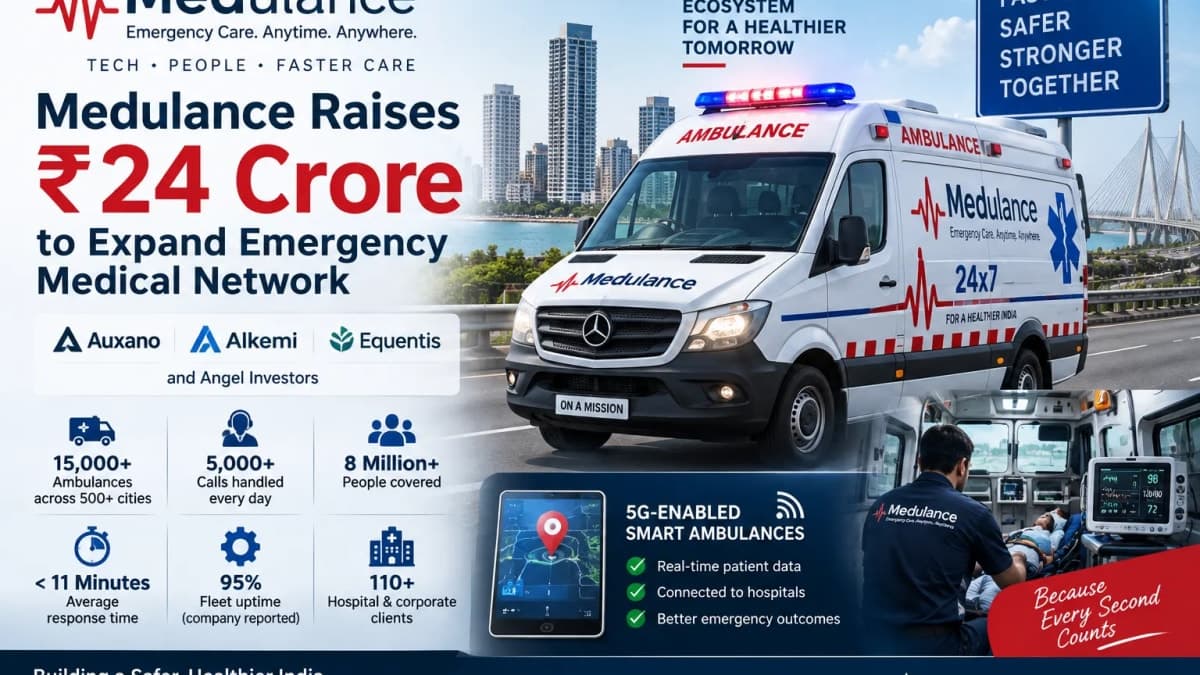
Medulance Raises ₹24 Crore to Expand Emergency Medical Network
Getting an ambulance to a patient is only one part of emergency care. The harder task is coordinating the vehicle, medical team and receiving hospital quickly enough for each of them to be useful.
Medulance has spent the past several years trying to bring those pieces onto one network. It now has another ₹24 crore to push that effort further.
The emergency healthcare company has raised the fresh capital in a Series A-2 round involving Auxano, Alkemi, Equentis and angel investors. Medulance plans to use the money to expand its emergency-response infrastructure, deepen its hospital and enterprise business and invest in technology, including connected ambulances capable of transmitting medical information while patients are in transit.
The company says its network has grown to more than 15,000 ambulances across over 500 Indian cities. It also reports handling about 5,000 calls each day.
Those figures suggest Medulance is entering a different stage of development. The immediate challenge is no longer simply putting more ambulances onto a digital network. It is making a large, distributed fleet operate consistently as part of the healthcare system.
An Ambulance Network Built Around Coordination
Pranav Bajaj and Ravjot Singh Arora founded Medulance in 2017, initially focusing on making ambulances easier to find during emergencies.
The business has broadened considerably since then.
Medulance now provides advanced life support ambulances, basic life support vehicles, patient transport and mortuary vans. Its customers range from individuals seeking emergency assistance to hospitals, companies and government organisations.
A centralised technology platform coordinates that network, using dispatch and location systems to identify and send available vehicles.
That sounds straightforward until the realities of emergency transport are considered.
A vehicle must be close enough to reach the patient quickly. It needs the appropriate equipment and personnel for the case. Once the patient is aboard, the crew must know where to go, while the receiving hospital may need time to prepare for the patient's condition.
Each handoff creates another opportunity for delay.
Medulance's longer-term proposition is therefore based less on booking an ambulance than on reducing the friction between those stages.
The Next Ambulance Could Be Connected to the Hospital
The company's investment in 5G-enabled smart ambulances is one of the more important uses of the new funding.
A connected ambulance can transmit patient information to doctors while travelling to the hospital. Depending on the equipment installed, that could include vital signs and other clinical data as well as a live communication link between the ambulance crew and medical staff.
The practical value lies in what happens before the vehicle reaches the hospital doors.
If emergency teams receive useful information while the patient is still travelling, they can prepare staff, equipment and treatment pathways in advance. In some cases, doctors may also be able to guide the ambulance team remotely.
That pushes the ambulance closer to being a mobile part of the emergency department rather than simply a vehicle carrying someone towards it.
Technology, however, does not eliminate the basic requirements of emergency medicine. Connected systems are useful only if the ambulance arrives promptly, its equipment works and trained personnel are available to use it.
Medulance Says Its Fleet Has Doubled Since 2023
The scale of the network has changed quickly.
In 2023, Medulance reported access to more than 7,500 ambulances across over 500 cities. The company was handling roughly 1,000 service requests per day at the time.
Its latest figures put the fleet above 15,000 ambulances, with daily call volumes around 5,000.
The number of cities has not increased at the same pace.
That is potentially significant for an emergency-response business. Adding vehicles within existing markets can be just as important as putting a pin on another city.
Ambulance response depends heavily on density. A service may technically cover a city, but that means little to a patient if the nearest available vehicle is too far away.
More vehicles within an existing service area can improve the chances of having an appropriate ambulance nearby when a request arrives.
Medulance says its network currently reaches more than 8 million people, with an average response time below 11 minutes and fleet uptime of 95%.
Those performance figures are reported by the company and should not be read as independently verified national benchmarks.
Local Ambulance Operators Are Part of the Model
Medulance's scale does not come from owning all 15,000-plus ambulances itself.
Its model combines technology and centralised coordination with vehicles supplied through a wider network of ambulance operators.
That approach is well suited to the structure of India's market.
Ambulance services are fragmented among government schemes, hospitals, private fleets and smaller local providers. Building an entirely new nationwide fleet would require enormous capital and would duplicate vehicles that already exist.
A network model offers another option: bring existing capacity onto a common dispatch system and attempt to make it easier to find, coordinate and monitor.
It also creates a different operational problem.
When vehicles belong to multiple operators, maintaining common standards becomes harder. Equipment, vehicle condition, crew training and response performance all have to remain dependable as the network expands.
For Medulance, the quality of those individual journeys will ultimately matter more than the headline number of ambulances connected to its platform.
Hospitals and Companies Offer More Predictable Demand
Medulance is also putting some of the new capital behind its institutional business.
The company says it works with more than 110 hospital and corporate clients.
Those relationships can be commercially important because emergencies are inherently unpredictable. Ambulances and medical teams need to remain ready whether or not a call arrives.
Hospital and corporate contracts introduce a degree of recurring demand into that equation.
For employers, an arrangement can provide organised emergency medical support for staff and facilities. Hospitals can use external ambulance networks to extend transport capacity without maintaining every vehicle themselves.
For Medulance, those contracts also provide another route into the healthcare system beyond one-off consumer bookings.
The result is a business increasingly split between two roles: responding directly to people who need an ambulance and supplying emergency-response infrastructure to organisations that need vehicles available before an emergency occurs.
The Company Has Raised About $5 Million
Medulance says it has now secured approximately $5 million across two funding rounds.
Its previous institutional financing included a $3 million Series A round in 2024, led by Alkemi Growth Capital.
The company also became familiar to a wider audience after Bajaj and Arora appeared on Shark Tank India Season 2.
The latest round arrives with Medulance at a more mature point than its earlier fundraising. Its fleet is larger, call volumes have increased and the company is attempting to add more clinical connectivity to the network.
Bajaj, Medulance's co-founder and CEO, described that expansion as an early stage of a much larger plan.
“Emergency healthcare is ultimately about ensuring that help is available when it matters the most. Medulance has come a long way, but in terms of what it can become, we are still only 1 per cent done.”
India's Ambulance Problem Is Bigger Than Vehicle Supply
The opportunity Medulance is pursuing comes from a persistent weakness in India's emergency-care system.
Availability is uneven. Different ambulance networks do not necessarily communicate with one another. Hospitals may operate their own vehicles, government schemes run separate services and local private providers serve individual markets.
That fragmentation can leave patients trying to locate help at the moment when they have the least time to do so.
A technology platform can improve visibility and dispatch. A sufficiently dense network can reduce the distance between an available vehicle and the patient. Connected ambulances can give hospitals earlier information about who is arriving.
But emergency healthcare is ultimately an operational business.
A well-designed app cannot compensate for a poorly equipped ambulance. A large network does not guarantee a short response time in every neighbourhood. A 5G connection has limited value if the receiving hospital cannot act on the information it receives.
Medulance's challenge is to make all of those components work together reliably.
The ₹24 Crore Question Is About Execution
The latest round gives Medulance additional resources, but the company is trying to build nationwide healthcare infrastructure with a model that must remain relatively capital-efficient.
That explains the appeal of its network approach.
Rather than owning every vehicle, Medulance can connect existing operators, add technology and centralise parts of dispatch and coordination. The model allows faster expansion without requiring the company to finance an entirely new ambulance fleet.
The trade-off is control.
As Medulance grows, investors, hospitals and patients will have reason to look beyond fleet size. Response times, availability, clinical standards and consistency across partner-operated vehicles will provide a clearer picture of how well the network performs.
The company has already demonstrated that it can aggregate substantially more ambulance capacity than it had three years ago.
Its next test is harder.
In emergency medicine, the number that matters most is not how many ambulances sit on a platform. It is how quickly the right one reaches the patient and how effectively the system takes over from there.