Google Introduces ‘Pics’ AI Design Tool to Challenge Canva and Adobe Express
Google is expanding deeper into creative software with Google Pics, an AI-first image generation and editing application designed to make professional-looking visual creation accessible without requiring traditional graphic-design skills.
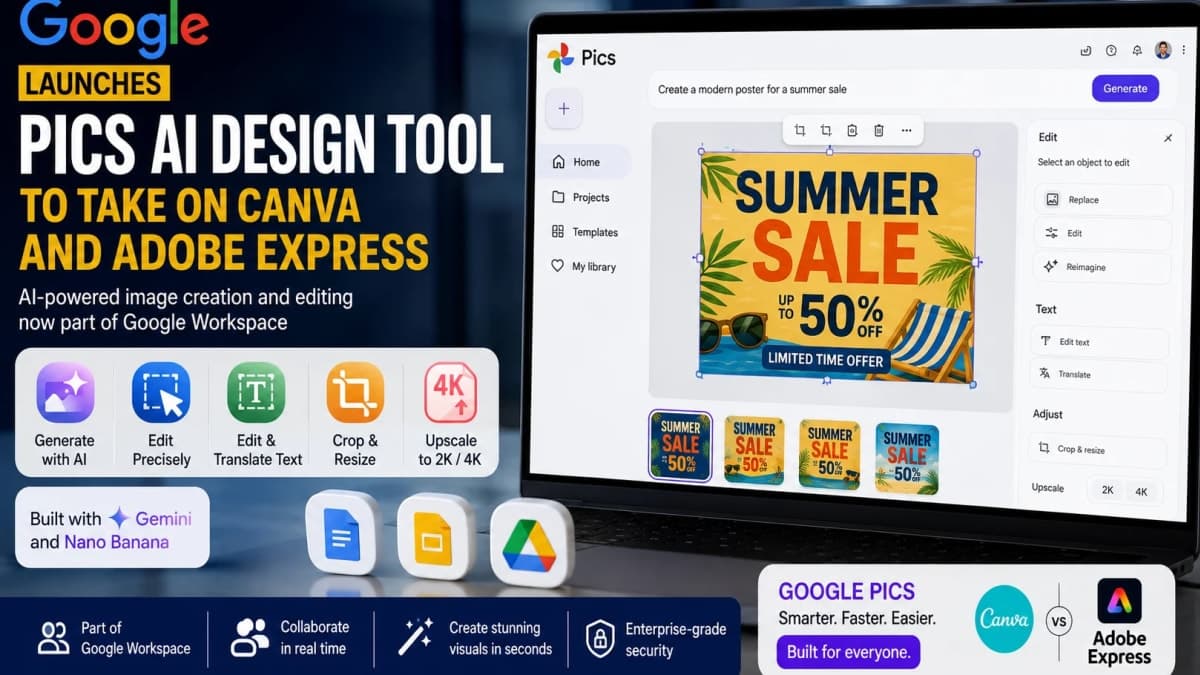
The new tool is being rolled out as part of Google Workspace and allows users to generate an image simply by describing what they want. They can then modify individual objects, change or translate text, crop designs for different formats and upscale images—all within an AI-focused editing environment.
Google says Pics is rolling out over the coming weeks to Google AI Pro and Ultra subscribers and most eligible Workspace business customers. Its arrival places Google more directly against established visual-creation platforms such as Canva and Adobe Express.
What Is Google Pics?
Google Pics is essentially an AI-native canvas for generating and manipulating images.
Users can start with a blank project and type a prompt describing the visual they want. Alternatively, they can import an existing image from their computer, Google Drive or Google Photos and use AI to modify it.
The technology is powered by Gemini and Google's Nano Banana image-generation and editing model. Google first announced Pics during Google I/O in May 2026 as part of a broader expansion of AI capabilities across Workspace.
Rather than forcing users to repeatedly regenerate an entire picture when one detail is wrong, Google is emphasizing more granular control over the generated result.
That distinction is central to the product's pitch.
Google Pics Turns Prompts Into Finished Visuals
A user could, for example, ask Pics to generate a promotional poster, event flyer, social-media graphic or digital illustration.
Pics can produce several alternatives from a prompt, allowing the user to select a preferred result before continuing to refine it.
The workflow effectively shifts part of the creative process from manually arranging graphical elements toward describing a desired outcome to AI and refining what it produces.
Google describes this approach as giving users creative control without the repetitive trial-and-error often associated with generative image tools.
Object-Level AI Editing Is a Major Feature
Pics is not limited to generating complete images.
Google has equipped the application with object-level editing capabilities that allow users to select individual elements within an image and modify them independently.
Among its confirmed capabilities, Google says users can:
Generate and refine images through text prompts; select and modify individual objects; edit, reformat or translate text inside images; crop visuals for web, social media, digital or print use; upscale images to 2K or 4K; perform multiple edits together; and revert unwanted changes.
Pics can also use existing images as style or element references, giving users another way to direct the visual output beyond text prompts alone.
Google Is Bringing Pics Directly Into Workspace
One of Google's strongest potential advantages is distribution.
Instead of positioning Pics solely as an independent creative application, Google is integrating its capabilities with software already used by Workspace customers.
Pics-powered image editing is available through Google Docs and Google Slides, while Google says integration with Drive is also planned.
That could be particularly significant for businesses.
An employee preparing a presentation, report or marketing document may be able to generate or edit the required visual without moving through several separate applications.
Google says Pics also supports collaboration, allowing multiple people to work together on designs.
Who Can Use Google Pics?
The rollout began on September 1, 2026.
Google says Pics is available for several paid account categories, including Business Standard and Business Plus, Enterprise Standard and Enterprise Plus, Google AI Pro and Ultra, Google AI Pro for Education, and AI Expanded Access.
For Rapid Release Workspace domains, Google said the gradual rollout could take up to 15 days from September 1. Scheduled Release domains are due to begin their gradual rollout on September 15.
Google's support documentation currently lists Pics as a desktop feature.
Generative AI functionality is also subject to usage limits. Google says eligible users will receive higher access to Pics' generative features at least through February 28, 2027, after which access levels could change.
Google Pics vs Canva: Different Approaches to Design
The comparisons with Canva are understandable, but Pics is not simply a direct copy of Canva's existing model.
Canva has built a broad visual-design ecosystem around templates, drag-and-drop editing, stock content, collaboration and a marketplace where creators can contribute assets.
Google Pics starts from a more explicitly AI-first premise: tell the software what you want, generate it and then manipulate the resulting elements.
This means Google's biggest opportunity may not initially be persuading professional designers to abandon their existing software.
Instead, Pics could appeal strongly to the much larger group of people who need designs but do not consider themselves designers—including marketers, small-business teams, sales employees, educators and office workers.
Google Pics vs Adobe Express
Adobe Express similarly targets users who need to quickly produce social-media graphics, promotional materials and other everyday visual content.
Google's differentiation again centres on AI generation combined with Workspace integration.
The competitive pressure is also broader than one application. Google is increasingly embedding Gemini-powered generation throughout productivity software, while Adobe has been integrating generative AI across its own creative ecosystem.
Pics therefore represents another stage in a larger contest over where AI-assisted creative work will happen: inside dedicated design platforms or directly inside everyday productivity suites.
Google itself has not framed every Pics capability as a direct replacement for Canva or Adobe's complete creative platforms. Claims that it will “kill” or replace either competitor would therefore go beyond the confirmed facts.
Why Google Pics Matters
The most consequential aspect of Pics may be its placement inside Workspace rather than any single image-generation feature.
Google says more than four billion users rely on Workspace applications such as Gmail, Docs and Drive.
Not all of those users will have access to Pics, since availability currently depends on eligible paid plans. Still, Google already owns many of the applications where businesses ultimately use graphics—documents, presentations and cloud storage.
Adding AI image creation directly to that environment could reduce the need to move between a productivity application and an external design tool for relatively simple creative jobs.
For Canva and Adobe, that creates a different kind of competition. Google does not necessarily need Pics to become the world's most sophisticated design application; making it sufficiently capable and convenient for everyday business graphics could itself make the product significant.
The launch also illustrates a wider change taking place across generative AI. The industry is moving beyond tools that simply create an entire image from a prompt toward systems that let users generate, select, manipulate and collaboratively refine individual elements.
Google Pics is the company's latest attempt to make that workflow part of ordinary office work.