A Viral Video Brings Automation Into an Unexpected Craft
A short video shared by industrialist Harsh Goenka has brought an unlikely profession into the conversation around automation.
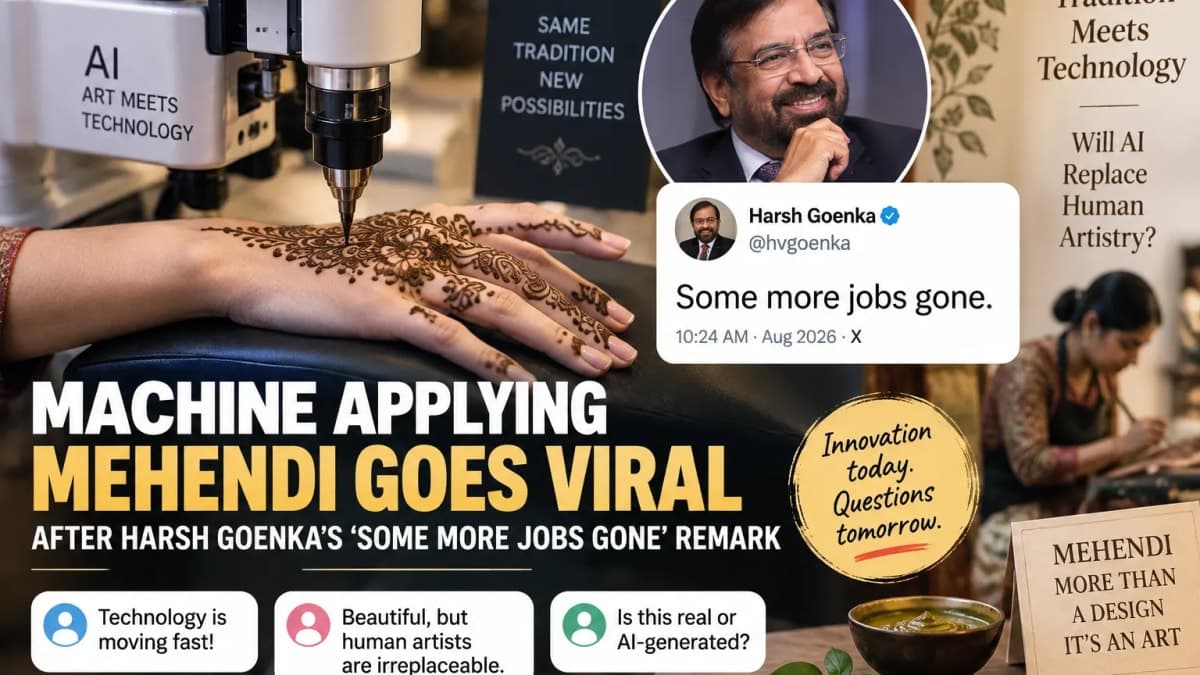
The footage appears to show a machine applying an intricate mehendi design directly onto a woman's hand, reproducing in seconds the kind of detailed work usually associated with skilled artists. Goenka, chairman of the RPG Group, posted the clip on X with four words: “Some more jobs gone.”
The comment quickly became as important as the video itself. Some viewers saw the machine as another example of technology moving into skilled manual work. Others argued that mehendi involves creativity, personalisation and human interaction that cannot be reduced to how quickly a pattern can be applied.
There is also a more immediate question surrounding the clip: whether the machine shown in it is real.
The footage has not been independently authenticated, according to published reports, and some social-media users have suggested it may have been created or manipulated using artificial intelligence.
What the Video Appears to Show
The device in the clip seems to work much like an automated printing system. A hand is positioned beneath the machine while a mechanism moves across it, apparently dispensing henna to form a detailed pattern.
If genuine, such technology would offer an obvious advantage in speed. Standardised designs could potentially be reproduced with less manual effort than conventional mehendi application.
But the video does not establish that the machine is commercially available, capable of consistently producing the same results or being used at scale.
Those distinctions matter. A striking demonstration on social media is not evidence that an occupation is already being displaced.
The post nevertheless travelled quickly online. Moneycontrol reported that it accumulated more than two lakh views within hours, giving Goenka's comment a much larger audience.
‘Some More Jobs Gone’ Changes the Conversation
Without Goenka's caption, the clip might have circulated primarily as a curiosity.
“Some more jobs gone” placed it in a different context.
Automation has spent decades replacing or reducing certain repetitive tasks in manufacturing. More recent advances in artificial intelligence and robotics have widened concerns to professions involving language, design, customer service and other forms of skilled work.
Mehendi artistry does not fit neatly into either category.
Applying henna requires precision, but professional artists also modify designs, respond to customer requests and make creative decisions as they work. Weddings and festivals can add a social dimension to the service that a machine reproducing a predetermined pattern would not necessarily provide.
That helps explain why some viewers rejected the idea that the technology automatically threatens the profession.
Speed Is Not the Same as Craft
A machine capable of accurately reproducing a fixed design could still have commercial value.
Customers looking for a quick, standard pattern might find automated application attractive, particularly if it were inexpensive and reliable. Businesses handling large numbers of customers could also see an advantage in faster service.
More elaborate work presents a different challenge.
Experienced mehendi artists routinely adapt patterns to the shape of a hand, combine different design elements and respond to requests while applying the henna. Bridal mehendi, in particular, can involve extensive customisation and hours of work.
The relevant question, then, is not simply whether a machine can draw a pattern. It is which parts of the service can realistically be automated without losing what customers value about the human version.
At present, the viral clip provides no evidence that professional mehendi artists are actually losing work because of such machines.
Viewers Raise Doubts About the Footage
The authenticity debate adds another layer to the story.
Some social-media users examining the video questioned whether the machine was functioning as presented. Among the concerns raised were the apparent mechanics of positioning and aligning a detailed design precisely with the hand.
Others suggested the footage could be AI-generated.
No independent technical verification accompanying the viral post has established that the device works as shown. That means the safest description is that the video appears to depict an automated mehendi machine rather than treating its capabilities as confirmed.
The uncertainty is significant because highly realistic AI-generated video has made visual evidence increasingly difficult to assess on appearance alone.
A clip can now start a serious discussion about the consequences of a technology before viewers have established whether the particular demonstration they are watching is authentic.
Goenka Has Raised Automation Concerns Before
The theme behind the post is not new for Goenka.
He has previously commented publicly on artificial intelligence, robotics and the possibility that machines could take over a growing share of human labour.
His mehendi post brought that concern into a setting far removed from the factories and offices normally associated with automation.
It also illustrates why predictions about job losses require more than evidence that a machine can perform a task.
Technology can eliminate some roles, change others and create demand for different skills. Its impact depends on cost, reliability, consumer preferences and how widely businesses adopt it.
None of those factors can be determined from this video alone.
The More Immediate Story Is About Trust
The clip ultimately raises two separate issues.
One is familiar: how much skilled work machines may eventually perform and what that could mean for people whose livelihoods depend on those skills.
The other is newer and arguably more immediate. As synthetic video becomes more convincing, viewers increasingly have to establish whether a technological breakthrough shown on their screens exists before debating what it might do to society.
Goenka's remark captured the first concern in four words. The reaction to the video exposed the second.
Until the device and footage are independently verified, predictions about the end of mehendi jobs run well ahead of the available evidence.