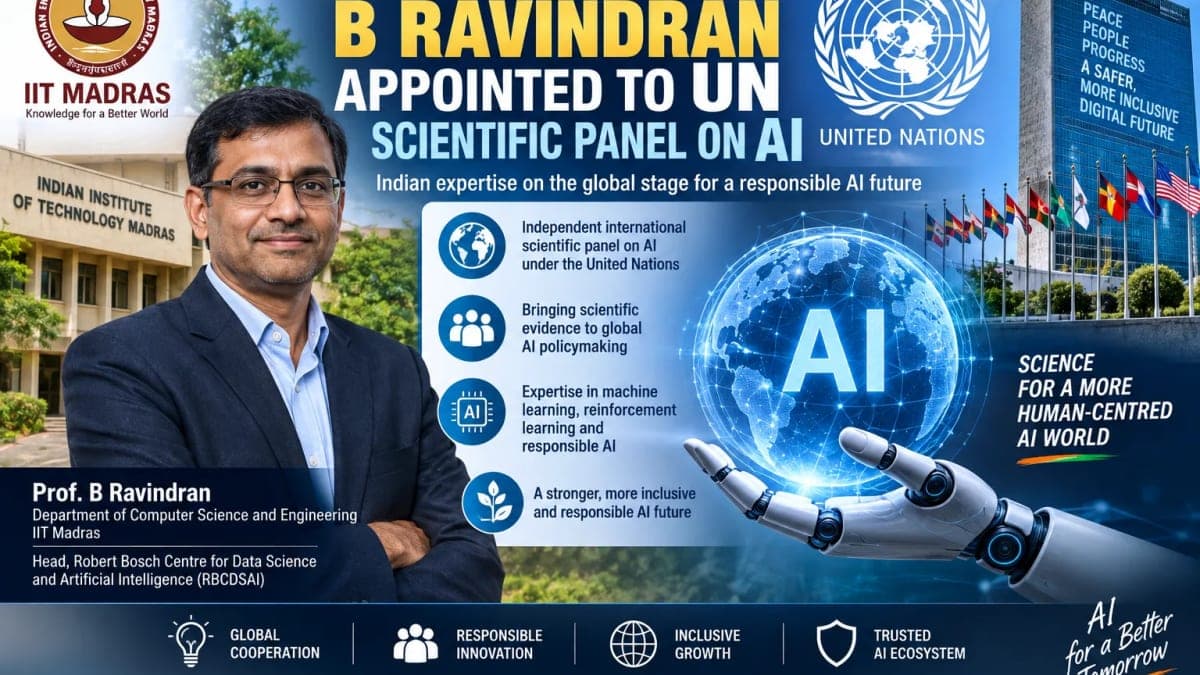
IIT Madras Professor B Ravindran Appointed to UN Scientific Panel on AI
Introduction
Professor B Ravindran of the Indian Institute of Technology Madras has been appointed to the United Nations' Independent International Scientific Panel on Artificial Intelligence, giving one of India's prominent AI researchers a role in an emerging global mechanism for assessing the rapidly evolving technology.
Ravindran is a professor in IIT Madras' Department of Computer Science and Engineering and heads the institute's Robert Bosch Centre for Data Science and Artificial Intelligence (RBCDSAI). His research has spanned reinforcement learning, machine learning and responsible artificial intelligence.
His appointment places an Indian academic voice within a panel intended to provide independent scientific assessments of AI developments, their potential impact and associated risks.
What Is the UN Scientific Panel on AI?
The Independent International Scientific Panel on Artificial Intelligence emerged from the UN's broader effort to create mechanisms for international AI governance.
The panel is designed to strengthen the connection between scientific evidence and global policymaking at a time when artificial intelligence is advancing faster than many existing regulatory systems.
Rather than functioning as a global AI regulator, the panel's role is scientific and advisory.
Its work is expected to help policymakers better understand developments in AI, identify areas where scientific consensus exists and highlight issues where evidence remains uncertain or contested.
That distinction matters because governments around the world are taking different approaches to AI regulation. An independent scientific mechanism can provide a common evidence base without replacing national regulatory authority.
Ravindran Brings Extensive AI Research Experience
Ravindran has built a substantial academic career around artificial intelligence and machine learning.
At IIT Madras, he leads RBCDSAI, an interdisciplinary research centre working across data science and AI. The centre's research extends into areas including responsible AI and the application of artificial intelligence to real-world problems.
Ravindran's own research is particularly associated with reinforcement learning, a branch of machine learning in which systems learn how to make decisions through interaction and feedback.
His academic work has also addressed responsible AI, an increasingly important field as powerful AI systems move from research laboratories into healthcare, finance, education, public services and consumer applications.
Why the Appointment Matters for India
Ravindran's inclusion gives India representation in a scientific process that could influence how policymakers internationally understand the benefits and risks associated with artificial intelligence.
India has emerged as both a major market for AI technology and a growing centre for AI research, development and deployment.
That creates a distinctive policy perspective.
Much of the global debate surrounding AI has been shaped by the United States, Europe and China, where many of the world's largest technology companies and frontier AI laboratories are concentrated. India, by contrast, combines a large digital population with substantial linguistic diversity, a growing technology sector and extensive digital public infrastructure.
Those conditions raise questions around AI that are not always identical to those confronting wealthier economies.
They include access to technology, linguistic inclusion, affordability, skills, employment effects and the responsible deployment of AI across large and diverse populations.
Having researchers familiar with those conditions involved in international scientific discussions can broaden the evidence considered in global AI policymaking.
Scientific Advice Becomes More Important as AI Advances
The appointment comes as governments and international institutions grapple with increasingly capable AI systems.
Generative AI has expanded rapidly across consumer and enterprise applications, while advances in reasoning systems, AI agents and multimodal models are increasing the range of tasks machines can perform.
At the same time, researchers and policymakers are examining risks involving misinformation, bias, cybersecurity, privacy, labour-market disruption and the reliability of increasingly autonomous systems.
There are also disagreements about the scale and urgency of some AI risks.
A scientific panel therefore faces a difficult task: distinguishing established evidence from projections, identifying genuine areas of consensus and clearly communicating where substantial uncertainty remains.
That approach is particularly important in AI, where commercial competition and rapid technological change can make long-term predictions unreliable.
UN Pushes for More International Cooperation on AI
The scientific panel forms part of a broader UN effort to build international cooperation around artificial intelligence.
The UN General Assembly adopted the Global Digital Compact in September 2024 as part of the Pact for the Future. Among its AI-related commitments were steps toward establishing an independent international scientific panel and creating a global dialogue on AI governance.
The objective is not to impose a single regulatory system on every country but to create forums in which governments, researchers and other stakeholders can address challenges that cross national borders.
AI is particularly suited to such cooperation because models, digital services, data flows and potential harms are rarely confined to one jurisdiction.
A Link Between AI Research and Global Policy
Ravindran's appointment also illustrates the growing role academic researchers are playing in international technology policy.
Questions about AI governance increasingly require expertise extending beyond computer science. Policymakers must consider economics, law, ethics, security, social consequences and human rights alongside the technical capabilities of AI systems.
Scientific experts can contribute by separating what current systems demonstrably can do from assumptions about what future systems might become capable of doing.
For researchers such as Ravindran, that means translating highly technical developments into evidence that can be understood and used by policymakers.
India's Role in the Global AI Debate Is Growing
India's participation in global AI governance has expanded alongside the country's ambitions in artificial intelligence.
The country is developing domestic AI capabilities while simultaneously advocating approaches that account for the needs of developing economies and the Global South.
Ravindran's inclusion on the UN scientific panel adds an academic dimension to that participation.
It also puts IIT Madras and Indian AI research into a forum whose work could help shape how governments understand one of the most consequential technological shifts of the decade.
The panel's influence will ultimately depend on the quality and independence of its scientific assessments and on how governments use its findings.
For India, however, the appointment provides an opportunity for experience from one of the world's largest and most diverse digital societies to become part of the international scientific conversation surrounding AI.