India has one of the strongest growth rates among major economies, corporate earnings have improved, investment is strengthening and domestic investors continue pouring money into mutual funds.
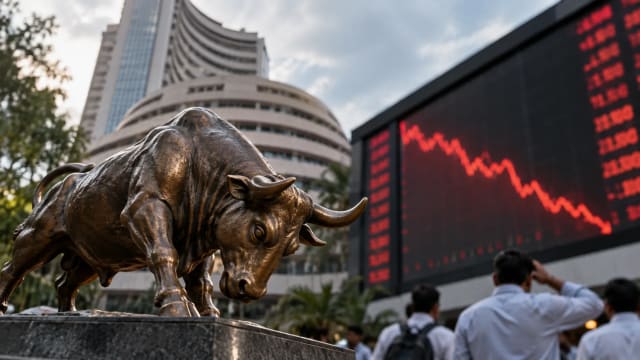
Yet foreign institutional investors—more formally classified today as foreign portfolio investors (FPIs)—have been persistent sellers of Indian equities in 2026.
At first glance, the two developments seem contradictory.
They aren't.
India's real GDP grew 7.8% year-on-year in April–June 2026, according to India's official statistics agency, beating expectations. At the same time, foreign investors had withdrawn a record $24.6 billion from Indian equities during 2026 through August, despite returning strongly in August itself.
The reason is one of the most important concepts for investors to understand:
A fast-growing economy and an attractively priced stock market are not the same thing.
Foreign fund managers are not deciding whether India's economy is “good” or “bad.” They are deciding whether Indian stocks offer a better risk-adjusted return than alternatives available around the world.
Right now, that calculation is being influenced by at least five forces.
First, the economy really is growing strongly
The premise behind the question is correct.
India's real GDP expanded 7.8% in the first quarter of FY2026–27, according to the Ministry of Statistics and Programme Implementation.
The composition was also encouraging.
Investment strengthened, manufacturing remained resilient and financial, real-estate and professional services expanded strongly. Gross fixed capital formation increased, while Reuters reported signs that private-sector investment is broadening beyond the government-led infrastructure cycle.
That makes it difficult to explain foreign selling simply by saying:
“India's economy is weak.”
The evidence doesn't support that explanation.
Instead, investors need to look at the difference between economic growth and investment returns.
1. India's strong growth was already expensive
Imagine two companies.
Company A is growing earnings at 15% but trades at a very high valuation.
Company B is growing earnings at 12% but trades at a much cheaper valuation.
The faster-growing company isn't automatically the better investment.
The same logic applies across markets.
India has commanded a significant valuation premium to many emerging-market peers. When investors expect exceptional long-term growth, they are willing to pay more for Indian earnings.
But the higher the starting valuation, the stronger future earnings need to be to justify that price.
This has become especially relevant in 2026.
A Reuters poll in August found analysts repeatedly reducing their Indian equity-market forecasts as foreign funds looked for better value elsewhere in Asia. The same report noted that India was growing at close to 8% and Nifty companies had delivered strong profit growth—yet overseas investors had still sold roughly $25 billion of Indian shares during the year.
That isn't necessarily a rejection of India's economy.
It can simply mean:
Foreign investors like India, but not every Indian stock at every valuation.
2. The AI boom gave global investors attractive alternatives
This is one of the less obvious explanations for India's FPI problem.
International investors don't evaluate India in isolation.
They compare it with:
Taiwan
South Korea
China
Japan
the United States
other emerging markets
global bonds
and many other asset classes.
During 2026, Taiwan and other technology-heavy Asian markets benefited substantially from global enthusiasm around artificial intelligence and semiconductors.
In August alone, Taiwan attracted $11.15 billion of foreign equity inflows, while India received about $3.1 billion, according to data compiled by Reuters.
India's stock market has excellent businesses in banking, consumer goods, infrastructure, pharmaceuticals, industrials and IT services.
What it doesn't have in comparable scale is the kind of semiconductor-heavy exposure that made parts of North Asia a direct beneficiary of the enormous global AI infrastructure boom.
That created an opportunity-cost problem.
A global fund manager could remain optimistic about India while reallocating part of the portfolio toward markets offering stronger immediate exposure to AI hardware.
This is portfolio rotation—not necessarily loss of faith in India.
3. The rupee changes foreign investors' actual returns
This is another major difference between Indian and foreign investors.
An Indian investor measures returns primarily in rupees.
A U.S. investor ultimately cares about returns in dollars.
Suppose an overseas fund buys an Indian stock for ₹100.
A year later it is worth ₹110.
That's a 10% gain in rupee terms.
But if the rupee depreciates significantly against the dollar during the same period, the investor's dollar return will be considerably smaller.
That currency risk has become more important in 2026.
The rupee suffered its sharpest weekly fall in four months last week, declining 1.1% to ₹95.55 per dollar.
On September 15 it weakened further, closing around ₹95.96 per dollar, as oil prices and expectations of tighter U.S. monetary policy pressured Indian assets.
India's foreign-exchange reserves remain substantial—Reuters reported a record level around $785 billion—giving the Reserve Bank of India considerable capacity to manage excessive volatility.
But currency risk still affects the return calculation for foreign portfolio investors.
4. Oil above $100 is particularly uncomfortable for India
India's economic strength doesn't eliminate one major vulnerability:
crude oil.
India is a large oil importer.
Brent crude climbed to around $108.20 a barrel on September 15, amid global supply and geopolitical concerns.
India's own crude basket averaged $90.19 a barrel in August but had risen to $109.76 in September, according to government trade data reported by Reuters.
That's a substantial change in only a few weeks.
Higher oil can affect India through several channels:
larger import costs → inflation pressure → rupee pressure → higher corporate costs → tighter monetary-policy expectations.
The inflation effect is already worth watching.
India's consumer inflation accelerated to 4.82% in August from 4.45% in July, while core inflation also strengthened.
None of this means India's 7.8% growth suddenly disappears.
It means the risk surrounding future returns has increased.
5. U.S. bonds suddenly offer much more competition
Foreign investors have another option that Indian retail investors sometimes overlook:
They don't have to buy equities at all.
U.S. Treasury yields have risen sharply. On September 14, the U.S. 10-year Treasury yield moved above 5%, while global bond yields reached multi-year highs.
That changes the investment equation.
A global portfolio manager deciding between an emerging-market equity and a U.S. government bond asks:
How much additional return am I being compensated for taking additional risk?
If relatively low-credit-risk government bonds offer much higher yields, the required return from equities also rises.
Indian stocks then face competition not merely from Korean or Taiwanese stocks, but from bonds.
This is why rising U.S. yields frequently matter for emerging-market capital flows.
But August proves foreign investors haven't simply rejected India
There is a particularly useful piece of evidence against the idea that FPIs have permanently lost confidence in India.
They came back.
Foreign investors purchased $3.1 billion of Indian equities in August, their largest monthly inflow in 23 months.
The return followed four consecutive months of selling and was supported by improved corporate earnings and greater currency stability.
Across seven major Asian markets, foreign investors bought a net $4.72 billion of equities in August, ending a nine-month regional selling streak.
If India's growth story itself had become fundamentally unacceptable to foreign investors, such a rapid return would be harder to explain.
Instead, August reinforces a different interpretation:
Foreign capital remains willing to buy India when valuations, earnings, currency conditions and global alternatives produce an attractive risk-reward equation.
September changed several of those conditions again.
GDP growth and stock-market returns measure different things
This distinction deserves more attention.
GDP measures the value of economic activity occurring across a country.
A stock index measures the market value of a particular group of listed companies.
The relationship between the two is real—but imperfect.
A country can have:
high GDP growth + expensive equities = mediocre stock returns
or:
slower GDP growth + cheap equities + improving profits = strong stock returns.
There are several reasons.
Stock prices depend on future earnings, interest rates, valuations, liquidity and expectations—not simply today's GDP number.
And markets are forward-looking.
If investors already expected 7–8% growth when they bought a stock, confirmation of that growth doesn't necessarily create a new reason to pay an even higher valuation.
This explains much of the apparent contradiction surrounding India in 2026.
Domestic investors are changing the market at the same time
There is another major development occurring beneath the FPI headlines.
Indian households continue putting extraordinary amounts of money into mutual funds.
According to the Association of Mutual Funds in India, monthly SIP contributions reached a record ₹32,297 crore in August 2026, while there were more than 10.75 crore outstanding SIP accounts.
This domestic capital is important.
It means foreign selling does not automatically translate into an equivalent collapse in Indian equity demand.
India's market is increasingly experiencing something like:
FPIs selling ↔ DIIs/retail investors buying
That helps explain why understanding only the foreign-flow number can give investors an incomplete picture of the market.
The contradiction disappears when you look at what FPIs actually optimise
Put the pieces together.
India offers:
7.8% economic growth
strengthening private investment
a large domestic market
strong household investment flows
But foreign investors simultaneously face:
relatively expensive Indian equities
alternative opportunities in AI-heavy Asian markets
a weaker rupee
oil above $100
higher U.S. bond yields
greater global geopolitical uncertainty
The decision isn't:
“Is India growing?”
It is:
“Given everything available globally today, does adding another dollar to Indian equities offer the best risk-adjusted return?”
Those are fundamentally different questions.
What would bring FIIs back?
August gives us some clues.
The probability of sustained foreign buying would likely improve if several things happened together.
Oil falls: Lower crude would reduce pressure on India's import bill, inflation and currency.
The rupee stabilises: Lower currency risk improves foreign investors' dollar returns.
U.S. yields decline: Emerging-market equities become relatively more attractive.
Indian earnings continue improving: Strong earnings can make current valuations easier to justify.
Valuations become more attractive: Either prices fall, earnings rise, or both.
India offers competitive sector opportunities: Stronger exposure to manufacturing, electronics, AI infrastructure, financials and other structural-growth areas could improve India's position relative to alternative Asian markets.
None individually guarantees foreign buying.
Together, however, they would materially improve the investment equation.
So why are FIIs selling despite India's economic growth?
The most accurate answer is:
Because FIIs buy expected investment returns—not GDP growth itself.
India's 7.8% GDP growth is real and strong.
So is the record foreign selling seen during much of 2026.
Those facts can coexist.
High valuations, competition from AI-oriented Asian markets, rupee depreciation, expensive crude and sharply higher global bond yields have all made the relative risk-reward equation less straightforward for overseas investors.
And August's $3.1 billion comeback shows why calling the situation an outright foreign-investor “exit from India” would go too far.
Foreign capital has demonstrated that it can return rapidly when conditions improve.
For investors, therefore, the FII number is the symptom.
Valuations, earnings, oil, the rupee, U.S. yields and relative opportunities elsewhere are the variables worth watching.