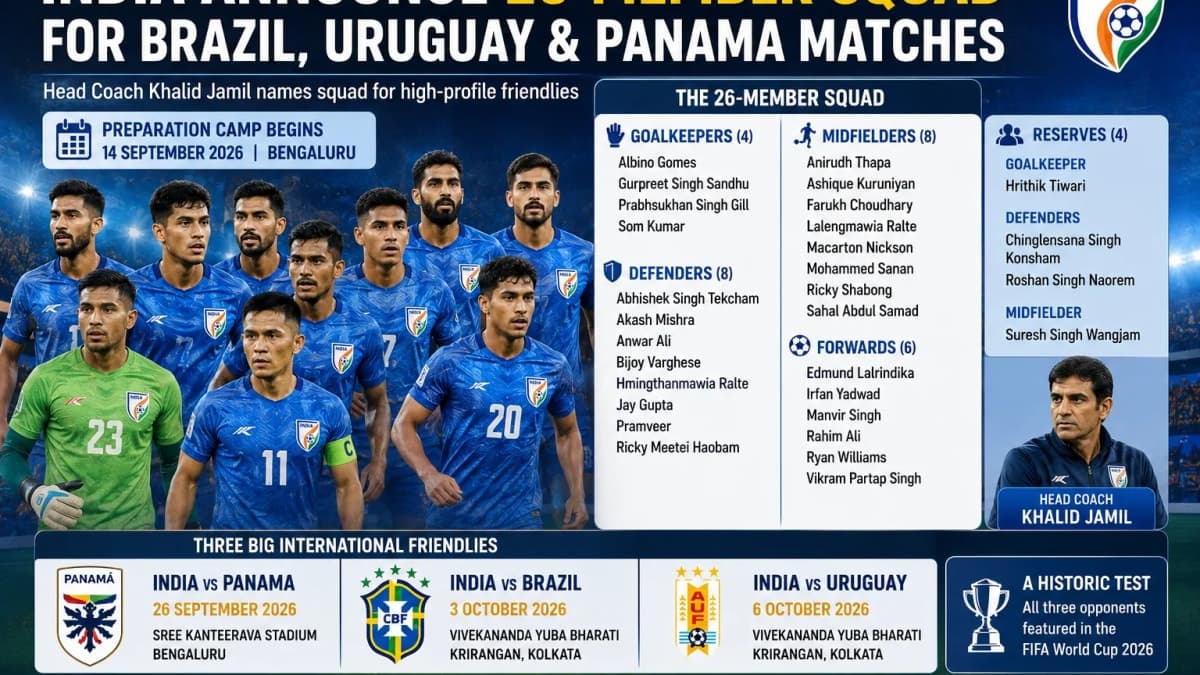
India Announce 26-Member Football Squad for Brazil, Uruguay and Panama Friendlies
Introduction
The Indian men's football team is preparing for one of its most demanding international windows in recent years after head coach Khalid Jamil named a 26-player squad to face Panama, Brazil and Uruguay.
India will begin against Panama at Bengaluru's Sree Kanteerava Stadium on September 26 before moving to Kolkata for two marquee fixtures.
The Blue Tigers will face five-time FIFA World Cup champions Brazil on October 3 and two-time champions Uruguay on October 6 at the Vivekananda Yuba Bharati Krirangan, popularly known as Salt Lake Stadium.
All three opponents featured at the 2026 FIFA World Cup, giving India an unusual opportunity to measure itself against teams accustomed to competing at football's highest international level.
India’s Full 26-Member Squad
Goalkeepers
Albino Gomes, Gurpreet Singh Sandhu, Prabhsukhan Singh Gill, Som Kumar
Defenders
Abhishek Singh Tekcham, Akash Mishra, Anwar Ali, Bijoy Varghese, Hmingthanmawia Ralte, Jay Gupta, Pramveer, Ricky Meetei Haobam
Midfielders
Anirudh Thapa, Ashique Kuruniyan, Farukh Choudhary, Lalengmawia Ralte, Macarton Nickson, Mohammed Sanan, Ricky Shabong, Sahal Abdul Samad
Forwards
Edmund Lalrindika, Irfan Yadwad, Manvir Singh, Rahim Ali, Ryan Williams, Vikram Partap Singh
Head Coach: Khalid Jamil
Four Players Named as Reserves
The coaching staff has also selected four players as reserves who can be called into the main squad if required.
They are:
Goalkeeper: Hrithik Tiwari
Defenders: Chinglensana Singh Konsham, Roshan Singh Naorem
Midfielder: Suresh Singh Wangjam
Their inclusion gives Jamil additional options should injuries or other circumstances force changes before or during the international window.
India vs Panama Opens the Three-Match Run
India's first assignment will come against Panama on September 26 at the Sree Kanteerava Stadium in Bengaluru.
The fixture offers a different tactical challenge from those India normally encounters in Asian competition.
Panama has established itself as a competitive CONCACAF side and participated in the 2026 FIFA World Cup.
India and Panama are also separated significantly in the international rankings, making the fixture an opportunity for the Blue Tigers to test their organisation, physical intensity and defensive structure against stronger opposition.
The match will additionally serve as India's final competitive test before the headline encounter with Brazil.
Brazil Await India in Kolkata on October 3
The biggest attraction of the international window comes on October 3, when India face Brazil at Kolkata's Vivekananda Yuba Bharati Krirangan.
Brazil's football history makes the fixture exceptional from an Indian perspective.
The South American giants have won the FIFA World Cup five times, more than any other men's national team.
For India's players, facing Brazil provides an opportunity that rarely appears on the national team's calendar: competing directly against one of international football's historically dominant sides.
The challenge will also provide Jamil and his coaching staff with valuable information about how India's players respond when faced with substantially greater technical quality, pace and pressure.
Uruguay Follow Just Three Days Later
India will have little recovery time after Brazil.
On October 6, the Blue Tigers will return to the same Kolkata venue to face Uruguay.
Uruguay are two-time FIFA World Cup champions and remain one of South America's most historically successful football nations.
Facing Brazil and Uruguay only three days apart will place considerable demands on India's squad.
Fitness, recovery, tactical flexibility and squad rotation could therefore become particularly important.
Rather than assessing only India's starting XI, the two matches could give Jamil an opportunity to evaluate the depth of his 26-player group.
Preparatory Camp Begins September 14
India will begin preparations well before the opening fixture.
Khalid Jamil's squad will assemble in Bengaluru on September 14 for a preparatory camp.
That gives the coaching staff approximately 12 days before the Panama match.
After playing Panama, the Blue Tigers are scheduled to travel to Kolkata on September 28, allowing several days of preparation before facing Brazil.
The structure gives Jamil a valuable training window to work on defensive organisation, transitions, pressing and combinations before the level of opposition increases dramatically.
Some Established Names Miss Out
The squad announcement also includes several notable omissions.
Experienced defender Sandesh Jhingan and winger Lallianzuala Chhangte are not part of the 26-player group.
Other established names including Vishal Kaith, Rahul Bheke, Jeakson Singh and Liston Colaco have also been left out.
Their absence creates opportunities for other players to establish themselves against elite international opposition.
At the same time, Jamil has retained experienced figures including goalkeeper Gurpreet Singh Sandhu and midfielders Anirudh Thapa and Sahal Abdul Samad.
The resulting squad combines established internationals with younger players receiving an opportunity to demonstrate whether they can become part of India's longer-term plans.
Young Players Get a Major Opportunity
One of the most interesting elements of the squad is its age profile.
The 26-player group has an average age of approximately 26.24 years.
At 34, Gurpreet Singh Sandhu is the oldest player selected, while 19-year-old defender Pramveer is the youngest.
Players including Mohammed Sanan, Macarton Nickson and Som Kumar are among those who will have the opportunity to make an impression during a particularly demanding international window.
Playing against opponents of this level can expose weaknesses quickly, but that is precisely what makes the fixtures potentially useful from a development perspective.
India Prioritised High-Profile Friendlies
The three-match schedule also reflects a broader change in India's international calendar.
India had initially been due to participate in the inaugural FIFA ASEAN Cup in Indonesia.
However, after the Brazil friendly was arranged, logistical complications emerged around participating in both programmes.
The All India Football Federation explored whether separate squads could fulfil the different commitments, but that possibility was eventually ruled out on technical grounds.
India subsequently withdrew from the ASEAN competition, allowing the national team to concentrate on the friendlies against Panama, Brazil and Uruguay.
Sunil Chhetri Reacts to Rare Opportunity
The significance of facing Brazil and Uruguay was also highlighted by former India captain Sunil Chhetri.
Chhetri, who has retired from international football, said he felt “a little jealous” that the current generation would receive the opportunity to face teams of this stature.
His reaction underlines how unusual these fixtures are for Indian football.
Even during Chhetri's long international career, India rarely had opportunities to face countries carrying the footballing history and international pedigree of Brazil and Uruguay.
India's September-October Match Schedule
September 26: India vs Panama
Sree Kanteerava Stadium, Bengaluru
October 3: India vs Brazil
Vivekananda Yuba Bharati Krirangan, Kolkata
October 6: India vs Uruguay
Vivekananda Yuba Bharati Krirangan, Kolkata
Why These Matches Matter for Indian Football
Results will naturally attract attention, particularly when Brazil and Uruguay arrive in Kolkata.
But judging the international window purely by the final scores could miss its broader value.
India will be competing against three higher-ranked opponents that all participated in the 2026 FIFA World Cup.
Such matches can expose tactical, technical and physical gaps far more clearly than games against weaker opposition.
For Khalid Jamil, that provides valuable evidence about which players can cope with higher intensity, how effectively India can defend without possession and whether the team can create attacking opportunities when opponents control large portions of a match.
The fixtures also give younger players something difficult to replicate in domestic football: direct experience against World Cup-level opposition.
With Panama providing the opening examination before Brazil and Uruguay raise the difficulty further, the three matches could become an important benchmark for assessing where the Blue Tigers currently stand — and how far they still need to progress.


