India and Pakistan Unhappy With Asian Games Cricket Facilities as Japan Preparations Face Scrutiny
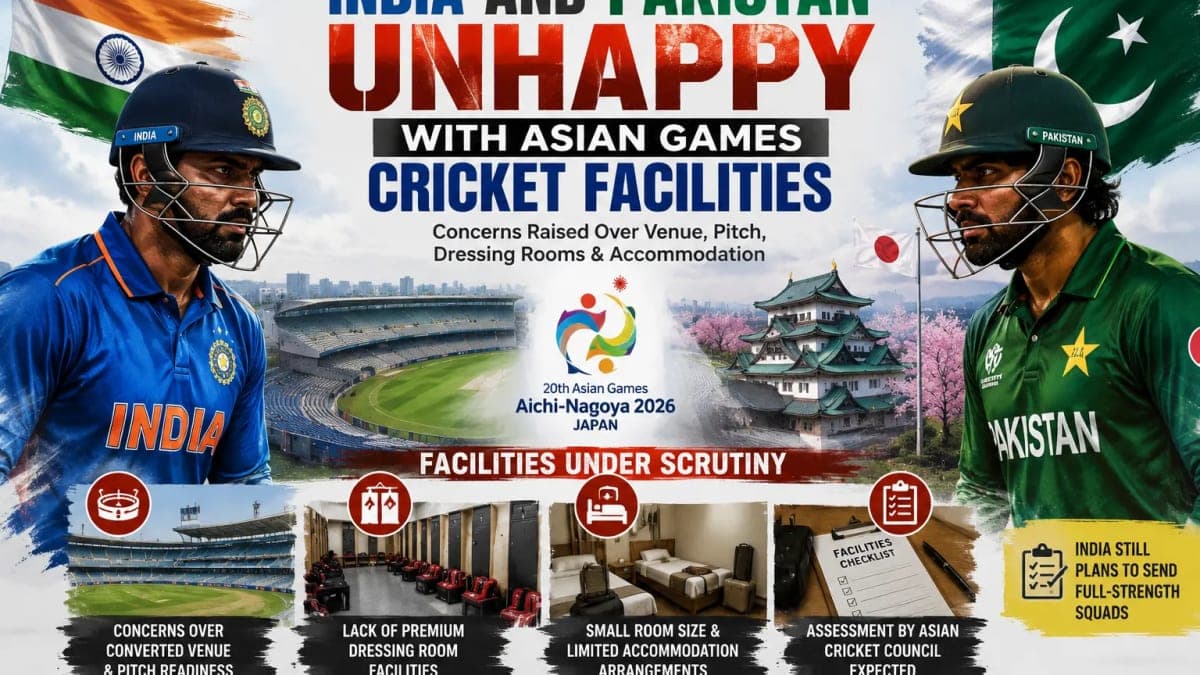
Preparations for cricket at the 2026 Asian Games have come under scrutiny after India, Pakistan and other leading Asian cricket nations reportedly expressed concerns about the facilities being arranged for players in Japan.
The issues have emerged only weeks before the Asian Games in Aichi-Nagoya, putting additional pressure on organisers to ensure that the cricket competition meets the expectations of teams featuring some of Asia's leading international players.
Concerns reportedly centre on the cricket venue at Korogi Sports Park in Nisshin, player accommodation and the facilities available to teams on match days.
The matter has also reached the Asian Cricket Council, with representatives expected to examine the arrangements before the competition begins.
What Are India and Pakistan Concerned About?
One of the biggest concerns involves the cricket venue itself.
Korogi Sports Park was previously used as a baseball facility and has been converted to accommodate cricket for the Asian Games.
The venue features a hybrid cricket surface, but because it has only recently been prepared for the sport, questions have been raised about how extensively the pitch has been tested under competitive conditions.
The facility hosted an ICC pathway tournament earlier in 2026, providing some competitive cricket experience before the Asian Games. However, leading boards reportedly remain interested in assessing whether the ground is fully prepared for a major multi-sport competition.
Another concern involves the absence of conventional permanent dressing-room facilities comparable with those normally found at established international cricket stadiums.
With elite international cricketers expected to participate, boards want adequate preparation, recovery and changing areas to be available throughout the competition.
Accommodation Becomes Another Major Issue
The playing venue is not the only concern.
Accommodation arrangements for cricketers have also attracted attention.
Reports suggest some of the rooms allocated to players may be relatively small, creating practical concerns because international cricketers travel with large kitbags, luggage and equipment.
Room size becomes particularly important if two players are expected to share accommodation.
Unlike many previous major multi-sport competitions, the Aichi-Nagoya Games will not operate around a conventional central Athletes' Village.
That has created a more complicated accommodation challenge for organisers, who are preparing to host thousands of athletes and officials across numerous sports.
Asian Cricket Council Expected to Assess Arrangements
The concerns have reportedly been discussed among Asian cricket authorities.
Pakistan is understood to have been among the first boards to flag problems with the arrangements, after which representatives from other major cricket nations also discussed the situation.
India subsequently raised its concerns through the appropriate sporting and organising channels.
An assessment of the venue and accommodation is expected to provide cricket boards with a clearer understanding of the conditions their players will experience during the Games.
That inspection could also give organisers an opportunity to address practical shortcomings before the tournament starts.
India Still Expected to Send Strong Squad
Reports surrounding the facilities initially raised speculation that India could reconsider the strength of the squad it sends to Japan if conditions were considered inadequate.
However, subsequent reporting has indicated that India does not currently plan to downgrade its squad because of the facilities issue.
That distinction is important.
The concerns remain genuine, but they should not automatically be interpreted as meaning India intends to withdraw leading players from the competition.
India has already selected strong men's and women's squads for the Asian Games, reflecting the importance placed on defending the country's cricket titles.
Cricket Returns After India's Double Gold
Cricket's appearance at the 2026 Asian Games follows India's highly successful campaign at the previous edition.
At the Hangzhou Asian Games, which were held in 2023 after being postponed from 2022, India captured gold medals in both men's and women's cricket.
That achievement means India enters the 2026 competition as defending champion in both categories.
Cricket will once again be played in the T20 format.
The men's competition features 10 teams, while eight teams are scheduled to participate in the women's tournament.
India, Pakistan, Sri Lanka and Bangladesh have received direct entry into the knockout stage of the men's competition based on the tournament structure.
Could India and Pakistan Play Each Other?
The possibility of an India-Pakistan encounter will naturally generate significant interest.
However, the tournament draw means the two rivals will not automatically meet during the early stages of the men's competition.
Both teams have been placed on different sides of the knockout structure.
As a result, an India-Pakistan men's match would require the teams to progress sufficiently far in the tournament, potentially setting up a meeting in one of the medal contests.
Given the rarity of bilateral cricket between the two countries, any meeting at a major multi-sport competition would attract considerable global attention.
Why the Facilities Controversy Matters
The controversy is important for reasons extending beyond player comfort.
Cricket is preparing for an increasingly prominent role within international multi-sport competitions.
The sport returned to the Asian Games in Hangzhou and is also set to feature at the Los Angeles 2028 Olympic Games.
That means the ability to provide high-quality temporary or converted cricket facilities is becoming increasingly important, particularly in countries where large international cricket stadiums do not already exist.
Japan does not have the same established cricket infrastructure as countries such as India, Pakistan, Sri Lanka or Bangladesh.
Transforming an existing sporting facility into an international-standard cricket venue is therefore a significant logistical challenge.
The Asian Games could provide valuable lessons about how cricket can be staged in emerging markets.
A Balance Between Expansion and Elite Standards
There are two sides to the debate.
From the teams' perspective, concerns over pitch quality, dressing rooms and accommodation are legitimate. Professional athletes competing for medals need safe playing conditions and suitable facilities.
Cricket also requires specialist infrastructure that differs considerably from many other sports.
From the organisers' perspective, hosting a massive multi-sport event requires balancing the needs of thousands of competitors across dozens of disciplines.
The 2026 Asian Games is expected to accommodate more than 17,000 registered athletes and officials, adding substantial logistical pressure.
Therefore, the current concerns do not necessarily mean that the cricket competition is in danger.
Instead, they highlight the challenge of introducing a major cricket tournament into a sporting environment where permanent international cricket infrastructure remains limited.
Focus Now Turns to Final Preparations
With the Asian Games approaching rapidly, attention will now turn to what improvements can be made before the first cricket match.
The women's cricket competition is scheduled to begin on September 17, followed by the men's tournament on September 24.
That leaves organisers with a limited but important window to address concerns raised by participating boards.
If inspections lead to improvements in dressing rooms, accommodation and match-day operations, the controversy could ultimately have little impact on the competition itself.
For India, Pakistan and the other participating nations, the priority will be ensuring that players can focus on cricket rather than logistical problems.
And for the organisers, successfully resolving the concerns would demonstrate that Japan can accommodate elite cricket alongside the enormous operational demands of one of Asia's biggest sporting events.
This article is based on reporting published by The Economic Times.


