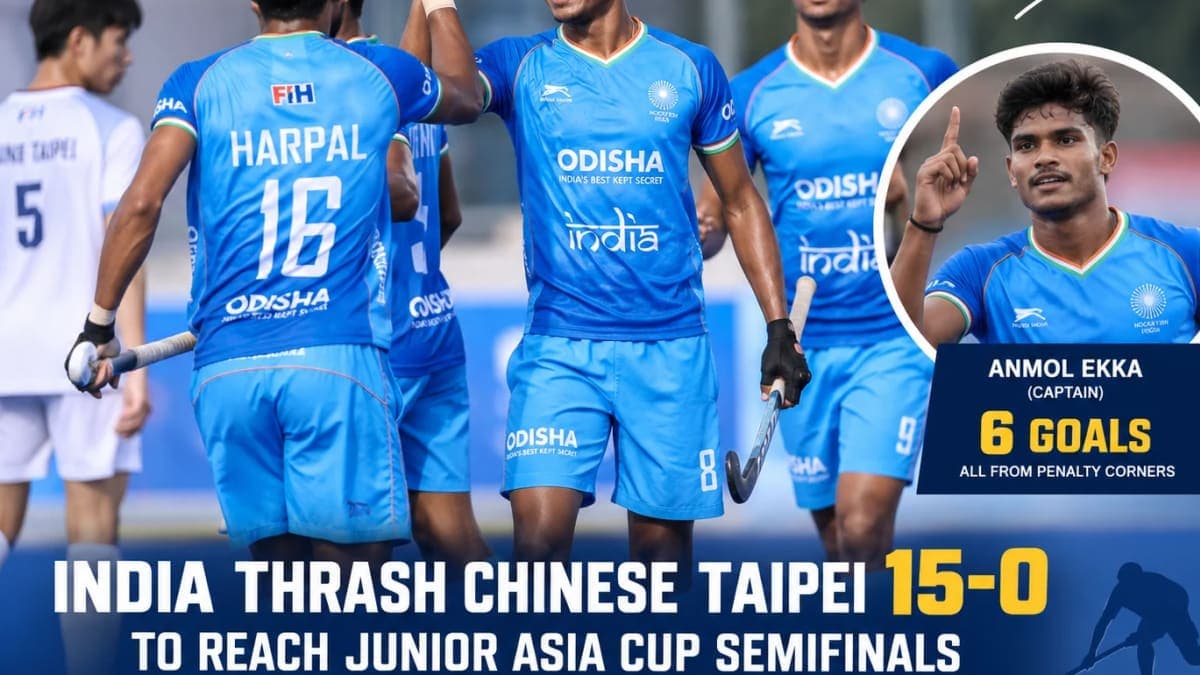
India Turn Slow Start Into 15-Goal Rout
India needed a quarter to find a way through Chinese Taipei. Once they did, the match changed quickly.
The defending champions scored six times in the second quarter and never eased their pressure, completing a 15-0 victory in their final Pool A match at the AHF Junior Asia Cup 2026 in Moqi, China, on Wednesday.
Captain Anmol Ekka was at the centre of the result, converting six penalty corners. The win took India to 10 points from four matches and secured top spot in Pool A, with South Korea joining them in the semifinals.
For all the eventual one-sidedness of the scoreline, the opening quarter was considerably more competitive.
Chinese Taipei Hold Out Early
India controlled much of the play from the start but could not turn possession into goals during the first 15 minutes. Chinese Taipei defended deep and reached the quarter break with the match still scoreless.
India returned with greater urgency.
Aryan Xess opened the scoring in the 17th minute and Prabhdeep Singh followed almost immediately, striking in the 18th. By the 22nd minute, Gursewak Singh had added another.
Three goals in five minutes changed the complexion of the game and gave India the space to attack with increasing freedom.
Ekka then converted his first penalty corner in the 25th minute. Arjun Santosh Hargude made it 5-0 three minutes later before Ekka struck again in the 29th.
A goalless first quarter had been followed by six Indian goals in the second.
Ekka Makes Penalty Corners Count
The break did little to slow India's momentum.
Ekka's drag-flicking became a recurring problem for Chinese Taipei as India repeatedly earned opportunities from penalty corners. He scored twice early in the third quarter, taking his personal tally to four.
Ajeet Yadav added another goal in the 35th minute before Ekka converted again in the 45th.
India entered the final quarter 10-0 ahead, with Ekka responsible for half of those goals.
His contribution was notable not simply for the number. All six of his goals came from penalty corners, giving India an efficient set-piece outlet at a stage of the competition when tighter matches are likely to offer fewer chances from open play.
India Keep Attacking Until the Finish
With the result settled, India could have managed the closing stages conservatively. Instead, they continued to push forward.
Harpal scored from open play in the 48th minute. Three minutes later, Ekka converted another penalty corner to complete his six-goal performance.
Harpal struck again later in the quarter, while Aryan Xess also finished with two goals as India eventually reached 15 without reply.
The scoring was spread across the side. Along with Ekka, Xess and Harpal, goals came from Prabhdeep Singh, Gursewak Singh, Arjun Santosh Hargude and Ajeet Yadav.
That distribution mattered. India were heavily reliant on Ekka from penalty corners, but they also found goals through different players and from open play once Chinese Taipei's defensive structure began to break down.
Unbeaten India Finish Top of Pool A
The result completed an unbeaten group stage for the five-time champions.
India finished Pool A with three wins and a draw, collecting 10 points from four matches. South Korea took second place with nine points after beating Japan 3-2 in their final pool fixture.
For India, the progression of Wednesday's match may be more useful than the size of the victory itself.
Chinese Taipei prevented them from scoring for an entire quarter before India adjusted and became considerably sharper around goal. The response produced 15 goals over the remaining 45 minutes, including a sustained run of successful penalty corners.
The margin will have little bearing once the knockout stage begins, where opportunities are likely to be harder to create. But India will enter the semifinals unbeaten, with their captain in prolific form and their penalty-corner attack functioning effectively.


