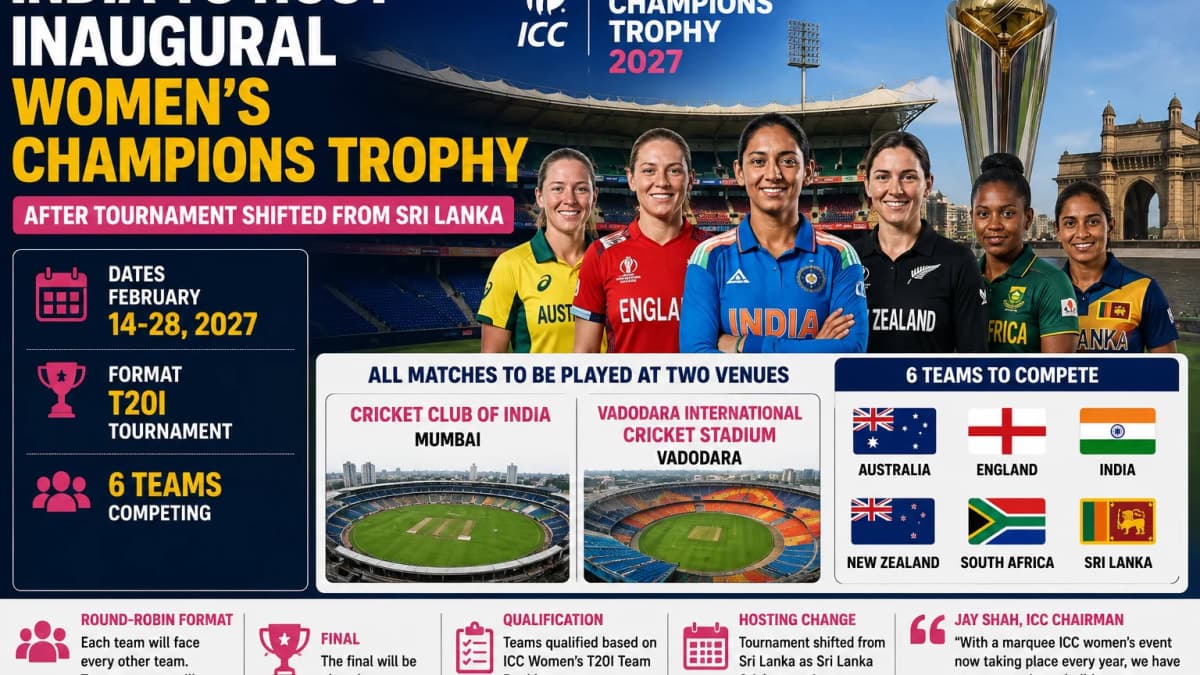
India will host the inaugural ICC Women’s Champions Trophy in 2027, after the International Cricket Council shifted the landmark tournament from its originally designated host, Sri Lanka.
The ICC confirmed on September 2, 2026 that the first edition will take place from February 14 to 28, 2027, with all matches being staged at two venues: the Cricket Club of India (CCI) in Mumbai and the Vadodara International Cricket Stadium in Vadodara.
Six teams will compete:
Australia, England, India, New Zealand, South Africa and Sri Lanka.
The competition will be played in the T20I format, with all six teams meeting in a round-robin league before the top two advance to the final on February 28.
The hosting change comes as Sri Lanka Cricket continues governance reforms outlined at the ICC Annual Conference in July.
Rather than automatically transferring the tournament to India, the ICC assessed Bangladesh, India and South Africa against its host-evaluation criteria before recommending India as the replacement.
The decision was subsequently ratified by the ICC Board.
Women’s Champions Trophy to Run From February 14-28
The inaugural competition will occupy a compact two-week window.
The tournament begins on February 14, 2027, and concludes with the final on February 28.
Unlike the men's Champions Trophy, which uses the ODI format, the new women's tournament will be played as a T20I competition.
That gives the ICC another major global women's T20 event alongside the Women's T20 World Cup, but with a smaller field and a different qualification structure.
The inaugural Champions Trophy will feature only six of the world's leading sides.
Mumbai and Vadodara Confirmed as Host Cities
All matches will be divided between two Indian venues.
Cricket Club of India, Mumbai
The Cricket Club of India (CCI) will serve as the Mumbai venue.
Its Brabourne Stadium has a long history of hosting international cricket and has also staged major women's matches.
Vadodara International Cricket Stadium
The second venue will be the Vadodara International Cricket Stadium in Gujarat.
Using two venues should allow the tournament to maintain a relatively compact logistical footprint during its February 14-28 window.
The complete match schedule and ticketing information have not yet been announced.
The ICC says those details will follow in due course.
Six Teams Qualify for Historic First Edition
The six teams competing in the first Women’s Champions Trophy are:
Australia
England
India
New Zealand
South Africa
Sri Lanka
Qualification was determined by the teams' positions in the ICC Women’s T20I Team Rankings at the July 6, 2026 qualification cut-off.
This means qualification was based on rankings rather than a separate qualifying tournament.
Notably, Pakistan and Bangladesh will not participate in the inaugural edition, having failed to finish among the six qualifying teams at the cut-off.
Sri Lanka, despite losing the tournament's hosting rights, remains part of the competition after qualifying through the rankings.
Round-Robin Format Means Every Team Faces Every Rival
The ICC has chosen a straightforward competition structure for the first edition.
All six teams will compete in a round-robin league.
That means each participating team will face every other team during the league stage.
Unlike tournaments divided into multiple groups, this structure provides a common league table across the entire field.
Once the round-robin stage is completed, the top two teams will qualify directly for the final on February 28.
There will therefore be no semifinal stage under the format currently announced by the ICC.
The structure places additional importance on consistency because every league result contributes toward the same qualification table.
Why Was Women’s Champions Trophy Moved From Sri Lanka?
The ICC's official explanation requires an important distinction from some reports surrounding the decision.
The governing body said:
“The tournament was originally scheduled to be held in Sri Lanka but will now be staged in India as Sri Lanka Cricket continues to make the requisite reforms outlined at the ICC’s Annual Conference in July.”
The ICC has therefore officially framed the relocation around continuing governance reforms within Sri Lanka Cricket.
Separate reporting has linked the situation more specifically to concerns over government involvement in Sri Lankan cricket administration.
Those reports should be distinguished from the ICC's own wording rather than treated as identical statements.
The ICC had previously indicated that Sri Lanka Cricket needed to progress toward a revised constitution and elections.
India Beat Bangladesh and South Africa in Host Evaluation
India was not the only country considered as Sri Lanka's replacement.
The ICC evaluated three potential hosts: Bangladesh, India and South Africa.
According to the governing body, the candidates were assessed against its established host-evaluation criteria.
India emerged as the recommended option.
The ICC Board then ratified the decision, formally transferring the tournament to India.
That process is significant because it shows the hosting decision was made through a comparative evaluation rather than simply awarding the competition to the geographically closest alternative.
Jay Shah Calls Tournament a ‘New Chapter’ for Women’s Cricket
ICC Chairman Jay Shah described the creation of the Women's Champions Trophy as an important expansion of the women's international calendar.
Shah said:
“The ICC Women’s Champions Trophy 2027 marks an exciting new chapter for women’s cricket.”
He said the inaugural tournament would bring together leading teams in an intense competition while creating another incentive for countries to improve their rankings and qualify for major global events.
Shah also highlighted the ICC's broader scheduling strategy.
“With a marquee ICC women’s event now taking place every year, we have a significant opportunity to build greater momentum, provide more consistency and create a stronger rhythm for the women’s game, its players and its fans around the world.”
The comments explain why the Champions Trophy matters beyond simply adding another trophy to the calendar.
The ICC is attempting to establish a more consistent annual cycle of major women's international events.
Why Create a Women’s Champions Trophy?
The Champions Trophy creates another elite-level global competition while deliberately limiting participation to six teams.
That makes rankings more consequential.
Unlike larger World Cups, qualification for the Champions Trophy requires teams to remain near the top of the international standings by the designated cut-off date.
The first edition illustrates that difference clearly.
Pakistan and Bangladesh are established international cricket nations but will not participate because they did not occupy qualifying positions in the Women's T20I rankings at the July 6 cut-off.
For teams outside the top six, future Champions Trophy qualification therefore provides another measurable objective between World Cups.
India Gets Another Major Women’s Cricket Tournament
Hosting the inaugural Champions Trophy continues a particularly important period for women's cricket in India.
India hosted the 2025 ICC Women’s Cricket World Cup, where the home side won the title.
The Champions Trophy will therefore bring another major ICC women's competition to the country less than two years later.
The difference this time is that India will enter as both host and reigning Women's ODI World Cup champion.
Australia, meanwhile, remains one of the dominant forces in women's international cricket and will be among the leading contenders in the T20 competition.
England, New Zealand, South Africa and Sri Lanka complete a field with considerable international experience.
Mumbai Could Deliver Strong Commercial Visibility
Moving the competition to India also gives the ICC access to one of cricket's largest commercial and broadcast markets.
Mumbai in particular provides the tournament with a major metropolitan venue and a deeply established cricket audience.
India's women's cricket market has expanded substantially in recent years, aided by greater international exposure and the development of the Women's Premier League.
A compact six-team ICC event provides another opportunity to test how strongly that audience translates into attendance, television consumption and digital engagement for international women's cricket.
Those commercial outcomes will be worth watching because the Champions Trophy is a new product rather than an established event with decades of history.
A Different Identity From the Women’s T20 World Cup
The existence of both a Women's T20 World Cup and a T20-format Women's Champions Trophy may initially appear unusual.
Their identities, however, are structurally different.
The Champions Trophy is designed around a smaller elite field determined through rankings.
Its six-team round-robin format also means the competition moves quickly toward a final without semifinals.
That creates a tournament in which qualification itself becomes part of the prestige.
For the ICC, the challenge will be establishing a distinctive identity for the competition so that it complements rather than simply duplicates the Women's T20 World Cup.
What India’s Hosting Means for the Tournament
The relocation creates both an opportunity and a logistical challenge.
India has substantial experience staging major international cricket tournaments and possesses extensive broadcast, commercial and venue infrastructure.
But the inaugural edition will also establish expectations for the Champions Trophy as a new women's event.
Attendance, television audiences, scheduling, pitch conditions and the overall competitiveness of the six-team field will help determine how successfully the new tournament establishes itself on the international calendar.
With only two venues, the event should also have a more concentrated atmosphere than a tournament distributed across a large number of cities.
Sri Lanka Still Has a Major Role to Play
Losing hosting rights does not remove Sri Lanka from the competition.
The Sri Lankan women's team qualified on sporting merit through the T20I rankings and will travel to India as one of the six participating sides.
That creates an unusual dynamic.
Sri Lanka was supposed to stage the historic first edition but will instead compete in the tournament hosted by the country chosen to replace it.
The continuing governance reforms within Sri Lanka Cricket will therefore remain a separate administrative issue from the women's team's qualification and participation.
Full Schedule and Tickets Still to Come
Several important details remain outstanding.
The ICC has confirmed:
Host country: India
Dates: February 14-28, 2027
Format: T20I
Teams: Six
Competition structure: Round robin followed by final
Final: February 28
Cities: Mumbai and Vadodara
Venues: Cricket Club of India and Vadodara International Cricket Stadium
However, the individual match fixtures, match timings and ticketing information have not yet been released.
Those announcements will provide a clearer picture of which city will stage the opening game and final, as well as the dates of India's biggest league-stage matches.
A Landmark Addition to Women’s International Cricket
The significance of the 2027 Women's Champions Trophy goes beyond the identity of its host.
For the first time, women's international cricket will have its own Champions Trophy.
Its ranking-based qualification system gives teams another reason to prioritise bilateral T20I performance, while the six-team format creates a concentrated tournament involving many of the strongest sides in the game.
For India, becoming the replacement host extends the country's increasingly prominent role in staging major women's cricket events.
For Sri Lanka Cricket, the relocation underlines the consequences of unresolved governance reforms even though its women's team remains qualified to compete.
And for the women's game more broadly, February 2027 will introduce another global title to pursue.
Six teams, two Indian cities and one final on February 28 will determine the first-ever ICC Women's Champions Trophy winner.


