India’s Biggest International Football Window Takes Shape
Indian football is heading towards an extraordinary few days.
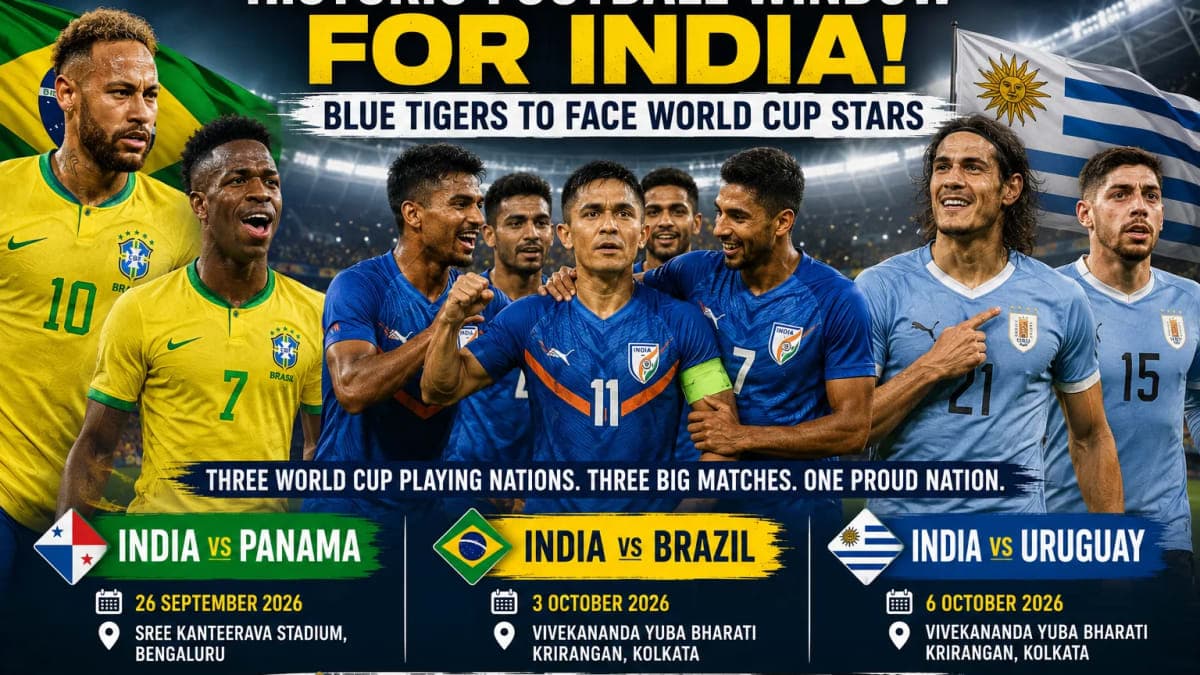
The Indian senior men's national team will play three high-profile international friendlies against Panama, Brazil and Uruguay during the September-October FIFA international window.
The schedule begins against Panama at Bengaluru's Sree Kanteerava Stadium on September 26.
One week later, India will face five-time FIFA World Cup winners Brazil at the Vivekananda Yuba Bharati Krirangan, commonly known as Salt Lake Stadium, in Kolkata on October 3.
The remarkable run concludes at the same Kolkata venue on October 6, when India take on two-time world champions Uruguay.
For a national team that rarely gets the opportunity to play this concentration of elite opposition, the three-match window represents a major change in the level of international exposure available to Indian players.
India vs Panama: September 26 in Bengaluru
Panama will provide the first test.
India will face the Central American nation at the Sree Kanteerava Stadium in Bengaluru on September 26, 2026.
It will be the first meeting between India and Panama in senior men's international football.
Panama are ranked 44th in the world and competed at the 2026 FIFA World Cup, making them significantly stronger opposition than many teams India regularly encounter.
The match will also bring the Blue Tigers back to Bengaluru for the first time since their memorable 2023 SAFF Championship campaign.
For India, Panama should provide a valuable tactical test before the difficulty rises dramatically against Brazil and Uruguay.
Brazil Arrive in Kolkata on October 3
The centrepiece of the international window will come seven days later.
India will host Brazil on October 3 at Kolkata's Vivekananda Yuba Bharati Krirangan.
Few fixtures could generate more attention among Indian football supporters.
Brazil remain one of the most recognisable national teams in world sport, with five FIFA World Cup titles and a footballing tradition that has produced generations of global superstars.
For Indian players, facing Brazil represents something different from simply watching or studying elite football.
They will have to deal with the speed of decision-making, technical quality, movement and pressure associated with one of the world's strongest football cultures in an actual international match.
That makes the fixture potentially valuable regardless of the final score.
Uruguay Add Another World Champion to the Schedule
Just three days after Brazil, India will return to the Salt Lake Stadium pitch for another formidable challenge.
Uruguay will face India in Kolkata on October 6.
The South American nation has won the FIFA World Cup twice, in 1930 and 1950, and remains one of international football's historically important teams.
Uruguay are currently ranked 20th in the world.
Their addition transforms what was already an exciting window into something unprecedented for Indian football.
Instead of one marquee friendly surrounded by more familiar opposition, India will face three teams that competed at the 2026 World Cup.
India’s Blockbuster Football Schedule
September 26, 2026
India vs Panama
Sree Kanteerava Stadium, Bengaluru
October 3, 2026
India vs Brazil
Vivekananda Yuba Bharati Krirangan, Kolkata
October 6, 2026
India vs Uruguay
Vivekananda Yuba Bharati Krirangan, Kolkata
Three matches. Eleven days. Three World Cup-level opponents.
For India's national team, it will be one of the most demanding friendly schedules in recent memory.
Why These Matches Matter for Indian Football
The biggest benefit is competitive exposure.
International football development does not happen solely through training camps.
Players need opportunities to compete against opponents who operate at faster speeds, make decisions under greater pressure and punish mistakes more consistently.
Playing stronger teams exposes weaknesses that may remain hidden against lower-ranked opposition.
That can be uncomfortable in the short term but valuable for long-term development.
India's defenders could be tested by faster attacking combinations. Midfielders may have less time on the ball. Forwards could discover how difficult it is to create chances against experienced international defensive units.
Each problem provides information that coaches can use.
Khalid Jamil’s Team Faces an Enormous Test
The window will also provide a major examination for head coach Khalid Jamil.
Managing one difficult international match is challenging.
Managing three demanding games within eleven days requires considerably more planning.
Player workload, recovery, tactical preparation and squad rotation could all become important.
The short three-day turnaround between Brazil and Uruguay is particularly demanding.
Jamil and his staff will have to decide how aggressively to rotate the squad while still giving key players meaningful experience against elite opponents.
The matches could therefore test India's squad depth as much as the quality of its strongest starting eleven.
A Rare Opportunity for Indian Players
For Indian footballers, these fixtures offer something that domestic competition cannot replicate.
Playing against world-class international opponents allows players to measure themselves directly against a much higher competitive benchmark.
Defenders can learn how quickly elite attackers exploit positioning mistakes.
Midfielders can experience the intensity required to retain possession under pressure.
Attackers can discover how much sharper their movement and finishing must become when opportunities are limited.
Young players could benefit particularly from this exposure.
Even difficult moments can become useful lessons when the objective is long-term improvement.
Kolkata Becomes the Centre of the Football Spotlight
Kolkata will host the two biggest fixtures of the window.
The city has one of India's deepest football cultures, with enormous support surrounding clubs such as Mohun Bagan, East Bengal and Mohammedan Sporting.
The Vivekananda Yuba Bharati Krirangan provides the scale required for matches capable of generating massive public interest.
Hosting Brazil and Uruguay within three days could turn Kolkata into the centre of Indian sporting attention.
The Brazil fixture in particular has the potential to attract interest well beyond regular followers of the Indian national team.
That visibility itself could become valuable for Indian football.
Bengaluru Gets Its Own World Cup-Level Contest
Bengaluru will open the series against Panama.
The Sree Kanteerava Stadium has strong recent memories for Indian supporters after hosting India's successful 2023 SAFF Championship campaign.
Returning there against a World Cup participant gives Bengaluru supporters an opportunity to experience a different level of international opposition.
It also spreads the international window beyond one city.
If India wants major international football to develop a broader national audience, taking important matches to multiple football centres can help.
The FIFA Ranking Gap Shows the Scale of the Challenge
Expectations around the matches need to remain realistic.
India are ranked 138th in the FIFA rankings, while Panama sit 44th and Uruguay 20th.
Brazil operate at an entirely different level of international football pedigree.
Those gaps underline why these games should primarily be viewed as opportunities for development and benchmarking rather than matches India are expected to dominate.
Facing superior opposition can produce heavy defeats.
But avoiding strong teams simply to protect results can also limit development.
The challenge for India is to use these matches constructively.
Results Will Matter — But Performance May Matter More
Football remains a results business, and India's players will naturally want positive outcomes.
However, judging this window purely by wins and losses could miss its broader value.
More useful questions may include:
Can India maintain its defensive structure under sustained pressure?
Can the team progress the ball against aggressive pressing?
Can players create scoring opportunities against higher-quality defenders?
Can India remain competitive physically for 90 minutes?
Can the squad recover quickly enough to perform across three difficult matches?
Answers to those questions could reveal more about India's development than the final scorelines alone.
Commercial Opportunity for Indian Football
High-profile international friendlies also carry a commercial dimension.
A match against Brazil can attract television audiences, sponsors, ticket buyers and casual sports fans who may not regularly watch the Indian national team.
Brazil's visit in particular is expected to involve substantial organisational costs.
Reports indicate that hosting associations carry much of the financial responsibility for arranging marquee international friendlies.
That creates both opportunity and risk.
Strong ticket sales, sponsorship and broadcasting interest could help offset costs and demonstrate that India has a viable market for elite international football.
Poor commercial execution, however, could make regularly hosting such opponents difficult.
Could This Become a New Model for India?
The most important long-term question is whether this window becomes an exceptional event or the beginning of a more ambitious international strategy.
India cannot play Brazil and Uruguay during every FIFA window.
Nor would that necessarily be the ideal development model.
A balanced programme would likely require a mixture of opponents.
Matches against stronger teams provide benchmarking and experience.
Games against similarly ranked nations give India realistic opportunities to develop attacking patterns and compete for victories.
Matches against slightly higher-ranked opponents can help bridge the gap between the two.
The real objective should therefore be consistent exposure to varied international opposition rather than simply chasing famous names.
Another Major Test Awaits in November
The three home friendlies are not expected to be India's only matches against World Cup-level opposition this year.
India are also scheduled to play New Zealand twice in November, on November 12 and November 15.
That means the Blue Tigers could accumulate an unusually valuable series of international matches against teams that participated at the 2026 World Cup.
For player development, such continuity could prove more useful than any single marquee event.
Balanced Analysis: Huge Opportunity, But Expectations Need Perspective
There is plenty of reason for excitement.
India hosting Panama, Brazil and Uruguay within one international window is extraordinary.
Players gain rare elite-level exposure.
Supporters get to watch world-class international football at home.
The federation receives an opportunity to increase the national team's visibility.
Sponsors and broadcasters gain potentially valuable events.
But there are also reasons for perspective.
Friendly matches alone cannot transform Indian football.
Long-term progress still depends on youth development, coaching standards, competitive domestic leagues, club stability, infrastructure, scouting and consistent international exposure.
A spectacular night against Brazil can inspire young supporters.
It cannot replace the development systems required to produce better footballers.
The greatest value of this window will therefore come if the experience becomes part of a larger sporting strategy.
A Historic Eleven Days for the Blue Tigers
Between September 26 and October 6, Indian football will experience an unusual concentration of global talent.
Panama will bring World Cup-level CONCACAF opposition to Bengaluru.
Brazil will bring five-time world champion pedigree to Kolkata.
Uruguay will follow with the history of a nation that has lifted football's biggest trophy twice.
For India's players, the challenge will be enormous.
For supporters, the spectacle could be unforgettable.
And for Indian football, the three matches offer something it has long needed — the opportunity to discover exactly where it stands when confronted directly by teams operating at a much higher international level.
The scoreboards will tell one story.
What India learns from those eleven days could ultimately matter much more.
This article is based on reporting published by Hindustan Times.


