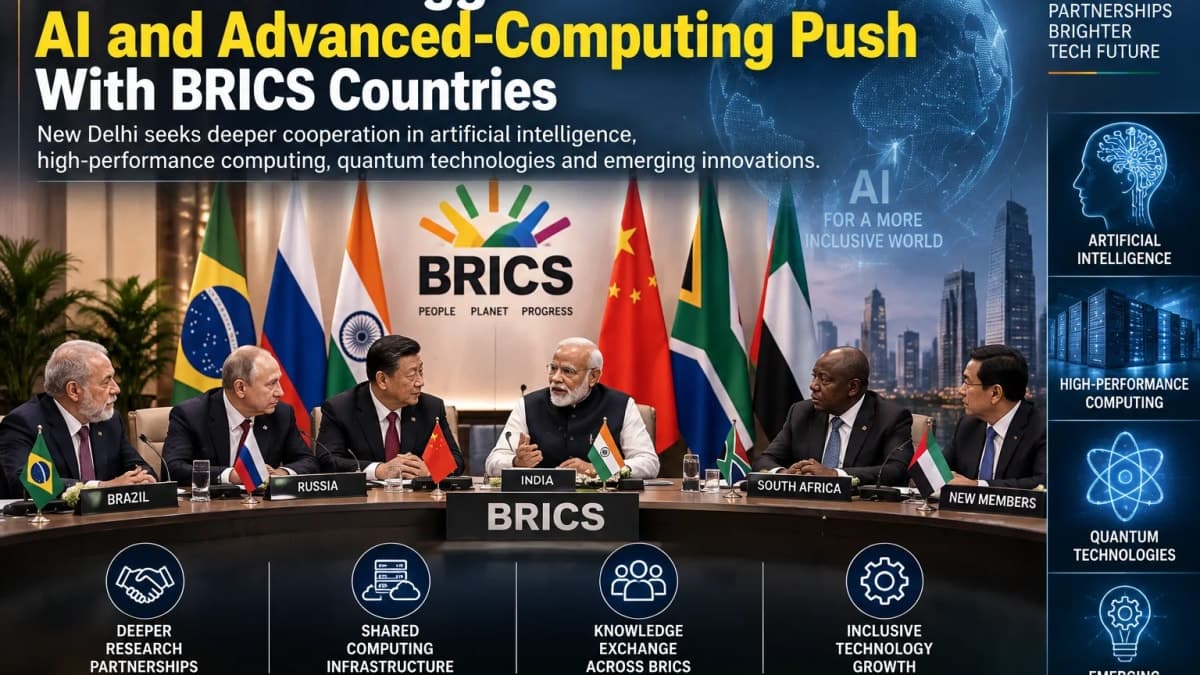
India Seeks Bigger AI and Advanced-Computing Partnership With BRICS Countries
India is looking to make artificial intelligence and advanced computing a larger part of its engagement with BRICS, signalling that technology cooperation will occupy a more prominent place in New Delhi's relationship with the grouping.
The push covers areas including AI, high-performance computing, quantum technologies and other emerging technologies, with India seeking stronger research links and greater collaboration between institutions across BRICS countries.
The effort comes as AI infrastructure and access to computing power increasingly influence countries' ability to develop domestic technology capabilities. For India, cooperation through BRICS offers another route to build research partnerships while pursuing its own national investments in AI and advanced computing.
India Wants Technology to Play a Bigger BRICS Role
India's proposal is broader than simply increasing the use of artificial intelligence.
The emphasis is on creating deeper cooperation across advanced scientific and computing fields, including the infrastructure and research capabilities required to develop new technologies.
That could involve closer connections between researchers, universities and scientific institutions across BRICS economies, alongside greater exchange of technical expertise.
India has already used multilateral forums to argue for technology development that is accessible to a wider range of countries rather than concentrated among a small number of economies or companies.
The BRICS framework gives New Delhi an additional platform for that approach.
AI Computing Power Moves Up the Agenda
The focus on advanced computing is particularly significant.
Modern AI systems require large amounts of computing capacity for training and deployment. Access to advanced chips, data centres and high-performance computing infrastructure has therefore become a strategic issue alongside the development of AI models themselves.
India has been expanding domestic capacity through the IndiaAI Mission, which is intended to strengthen the country's AI ecosystem through computing infrastructure, datasets, skills, startup financing and other initiatives.
Closer cooperation with BRICS countries could complement those domestic programmes, particularly in scientific research and areas where computing resources can be shared or jointly developed.
It would not, however, remove the technological and commercial differences between BRICS members. Their semiconductor capabilities, AI industries, research systems and access to advanced hardware vary considerably.
Any deeper partnership would have to operate across those differences.
Quantum and High-Performance Computing Also in Focus
Artificial intelligence is only one part of the proposed expansion.
India is also interested in stronger collaboration around high-performance computing and quantum technologies, two areas with applications ranging from scientific modelling and drug discovery to materials research and cybersecurity.
India already has national programmes targeting both fields.
Its high-performance computing efforts include the National Supercomputing Mission, while the National Quantum Mission is aimed at developing capabilities in quantum computing, communication, sensing and related technologies.
International cooperation could give researchers additional opportunities to work on common projects, exchange expertise and gain access to specialised infrastructure.
The practical value of any BRICS initiative will depend on how broad political commitments are translated into research programmes, funding mechanisms and institutional partnerships.
BRICS Has Become a Much Larger Group
The technology push also comes as BRICS itself has changed considerably.
The grouping began with Brazil, Russia, India and China before South Africa joined, turning BRIC into BRICS. It has since expanded to include additional countries, giving the bloc a larger economic and geographic footprint.
That expansion creates more potential partners for scientific cooperation but also makes consensus more complicated. Member countries have different economic priorities, regulatory systems and strategic relationships with major technology powers.
Those differences are especially relevant in AI.
China has one of the world's largest artificial-intelligence industries, while India has developed a substantial technology-services sector and is investing heavily in domestic AI infrastructure. Other members bring different research strengths, markets and natural resources to the grouping.
A BRICS technology programme therefore has potential scale, but its effectiveness will depend on whether members can identify projects where their interests genuinely overlap.
India’s AI Strategy Is Increasingly About Infrastructure
The BRICS initiative fits into a broader shift in India's technology policy.
The country's AI ambitions are no longer centred only on software development and startups. Computing infrastructure, semiconductor access, datasets, research capacity and skilled workers have become equally important parts of the strategy.
That reflects a change taking place across the global AI industry.
As models become more computationally demanding, countries without sufficient infrastructure risk becoming dependent on overseas providers for critical parts of their AI ecosystems. Governments are consequently treating computing capacity more like strategic infrastructure.
India's approach combines domestic investment with international partnerships.
BRICS cooperation could become one component of that strategy, alongside India's technology relationships with other countries and multilateral groups.
Cooperation Will Ultimately Be Measured by Projects
The ambition to deepen BRICS technology cooperation is significant, but announcements alone will not determine its impact.
The more important questions concern implementation: whether member countries establish joint research programmes, provide researchers with access to computing infrastructure, fund collaborative projects or create mechanisms for sharing scientific expertise.
Questions around data governance, intellectual property, cybersecurity and access to advanced technology could also become more complicated as cooperation moves from political statements to practical projects.
For India, the opportunity is clear. A wider BRICS technology network could give its researchers and companies access to additional expertise and collaborative opportunities while strengthening ties with emerging economies.
The next stage will show whether that ambition develops into durable computing and research infrastructure or remains primarily a framework for future cooperation.