Blue Is Back: Indian Hockey Teams Restore Traditional Jersey for Asian Games
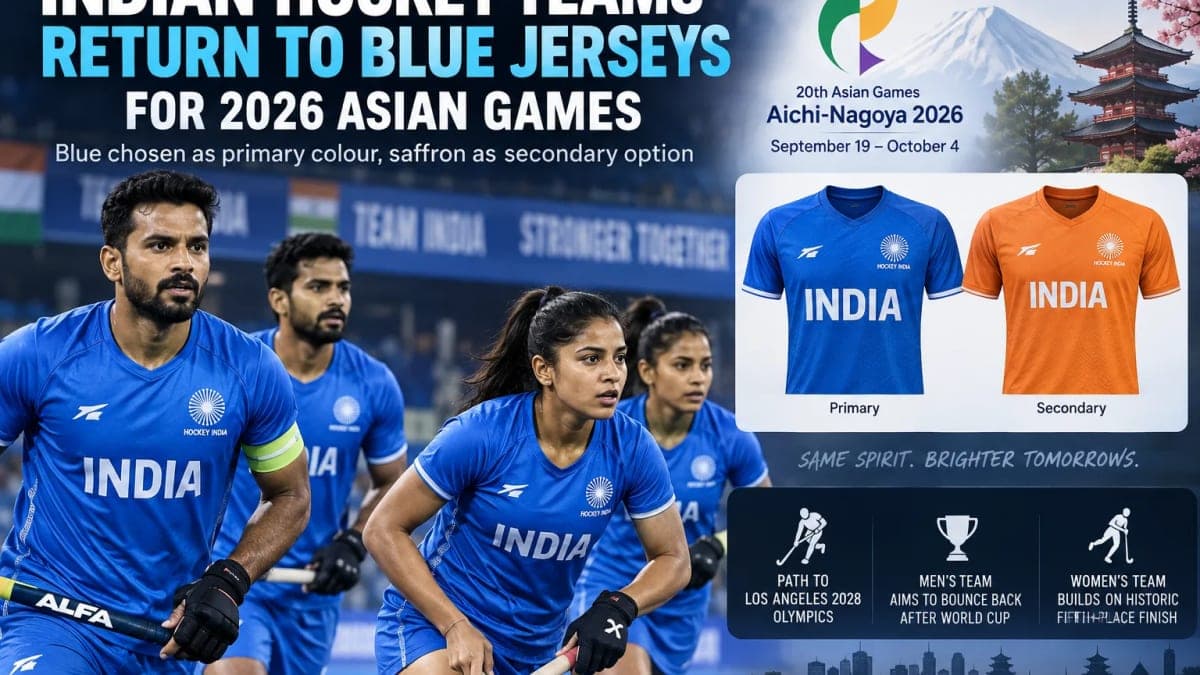
Indian hockey will have a familiar look at the 2026 Asian Games. Blue has been chosen as the primary jersey colour for the men’s and women’s national teams, weeks after their saffron kits at the World Cups prompted questions over a departure from one of the sport’s most recognisable Indian identities.
The decision applies to the Asian Games in Aichi-Nagoya, Japan, where the Indian Olympic Association (IOA) is coordinating the colours worn by the country’s contingent. Hockey India has submitted blue as its first preference and saffron as the second.
That does not amount to a permanent change in policy. Hockey India officials have said the federation will consider its colours separately for future competitions.
Hockey India Puts Blue First
The IOA sought colour preferences from national sports federations as part of preparations for the Asian Games. Hockey India’s response placed blue at the top of its list.
Federation president Dilip Tirkey said the saffron kit introduced for the World Cups was never intended to become a permanent replacement for blue.
“We never said it (the saffron jersey) was permanent. The Indian hockey team will sport the blue jersey. Nothing is permanent as we had seven colours to choose from,” Tirkey told The Indian Express.
Hockey India treasurer Shekar Manoharan also confirmed that blue was submitted as the first choice, followed by saffron.
The distinction matters because the decision concerns the Asian Games rather than establishing a fixed jersey colour for every international tournament.
Why the Saffron Jersey Became an Issue
India’s use of saffron at the recent FIH Men’s and Women’s Hockey World Cups in Belgium and the Netherlands represented a noticeable break from tradition.
Hockey India had pointed to a practical concern behind the change. With international hockey played on blue synthetic turf, the federation argued that using a similar shade for the jersey could affect visibility.
The explanation did not settle the discussion.
For generations of players and supporters, blue has been closely tied to India’s hockey identity. Former captain Viren Rasquinha was among those who publicly questioned the move away from the traditional colour.
The decision also became an internal issue within Hockey India. Tirkey said the switch to saffron had been made without the knowledge or approval of the federation’s elected leadership and Executive Board.
That disagreement added another dimension to what might otherwise have been a routine kit decision.
More Than a Change of Uniform
India’s association with blue in hockey stretches back decades, including much of the period in which the country established itself as one of the sport’s great Olympic powers.
Uniform designs have changed repeatedly and India has occasionally played in other colours, but blue has remained the shade most closely identified with the national side.
The Asian Games are also different from standalone hockey tournaments. As a multi-sport event, preparations involve the IOA and the broader visual identity of the Indian contingent, giving the Olympic body a role in coordinating kit choices across disciplines.
For Hockey India, choosing blue as its first preference brings the teams back to their established appearance without closing the door on other colours in future tournaments.
Asian Games Carry Bigger Stakes for Indian Hockey
The 2026 Asian Games will take place in Aichi-Nagoya, Japan, from September 19 to October 4.
The tournament is particularly important for India because success can provide a direct route towards the Los Angeles 2028 Olympics under the applicable qualification system.
India’s men arrive at the next phase of their international campaign looking for a response after finishing eighth at the recent World Cup.
The women have stronger recent momentum. Their fifth-place World Cup finish was India’s best in the competition since 1974.
Captain Salima Tete and coach Sjoerd Marijne are leading a 20-member women’s squad for the Asian Games campaign.
Against that competitive backdrop, the jersey debate is secondary to what happens on the field. But the decision does restore an image that Indian hockey supporters have known for decades.
When the national teams step onto the turf in Japan, blue will once again be their primary colour.


