India’s startup ecosystem is continuing its push toward the public markets in 2026, with a substantial pipeline of technology and new-age companies preparing to list even as investors become more demanding about financial performance.
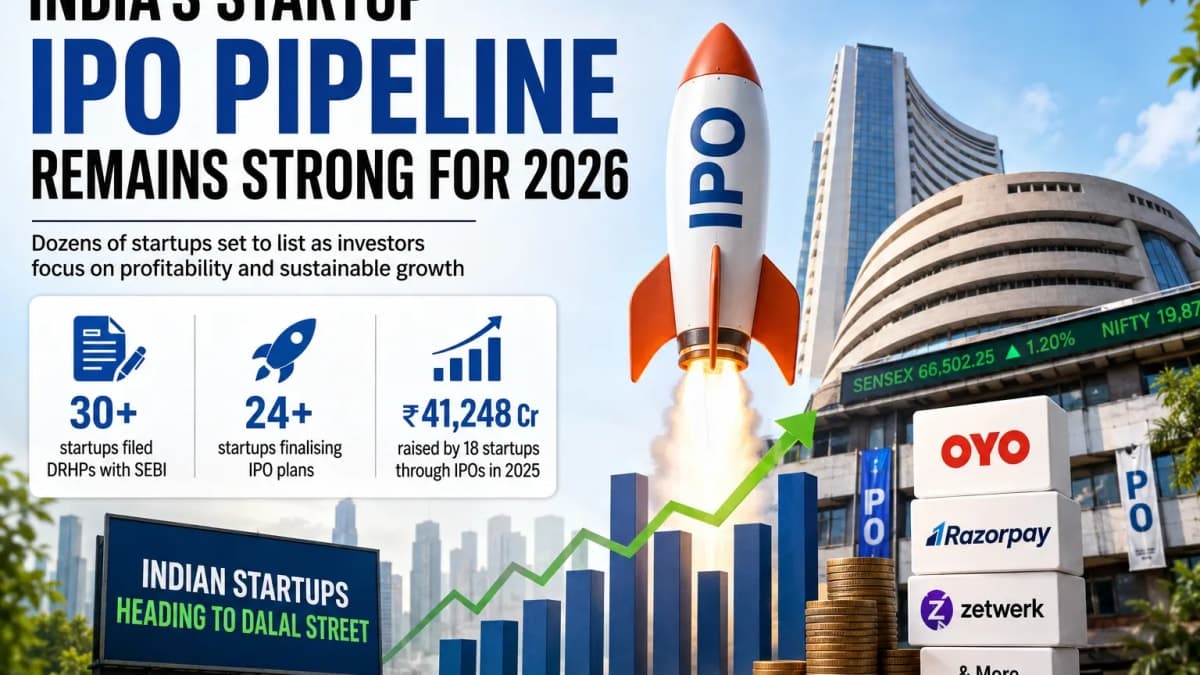
According to Inc42’s Indian Startup IPO Tracker, 30 startups had filed draft red herring prospectuses (DRHPs) with the Securities and Exchange Board of India (SEBI), while more than 24 others were at different stages of finalising IPO plans.
The pipeline follows an exceptional 2025, when 18 Indian startups listed on the stock exchanges and collectively raised a record ₹41,248 crore from public investors.
The numbers indicate that IPOs remain an important funding and liquidity route for India’s maturing startup ecosystem. However, the investment case is changing: public-market investors are increasingly looking beyond rapid expansion and focusing on sustainable unit economics, predictable cash generation and disciplined spending.
Startup Listings Build on Record 2025
The current pipeline comes after Indian startups established a new fundraising benchmark in 2025.
Eighteen startups went public during the year, collectively raising ₹41,248 crore, according to Inc42. That performance helped establish the public markets as an increasingly important destination for mature Indian startups.
The trend also reflects a broader evolution of the startup ecosystem. Companies that spent years relying on venture capital and private equity are increasingly reaching a stage where an IPO can provide access to a much larger investor base while offering liquidity opportunities to existing shareholders.
The transition, however, brings greater scrutiny. Listed companies must meet continuous disclosure and governance requirements while facing regular assessment from institutional and retail investors.
Dozens of Startups Remain in the IPO Pipeline
The number of companies preparing for public listings suggests the IPO cycle has considerable depth.
SEBI's public-issue records continue to show fresh filings. Atomberg Technologies filed draft IPO papers on August 27, while filings involving Nobel Hygiene, M P Steel (India) and other companies were recorded during the final week of August.
Zetwerk Manufacturing Businesses also appeared in SEBI's public-issue records in August, highlighting continued activity among companies associated with India's new-economy ecosystem.
According to Inc42's tracker, major startups including OYO, Razorpay and Zetwerk could together potentially raise more than ₹34,000 crore during 2026. Such fundraising figures remain projections rather than guaranteed outcomes because IPO sizes, valuations and launch schedules can change before an offering reaches the market.
Broader Indian IPO Market Is Accelerating
Startup IPOs are also benefiting from stronger activity across India's wider primary market.
India's IPO market is heading into an active September, with companies potentially seeking to raise around ₹20,000 crore to ₹25,000 crore during the month.
The acceleration follows a more cautious first half of 2026 and indicates that issuers are increasingly willing to proceed with fundraising when market conditions are supportive.
July had already delivered a significant revival. The mainboard market recorded 12 IPOs raising approximately ₹28,650 crore during the month, according to Moneycontrol.
Continued activity across the wider IPO market could provide a supportive environment for startup issuers, although individual companies will still need to convince investors about their valuations and long-term business prospects.
Investors Are Becoming More Selective
A large IPO pipeline does not necessarily mean every startup will receive the same investor response.
One of the biggest changes in India's startup market has been the growing emphasis on financial discipline.
Rehan Yar Khan, managing partner at Orios Venture Partners, told Inc42 that IPO-bound startups in 2026 would increasingly be judged on their ability to demonstrate “predictable cash flows, sustainable unit economics, and operational discipline.”
He also pointed to governance, capital efficiency and long-term value creation as important considerations for public-market investors.
The shift represents a significant change from the private-market environment in which many startups initially scaled. High revenue growth can still be attractive, but public investors are increasingly evaluating whether that growth can eventually translate into sustainable earnings and cash generation.
Foreign Investors Continue to Participate in IPOs
Another encouraging signal comes from foreign portfolio investor participation in India's primary market.
During the first eight months of 2026, foreign portfolio investors invested approximately $4.9 billion, or ₹45,848 crore, in IPOs, according to Economic Times data.
That was higher than the approximately $4.7 billion, or ₹40,309 crore, invested during the corresponding period of 2025.
The contrast is notable because foreign investors have also been withdrawing money from India's secondary equity market amid global geopolitical uncertainty.
Continued IPO participation therefore suggests that international investors may still be willing to back individual Indian businesses when they find the valuation and growth opportunity attractive.
Strong Listings Could Support Sentiment
Recent IPO performance has also helped maintain interest in the primary market.
Despite the Nifty declining around 0.6% during August, approximately 90% of IPOs launched during the month outperformed the volatile broader market, according to an Economic Times analysis.
Some newly listed stocks delivered gains of as much as 72%, although strong early performance does not guarantee longer-term returns.
Successful listings can nevertheless improve sentiment toward future offerings because they encourage retail and institutional investors to examine upcoming issues.
Why the 2026 Startup IPO Pipeline Matters
The significance of the current IPO pipeline extends beyond the amount of capital companies may raise.
A sustained wave of startup listings can change the structure of India's technology ecosystem.
For founders, IPOs create an additional route for raising growth capital. For venture capital and private-equity investors, public listings can provide opportunities to realise returns on investments made years earlier.
For employees holding stock options, successful listings can potentially create liquidity. And for public investors, the trend increases access to companies that previously remained largely within private investment portfolios.
The transition also introduces a tougher standard of accountability. Public companies must repeatedly demonstrate financial performance, governance quality and execution rather than relying primarily on expectations about future growth.
What Could Slow the IPO Momentum?
Despite the healthy pipeline, several risks remain.
Global geopolitical tensions, foreign investor flows, equity-market volatility and company valuations could affect the timing of individual offerings.
Companies can also postpone IPOs after filing their draft papers if market conditions become unfavourable.
Most importantly, the presence of dozens of companies in the IPO pipeline should not be interpreted as confirmation that all of them will list during 2026. Regulatory approvals, market conditions, valuation negotiations and company-specific decisions can all change the final timetable.
Outlook: 2026 Could Be Another Important Year for Startup Listings
India's startup IPO pipeline enters the remaining months of 2026 with significant momentum.
The combination of dozens of startup IPO preparations, continuing regulatory filings and stronger activity in India's wider primary market suggests that the public markets remain open to new-age businesses.
But the quality threshold is rising.
The companies best positioned to benefit may increasingly be those capable of combining growth with sustainable economics, disciplined cash management and credible corporate governance.
If that shift continues, 2026 could be remembered not simply for the number of startups pursuing IPOs, but as another stage in India's transition from a venture-capital-driven startup boom toward a more mature public-market ecosystem.