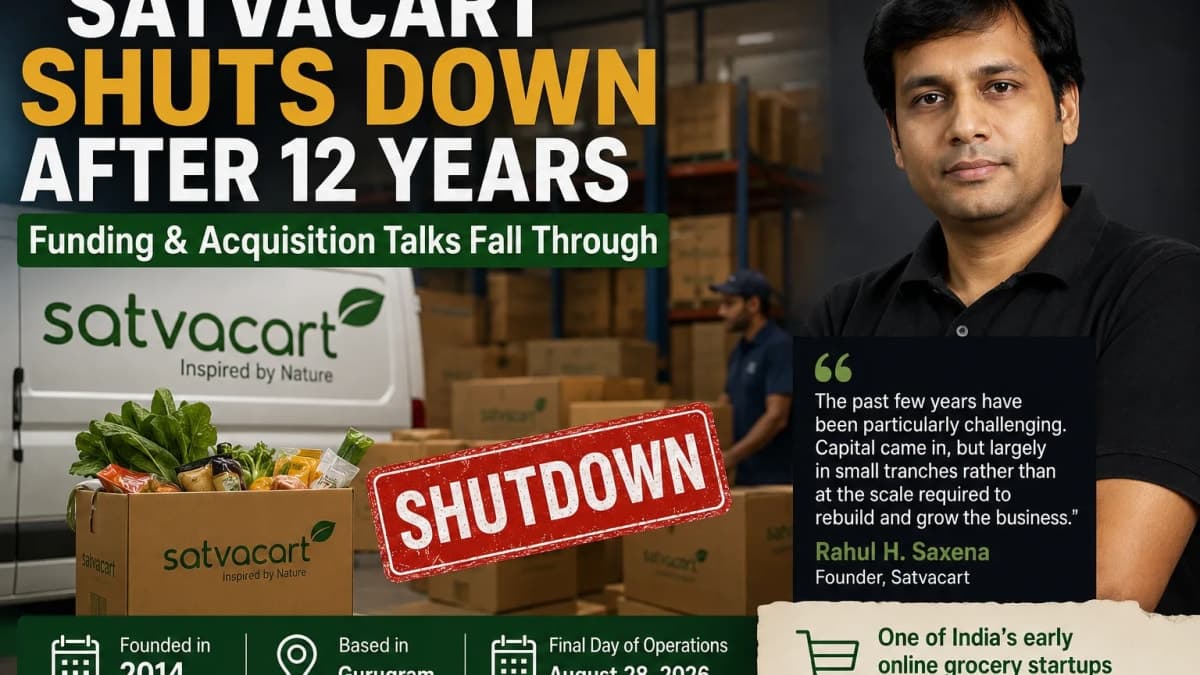
Gurugram-based online grocery startup Satvacart has shut down after 12 years of operations, bringing an end to one of the longer journeys among India’s early online grocery ventures.
Founder Rahul H. Saxena confirmed that August 28, 2026 was Satvacart’s final day of operations and that the company’s team had been disbanded.
The closure came after Satvacart spent several years trying to secure enough capital to rebuild and expand the business. The company also explored strategic investment and acquisition opportunities, but those efforts did not result in a transaction.
Satvacart’s exit is particularly notable because the startup entered online grocery in 2014—years before quick commerce reshaped the sector around rapid delivery, dense fulfilment networks and aggressive expansion.
Funding Challenges Led to Difficult Decision
According to Saxena, Satvacart continued receiving capital during its difficult period, but the money largely arrived in smaller tranches rather than at the scale required to rebuild and grow the company.
The startup continued searching for alternatives and evaluated funding, strategic investment and acquisition possibilities.
Satvacart was also in discussions with two larger investors regarding a significant investment, Saxena said. Neither opportunity ultimately materialised.
Acquisition discussions were held with multiple prospective parties as well, but these talks also failed to progress into a completed deal.
Saxena said:
“The past few years… have been particularly challenging. Capital came in, but largely in small tranches rather than at the scale required to rebuild and grow the business.”
Profitability Helped Satvacart Survive — But Scale Became a Challenge
Satvacart’s experience highlights an important tension facing startups operating in capital-intensive consumer markets: profitability and scale do not always develop together.
Saxena said Satvacart had become one of the early online grocery businesses to demonstrate profitability in the category in 2019.
The company maintained a profitability-focused approach rather than pursuing growth at any cost. That financial discipline helped Satvacart navigate a rapidly changing grocery market, but Saxena said it also meant the company did not reach the scale required to make potential acquisition discussions sufficiently attractive.
This distinction is important.
For a grocery-delivery company, scale can influence warehouse utilisation, delivery economics, customer density and negotiating power. It can also make a business more attractive to investors or strategic buyers seeking a substantial customer and fulfilment network.
Satvacart’s closure therefore illustrates how achieving profitability does not automatically guarantee access to the capital required for the next stage of expansion.
From Early Online Grocery to the Quick-Commerce Era
Founded in 2014, Satvacart entered the Indian online grocery market well before consumers became accustomed to receiving groceries within minutes.
The company initially started with milk subscriptions in Gurugram before developing an inventory-led grocery model.
Its operations were structured around micro-clusters, with individual warehouses serving consumers within approximately a five-kilometre radius.
In 2015, Satvacart raised seed funding from Palaash Ventures and angel investors, with plans at the time including operational expansion, customer acquisition and strengthening its technology capabilities.
The environment surrounding the company would change dramatically over the following decade.
Quick Commerce Changed the Competitive Landscape
When Satvacart started, Indian online grocery was still an emerging business model. Companies were experimenting with scheduled grocery deliveries, subscriptions, hyperlocal fulfilment and inventory-led operations.
Over time, the market shifted increasingly toward quick commerce.
Companies including Blinkit, Zepto and Swiggy Instamart helped establish rapid delivery as a major consumer proposition, while large ecommerce companies have also expanded their presence in fast-delivery commerce.
That transformation increased the importance of dense fulfilment networks, technology, delivery capacity, customer frequency and substantial investment.
For smaller operators, the challenge was no longer simply proving that groceries could be sold online profitably. Competing increasingly required enough capital and scale to operate effectively in a market where speed and network density had become important differentiators.
Founder Says Continuing Operations Was Affecting the Team
Satvacart continued trying to find a viable path forward, but Saxena said conditions became increasingly difficult during the company's final months.
Eventually, the founder concluded that continuing the business was placing too great a burden on the people who had remained with the company.
Saxena said:
“There came a point where continuing operations was coming at the cost of the people who had stood by the company.”
The company consequently decided to discontinue operations rather than continue without a sustainable route to rebuilding and growth.
What Satvacart’s Closure Says About India’s Startup Market
Satvacart’s shutdown offers a broader lesson about the evolution of India's consumer internet ecosystem.
The company survived for 12 years, through multiple phases of the online grocery industry, while maintaining a comparatively disciplined approach to growth.
Yet the market around it evolved toward businesses capable of deploying substantial amounts of capital into fulfilment infrastructure, technology and geographic expansion.
Satvacart’s experience suggests that in highly competitive and capital-intensive categories, profitability, longevity and scale can all matter—but achieving one does not necessarily guarantee the others.
Its closure also shows the difficult position that smaller established startups can face: a business may develop sustainable economics while still lacking sufficient scale to attract the size of investment or acquisition interest needed for its next stage.
A 12-Year Entrepreneurial Chapter Comes to an End
Despite the shutdown, Saxena said he had no regrets about building Satvacart.
During the company's 12-year journey, he worked across technology, operations, fundraising, marketing, supply chain and customer experience while steering the startup through multiple challenges.
Reflecting on the experience, Saxena said:
“I genuinely believe I gave Satvacart the very best effort I was capable of.”
He also thanked employees, customers, suppliers, investors, mentors and others who supported the company.
Saxena has not publicly detailed his next venture or professional move, saying only that he is looking forward to his “next chapter.”
For Satvacart, however, August 28 marked the end of a business that began during the early development of India's online grocery industry and survived long enough to witness the sector transform into today's highly competitive quick-commerce market.