India’s difficult road to the ICC World Test Championship 2025-27 final has acquired another complication—and this time the problem is happening away from the Test arena.
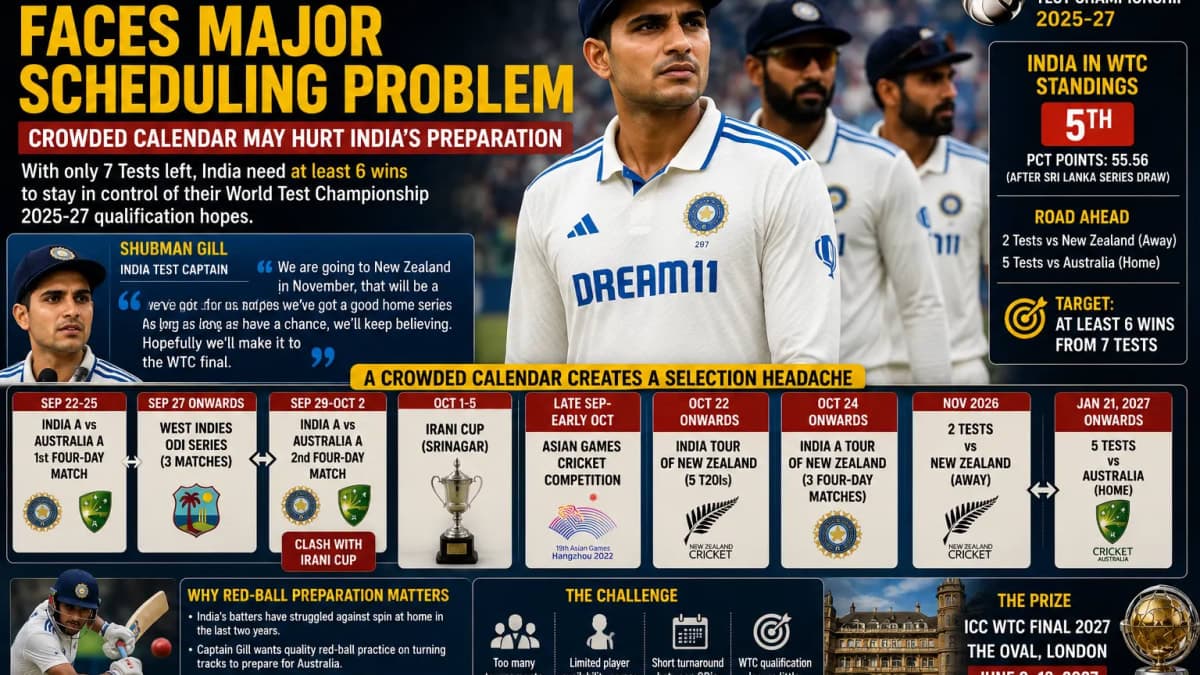
With India sitting fifth in the WTC standings, captain Shubman Gill, the team management and national selectors are facing a congested schedule that could restrict the amount of specialised red-ball preparation available before the two Test assignments that could decide India’s championship campaign.
India travel to New Zealand for two Tests in November 2026 before hosting Australia in a five-match Border-Gavaskar Trophy beginning January 21, 2027.
Those seven Tests carry enormous significance.
After India were held to a draw in the second Test against Sri Lanka in Colombo, they were left needing at least six victories from their remaining seven Tests to control their own path toward a top-two WTC finish.
But before the team can attempt that difficult qualification run, the BCCI must solve an equally complicated scheduling puzzle involving India, India A and domestic cricket.
Why India’s WTC Situation Has Become So Difficult
India’s position became significantly more challenging after the recently concluded Test series in Sri Lanka.
Gill’s side won the series 1-0, but Sri Lanka survived the second Test in Colombo to secure a draw after India had appeared well placed to complete a 2-0 sweep.
The missed victory cost India valuable WTC points.
India now have only seven Tests remaining in the current championship cycle:
Two away Tests against New Zealand and five home Tests against Australia.
According to the current qualification calculations, India need to win at least six of those seven Tests if they want to retain control over their qualification prospects rather than depend heavily on results involving other teams.
That means preparation for the New Zealand and Australia assignments has become unusually important.
Shubman Gill Wants Red-Ball Practice Against Australia A
According to The Times of India, Test captain Shubman Gill has proposed using the upcoming India A versus Australia A four-day matches in Puducherry to provide Test batters with valuable red-ball match practice.
The idea reportedly involves preparing surfaces that offer a reasonable amount of turn as the matches progress.
India A are scheduled to face Australia A in two four-day matches:
September 22-25
September 29-October 2
The reported objective is not to create extreme turning pitches but to give Indian batters an opportunity to face quality bowling in conditions where spin becomes increasingly influential.
A BCCI source cited in the report said Indian batters had not been at their best against spin at home over the previous two years and that Gill believed game time against Australia A could help prepare them for the Border-Gavaskar Trophy.
This is particularly relevant because Australia will visit India for five Tests early next year.
Irani Cup Creates the First Major Clash
The problem is that the second Australia A four-day match overlaps directly with one of India’s most important domestic red-ball fixtures.
The Irani Cup will be played in Srinagar from October 1-5, while the second India A-Australia A match runs from September 29 to October 2.
The overlap creates a selection dilemma.
If several Test players and leading domestic cricketers are sent to play Australia A, the Rest of India team selected for the Irani Cup could be weakened.
If those players instead participate in the Irani Cup, India could lose an important opportunity to give prospective Test players targeted preparation against an international-quality Australia A attack.
A BCCI source quoted in the report acknowledged precisely that concern, saying there could be too few Test players available for the A match without affecting the strength and standard of the Rest of India side.
Asian Games Add Another Selection Layer
The scheduling congestion extends beyond red-ball cricket.
The Asian Games cricket competition runs from late September into early October, overlapping with the same period.
Several leading Indian T20 players will be involved in the tournament.
That reduces the number of players available to cover other assignments at precisely the moment selectors are trying to build competitive squads across formats.
VVS Laxman is expected to serve as India’s head coach at the Asian Games.
According to the report, Laxman has also requested four additional net bowlers for the tournament, with logistical considerations surrounding the contingent adding another layer to the planning.
West Indies ODIs Further Squeeze India’s Player Pool
India are also scheduled to play a three-match ODI series against the West Indies beginning September 27.
That means the selectors simultaneously have to account for:
India A’s four-day series against Australia A
The Asian Games
The West Indies ODI series
The Irani Cup
All four assignments overlap or run extremely close together.
The consequences extend beyond simply finding enough players.
India are also preparing for the 2027 ODI World Cup, which will be staged in South Africa, Zimbabwe and Namibia.
Ideally, the team management would want its strongest available ODI group spending significant time together as preparations for that tournament intensify.
But India’s precarious WTC position could force Test preparation to take priority for some players.
Nearly 60 Players Reportedly Put on New Zealand Visa List
The scheduling challenge becomes even more complicated when attention turns to India’s New Zealand tour.
According to the September 2 report, the BCCI has drawn up a list of nearly 60 players for New Zealand visa applications.
That unusually large pool reflects the number of overlapping teams and formats India will need to manage.
India’s New Zealand tour begins with five T20Is on October 22.
India A, meanwhile, will play three four-day red-ball matches beginning October 24.
Those India A fixtures overlap with the five-match ODI series during the same tour.
Most importantly, the first Test is scheduled to begin only four days after the final ODI.
That creates another preparation challenge for players expected to feature in both white-ball and Test cricket.
Gill and Gambhir Reportedly Want 10-14 Days of Test Preparation
The scheduling issue is particularly important because Gill and head coach Gautam Gambhir have reportedly been vocal about wanting 10 to 14 days of preparation before major Test series.
That window becomes difficult to achieve in New Zealand.
Players involved deep into the ODI series would have only a short turnaround before the opening Test.
The team management and selectors are therefore reportedly considering releasing important Test players from the ODI squad after the third ODI, allowing them additional time to switch formats and prepare for the Test series.
No final selection arrangement has been publicly announced.
India A Matches Could Become Crucial
The India A programme may therefore become central to solving the problem.
One possibility under consideration, according to the report, is for some important Test players to appear in an India A red-ball match before joining the ODI series.
That would provide them with longer-format preparation.
But this creates another compromise.
Preparing for a red-ball game immediately before switching to ODIs is not necessarily ideal for players who are also preparing for the 2027 World Cup.
India’s selectors are effectively being forced to decide which objective carries greater immediate importance:
WTC qualification or ODI World Cup preparation.
Given India’s precarious WTC position, the New Zealand Test series may have to take priority.
Why New Zealand Is Particularly Dangerous
India cannot afford to treat the New Zealand tour as simply another overseas assignment.
Playing Test cricket in New Zealand presents specialised challenges.
Conditions can favour seam and swing bowling, while the adjustment from limited-overs cricket to Tests requires batters to alter their shot selection, defensive technique and approach outside off stump.
Bowlers must also adjust their lengths.
A four-day turnaround after an ODI series therefore becomes more significant than the calendar alone suggests.
It is not merely about player fatigue.
It is about switching from one format and tactical environment to another while preparing for matches India may effectively need to win to stay alive in the WTC race.
India Cannot Afford Another Colombo-Type Missed Opportunity
India’s situation became unforgiving because of what happened in Colombo.
After scoring 503/9 declared in their first innings, India dismissed Sri Lanka for 290 and enforced the follow-on.
Sri Lanka nevertheless survived after a determined second-innings resistance, denying India the opportunity to complete a clean sweep.
Gill remained optimistic after the draw.
He said:
“We are going to New Zealand in November, that will be a good series for us, and then we've got a good home series coming.”
Gill added:
“If we have a good New Zealand series, and as long as we have a chance, we'll keep believing. Hopefully we'll make it to the WTC final.”
The captain’s optimism is understandable, but the mathematics leave little room for another missed opportunity.
Australia Series Could Decide Everything
Even a successful New Zealand tour would only complete part of India’s task.
Australia then arrive for a five-Test Border-Gavaskar Trophy beginning January 21, 2027.
That series is likely to have major implications for the WTC standings.
India will have home advantage, but the length of the series means consistency will be essential.
One poor Test could have significant consequences when the qualification target potentially requires six wins from seven matches.
That also explains Gill’s reported interest in giving batters practice against Australia A on surfaces offering some turn.
The team management appears to be thinking several months ahead—but the calendar is making it difficult to translate those plans into actual match preparation.
Has There Been a Coordination Problem Within the BCCI?
The September 2 report also raises questions about how the crowded calendar was constructed.
According to unnamed sources cited by The Times of India, the Indian team management was not involved in drawing up the season’s fixtures.
The BCCI’s operations team normally coordinates scheduling with the Centre of Excellence (CoE), selectors and team management, according to the report.
Sources therefore suggested that the current congestion may reflect a coordination gap.
However, this point requires an important qualification.
The BCCI has not publicly confirmed that there was a coordination failure, and the claim is based on unnamed sources.
It should therefore be treated as a reported internal concern rather than an established institutional finding.
India Is Paying the Price for Success Across Formats
There is another way to view the problem.
India’s enormous player pool allows the country to field competitive squads simultaneously across multiple formats and tournaments.
But the calendar shows that depth alone cannot eliminate scheduling conflicts.
A player can physically represent only one team at a time.
When India A, the senior ODI team, the Asian Games squad and major domestic competitions all operate simultaneously, selectors must decide where each player provides the greatest strategic value.
Those choices become particularly difficult when several long-term objectives overlap:
WTC qualification, preparation for Australia, development of India A players, the prestige of the Irani Cup and preparation for the 2027 ODI World Cup.
The Scheduling Puzzle in Numbers
India’s preparation challenge can be understood through the key dates:
September 22-25: First India A vs Australia A four-day match
September 27: West Indies ODI series begins
September 29-October 2: Second India A vs Australia A four-day match
October 1-5: Irani Cup in Srinagar
Late September-Early October: Asian Games cricket competition
October 22: India’s New Zealand tour begins with T20Is
October 24: India A’s New Zealand red-ball programme begins
November: India face New Zealand in two WTC Tests
January 21, 2027: Five-Test Border-Gavaskar Trophy against Australia begins
The problem is therefore not a shortage of cricket.
It is too much cricket involving overlapping pools of the same players.
WTC Final at The Oval Awaits the Top Two
The prize India are chasing is a place in the 2027 World Test Championship final.
The ICC has confirmed that the final will be played at The Oval in London from June 9-13, 2027.
India are familiar with the venue and the occasion.
The Oval hosted the 2023 WTC final, where India were beaten by Australia.
India also reached the 2021 final, losing to New Zealand.
Qualifying again would therefore give India another opportunity to win the championship title that has so far eluded them.
But first they must finish among the top two teams in the WTC standings.
Why Scheduling Could Become as Important as Selection
The immediate challenge facing India illustrates an increasingly important reality in international cricket.
Squad strength alone does not determine preparation.
Calendar management does too.
India possess one of world cricket’s deepest talent pools, but if Test batters cannot access meaningful red-ball match practice at the right time, that depth does not automatically translate into optimal preparation.
Similarly, switching rapidly from T20 cricket to ODIs and then Tests can reduce the value of otherwise excellent players.
The BCCI and team management therefore face a resource-allocation problem rather than merely a selection problem.
They must decide which players need red-ball preparation most urgently, which can remain with the ODI team, who should play India A cricket and how much importance to assign to domestic competitions such as the Irani Cup.
India’s WTC Campaign Has Entered Must-Win Territory
The larger picture is straightforward.
India’s draw in Colombo has transformed their remaining WTC schedule into a high-pressure run.
Gill’s team still controls a significant part of its destiny, but doing so could require at least six victories from seven Tests against two formidable opponents.
That would be difficult even with ideal preparation.
The congested schedule makes the task harder.
India’s immediate challenge is therefore not simply beating New Zealand and Australia.
It is ensuring the right players arrive at those series physically fresh, technically prepared and accustomed to red-ball cricket.
With India A matches, the Irani Cup, Asian Games, ODIs and multiple New Zealand fixtures competing for the same player pool, solving that puzzle may become one of the most consequential decisions of India’s WTC campaign.
The race to reach The Oval in June 2027 has already begun—and before India can win it on the field, the BCCI may first have to win the battle against its own calendar.


