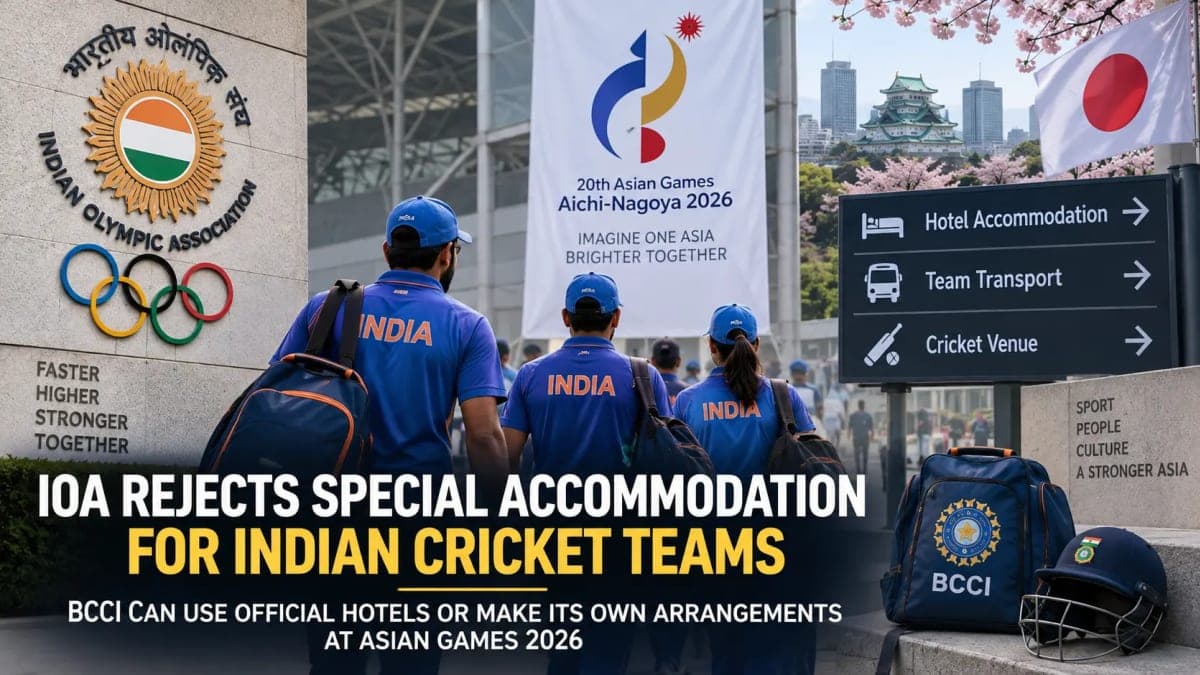
India’s cricketers will not receive a separate accommodation arrangement from the Indian Olympic Association at the 2026 Asian Games, even as the BCCI examines whether the facilities allocated to its players will meet the teams’ requirements.
The IOA has made clear that cricket will be treated like every other sport in the Indian contingent. The BCCI remains free to arrange alternative accommodation, but doing so would place the responsibility for hotels, meals and local transport on the cricket board.
The issue has come into focus as preparations gather pace for the Aichi-Nagoya Games, where organisers are relying on a combination of hotels and other accommodation rather than a conventional central Athletes’ Village.
BCCI Considering Inspection of Facilities in Japan
IOA CEO Raghuram Iyer said BCCI CEO Hemang Amin had been in contact with the Olympic body over the accommodation arrangements.
The cricket board is considering sending an advance team to Japan to inspect the facilities before making a final decision. That visit could determine whether the men's and women's squads use the accommodation assigned by the organisers or move to hotels selected independently by the BCCI.
For the IOA, however, the principle is straightforward.
“All sports, athletes, coaches and the entire delegation are treated equally by IOA,” Iyer said.
The IOA therefore does not intend to ask organisers to create a special accommodation category for cricket.
That does not prevent the BCCI from seeking different arrangements. It simply means the cricket board would have to organise and finance them itself while coordinating with the relevant Games authorities.
Separate Hotels Allocated to Men’s and Women’s Teams
According to current reports, the Indian men’s cricket team has been allocated rooms at the three-star APA Hotel Nagoya Ekimae. The women’s team is due to stay at the four-star Meitetsu Grand Hotel.
Room-sharing has emerged as one of the BCCI’s concerns.
Reports indicate that the board raised the prospect of two players being required to share rooms, along with questions about whether the available space would be sufficient for cricketers travelling with substantial kit and luggage.
Those concerns have contributed to speculation over possible alternatives, including reports that the men’s team could be housed on a cruise ship. That arrangement, however, has not been established as final.
The Japan Cricket Association has said cricket teams are being offered hotel accommodation and can make their own arrangements if they choose not to use the facilities provided.
Aichi-Nagoya Takes a Different Approach to Athlete Housing
The debate is partly a product of the accommodation model being used for the 2026 Asian Games.
Rather than concentrating competitors in one traditional Athletes’ Village, organisers have adopted a decentralised system involving hotels, temporary facilities and the Costa Serena cruise ship.
Accommodation capacity had initially been planned for up to 15,000 people under the Host City Contract, while registrations eventually exceeded 17,000 athletes and officials. Organisers and the Olympic Council of Asia later said appropriate accommodation had been secured for those registered before the deadline.
For cricket teams, the question is not limited to room size or privacy.
Matches will be played at Korogi Sports Park in Nisshin City, about 20 kilometres from central Nagoya. That makes travel time, team transport and match-day logistics important considerations if a board chooses accommodation outside the system arranged by organisers.
BCCI Would Take Responsibility for an Independent Stay
Should the BCCI decide that the allocated hotels do not meet its requirements, it has another route available.
The board could arrange its own accommodation, but the freedom to do so comes with additional responsibilities. It would need to manage rooms and meals, organise local transportation and ensure players reach the competition venue according to Games requirements.
BCCI Secretary Devajit Saikia has indicated that the board is prepared to intervene if the official facilities prove inadequate.
Saikia said the BCCI did not currently see an issue that would prevent the teams from participating comfortably, while making clear that the board could establish its own arrangements to ensure suitable facilities for the players if necessary.
The distinction is important. The IOA is not preventing the cricket teams from staying elsewhere; it is declining to obtain preferential accommodation for them within the Indian contingent.
Other Asian Cricket Boards Have Raised Concerns
India is not the only cricketing nation to have examined the arrangements closely.
Earlier reports said accommodation and venue-related concerns were discussed among several Asian cricket boards. Pakistan was reported to have raised the matter at an Asian Cricket Council meeting, with representatives from India, Bangladesh, Sri Lanka and Afghanistan also involved in discussions.
The cricket venue itself has attracted attention during preparations.
Korogi Sports Park is a remodelled baseball facility that was converted for cricket and uses a hybrid pitch. It hosted matches during the ICC Men’s T20 World Cup East Asia-Pacific Qualifier in May, providing competitive use of the surface before the Asian Games.
Decision Now Rests With the BCCI
The accommodation question has consequently narrowed to a practical decision rather than a dispute over whether India can participate under acceptable conditions.
The BCCI can use the facilities made available through the Asian Games system, or it can take greater control over the teams’ stay by arranging accommodation independently.
An advance inspection would give the board a clearer picture of the rooms, travel requirements and other facilities before it commits to either option.
For the IOA, meanwhile, the policy has already been settled: cricket will enter the Games under the same accommodation framework offered to the rest of India’s sporting contingent, unless the BCCI chooses to make and manage its own arrangements.


