Karnataka is trying to solve a problem that startup funding alone cannot fix: finding the first serious customer.
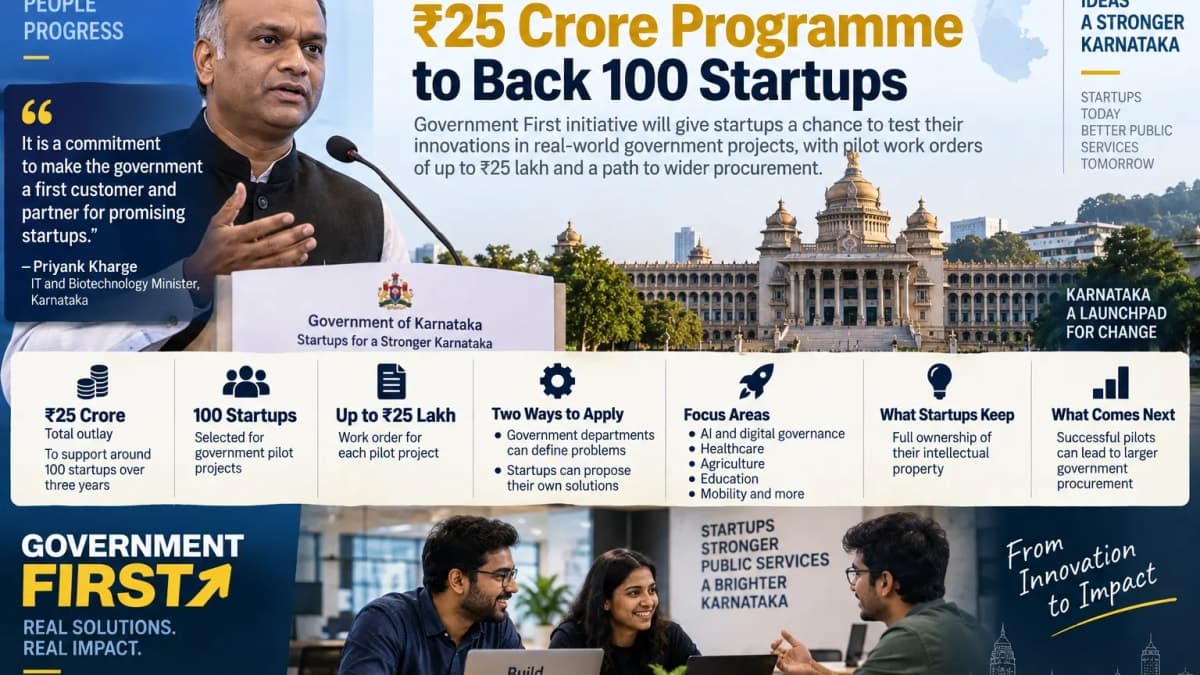
Under a new ₹25 crore initiative, the state government plans to work with around 100 startups over the next three years, giving selected companies an opportunity to deploy their technology within government departments.
The programme, called Government First, is part of Karnataka's Startup Policy 2025–30. Rather than distributing money solely as grants, it will issue pilot work orders worth up to ₹25 lakh for solutions that are ready to be tested in real operating environments.
For startups, the attraction goes beyond the initial contract. A pilot that meets its agreed targets can potentially move toward wider government procurement.
That makes the state not just a source of startup support, but a prospective customer.
Government as the First Customer
Karnataka IT and Biotechnology Minister Priyank Kharge described that relationship as central to the programme.
“It is a commitment to make the government a first customer and partner for promising startups.”
For an early-stage company, that distinction matters.
A startup may have developed a viable product and secured investment but still lack the institutional track record required to win large contracts. Government procurement can be particularly difficult to enter because established vendors generally have advantages in experience, references and familiarity with public-sector processes.
Government First is intended to create a route around that initial barrier.
Startups will not need previous experience working with the government to participate. Instead, companies with deployment-ready products can compete for a limited pilot and demonstrate whether their technology works under real conditions.
Departments Can Set Problems, Startups Can Propose Solutions
The programme is designed to work in both directions.
Government departments will be able to identify operational or public-service problems and seek proposals from startups capable of addressing them.
Companies will not always have to wait for that process.
A startup that already has a relevant, deployment-ready product can approach the government with its own proposal, allowing technologies to be considered even when a department has not formally issued a challenge around them.
That structure could widen the range of ideas entering government.
Traditional procurement usually begins with the buyer defining what it wants. Young technology companies often work differently: they may develop a product before potential customers have established a procurement category for it.
Allowing startups to initiate proposals gives the state another way to discover those products.
Pilot Orders Capped at ₹25 Lakh
Selected startups can receive work orders of up to ₹25 lakh for individual pilots.
The scheme is aimed at technologies that have progressed beyond an early concept or basic research stage. Companies are expected to have solutions sufficiently developed to be deployed and evaluated.
Once a pilot begins, its performance will be measured against defined objectives.
A successful result does not automatically guarantee a large government contract. It can, however, lead to an assessment and recommendation for procurement, after which the relevant department may consider a larger order through the applicable process.
Technology that proves useful in one department may also have applications elsewhere in government.
That is where the programme could become more valuable than the original ₹25 lakh ceiling. A small pilot can establish evidence that a product works in a public-sector environment, potentially giving the company a stronger basis for subsequent contracts.
AI and Digital Governance Among Target Areas
Karnataka is keeping the programme open to several areas where technology could be applied to public services.
Artificial intelligence and digital governance are among the identified fields, alongside healthcare, agriculture, education and mobility.
The range suggests the state is looking for practical applications rather than concentrating the fund on one fashionable technology category.
A healthcare startup, for example, would be judged on whether its product can address a defined need in that field. The same principle would apply to an AI company or a business working on mobility.
The relevant test is not simply whether a product is innovative. It is whether it can solve a government problem and demonstrate that performance during the pilot.
Startups Retain Their Intellectual Property
The intellectual-property terms could be particularly important for technology founders.
Participating startups will retain ownership of their intellectual property.
That allows a company to demonstrate proprietary technology within government without automatically giving up control of the underlying product or technical assets.
It also preserves the startup's ability to commercialise its technology with other customers.
For companies considering public-sector work, clarity around IP ownership can influence whether a government pilot is commercially worthwhile. A contract becomes less attractive if proving a technology requires the business to compromise ownership of what it has built.
Under Government First, the pilot is intended to test the solution rather than transfer ownership of the startup's core technology to the state.
Three-Level Oversight for Selection and Spending
The government has established three committees to oversee the initiative.
A Selection Committee will evaluate proposals and decide which projects should proceed.
A Technical Committee will supervise implementation and assess whether the startup is meeting agreed milestones.
A Review Committee will oversee financial matters.
That structure reflects an unavoidable tension in public-sector innovation programmes.
Startups generally benefit from fast decisions and room to experiment. Government spending, by contrast, requires documentation, oversight and accountability.
The practical success of Government First will depend partly on whether Karnataka can preserve both.
If pilots can be approved and evaluated within commercially useful timelines, the programme may give startups a genuine route into public-sector sales. If administrative processes become prolonged, the advantage of working with smaller and faster-moving companies could diminish.
Why Procurement Matters More Than the Fund Size
The ₹25 crore allocation provides the programme with its headline number, but it is not necessarily its most consequential feature.
Spread across approximately 100 startups and three years, the funding is relatively focused. The larger economic effect would come if successful pilots turn into regular procurement.
That is because a government customer can provide more than revenue.
For a young company, demonstrating that its product has operated successfully within a government department can provide a reference point when approaching other public agencies or large institutional customers.
For the state, a pilot limits the initial financial commitment while providing an opportunity to test newer technology before considering deployment at greater scale.
Neither side has to begin with a large contract.
The pilot becomes the evidence on which the next decision can be made.
Part of Karnataka’s Wider Startup Policy
Government First forms part of Karnataka's Startup Policy 2025–30, which has set a broader goal of facilitating the growth of up to 25,000 startups.
The state already has a major advantage in that effort: Bengaluru is one of India's most established technology and startup centres.
The new programme addresses a different question from the usual debate over startup funding.
Capital helps a company build. Customers determine whether it has a business.
By opening government departments to pilot projects, Karnataka is attempting to connect those two stages. The ₹25 crore allocation gives around 100 companies a chance to prove themselves, but the more meaningful measure will come later: how many pilots produce useful results, how many move into procurement, and whether successful products find applications across multiple departments.
If that pipeline works, the state will have created something more durable than another funding scheme.
It will have created a route from startup technology to government demand.