SORRY SUGAR Secures $1 Million Seed Funding to Scale Zero-Added-Sugar Business
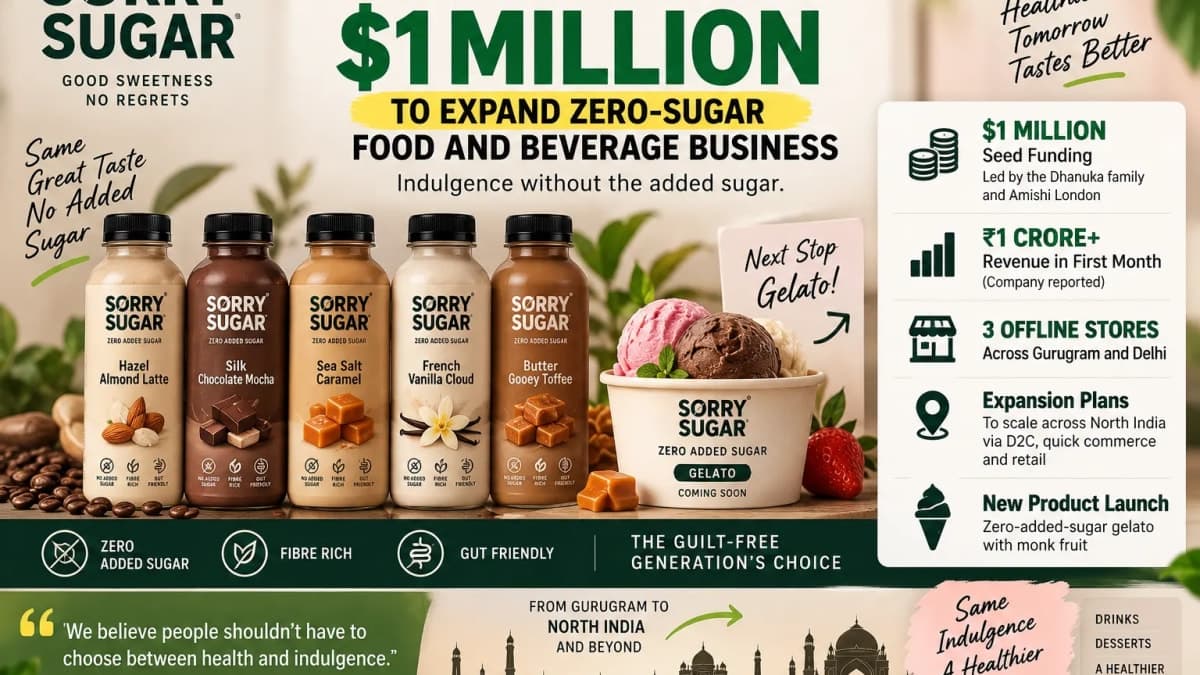
SORRY SUGAR has secured $1 million in its first seed funding round, giving the Gurugram-based startup fresh capital to expand a young consumer brand built around one proposition: indulgent food and beverages without added sugar.
The round was led by the Dhanuka family and Amishi London. The company intends to put the money behind distribution, product development and expansion across North India.
The funding comes early in SORRY SUGAR's development. It currently operates three offline stores across Gurugram and Delhi, while also selling through digital channels. The company says it generated more than ₹1 crore in revenue during its first month of operations.
That early performance is a company-reported figure. The more demanding test will be whether SORRY SUGAR can sustain sales as it moves beyond its initial stores and reaches consumers through a wider mix of channels.
A Beverage Brand Built Around Removing Added Sugar
SORRY SUGAR has positioned itself around zero-added-sugar products rather than conventional low-calorie or diet drinks.
Its beverages use monk fruit as a sweetener, and the company describes them as fibre-rich and gut-friendly. It has also said its formulations were developed with diabetic consumers in mind. Those descriptions reflect the company's positioning and should not be treated as independent medical or nutritional assessments.
The current portfolio leans heavily into familiar café-style flavours, including Hazel Almond Latte, Silk Chocolate Mocha, Sea Salt Caramel, French Vanilla Cloud and Butter Gooey Toffee.
That choice is central to the brand's strategy. Instead of asking consumers to abandon sweet, dessert-like flavours in pursuit of healthier choices, SORRY SUGAR is trying to remove added sugar while retaining the experience associated with an indulgent drink.
The company is particularly targeting Gen Z consumers, betting that closer attention to ingredient labels can coexist with demand for products that still feel like treats.
Expansion Will Test More Than Consumer Demand
SORRY SUGAR plans to use the seed capital to build its presence across North India, with growth expected through direct-to-consumer sales, quick-commerce platforms and physical retail.
Each channel solves a different part of the distribution problem.
Quick commerce can put the brand in front of consumers without requiring a large store network. D2C gives the company greater control over its customer relationship. Physical outlets, meanwhile, can help a relatively unfamiliar brand introduce its products through direct trial.
Running all three also creates complexity. Customer-acquisition costs, delivery economics, retail margins and store expenses will matter increasingly as the business moves beyond its launch phase.
The company's first-month revenue offers evidence of initial demand, but scaling will depend on whether that demand can be repeated across new locations and sales channels without weakening unit economics.
Gelato Will Be the First Test Beyond Drinks
The next stage of SORRY SUGAR's product strategy takes the company outside its original beverage category.
It plans to introduce zero-added-sugar gelato sweetened with monk fruit, extending the same basic proposition into frozen desserts.
The move is more significant than simply adding another item to the menu.
If consumers respond, SORRY SUGAR could begin to develop from a specialist beverage company into a broader zero-added-sugar food and beverage brand. It would also give the business more occasions to reach customers beyond coffee-style drinks.
But gelato introduces a different operating challenge. Frozen products require cold-chain handling and distribution infrastructure that packaged beverages do not necessarily need. Geographic expansion therefore becomes more complicated when the product portfolio expands at the same time.
How the company handles that transition will help determine whether its brand can travel successfully across categories.
Four Founders Behind the Business
SORRY SUGAR was founded by Deepak Pathak, Kunal Verma, Shashank Sherawat and Saiyam Malik.
The startup was incubated by Palash Arneja, founder of BlaBliBlu, alongside Wolfpack Labs, led by Aakash Anand and Prerna Gupta.
Its strategy places the company within a broader shift in India's consumer market, where startups are experimenting with products aimed at shoppers who want to reduce sugar intake without moving entirely away from desserts, flavoured beverages and other indulgent categories.
That market opportunity, however, does not remove the need to compete on taste, price and convenience. A health-oriented proposition may attract a first purchase, but repeat consumption ultimately determines whether a food or beverage brand can build scale.
SORRY SUGAR Targets ₹60 Crore-Plus Revenue Run Rate
The company's growth ambitions are considerably larger than its present footprint.
SORRY SUGAR says it is targeting an annualised revenue run rate of more than ₹60 crore by the end of the current financial year.
That figure is a forward-looking company target, not annual revenue already earned.
Reaching it would require a sharp increase from the company's current scale, making the planned expansion across quick commerce, D2C and physical retail particularly important over the coming months.
The new funding gives the company more resources to pursue that target, but capital alone will not settle the larger question facing the business.
SORRY SUGAR has shown that a zero-added-sugar proposition can generate early consumer interest. Its next phase will reveal whether that interest can support a durable brand across more cities, more distribution channels and, with the arrival of gelato, more product categories.