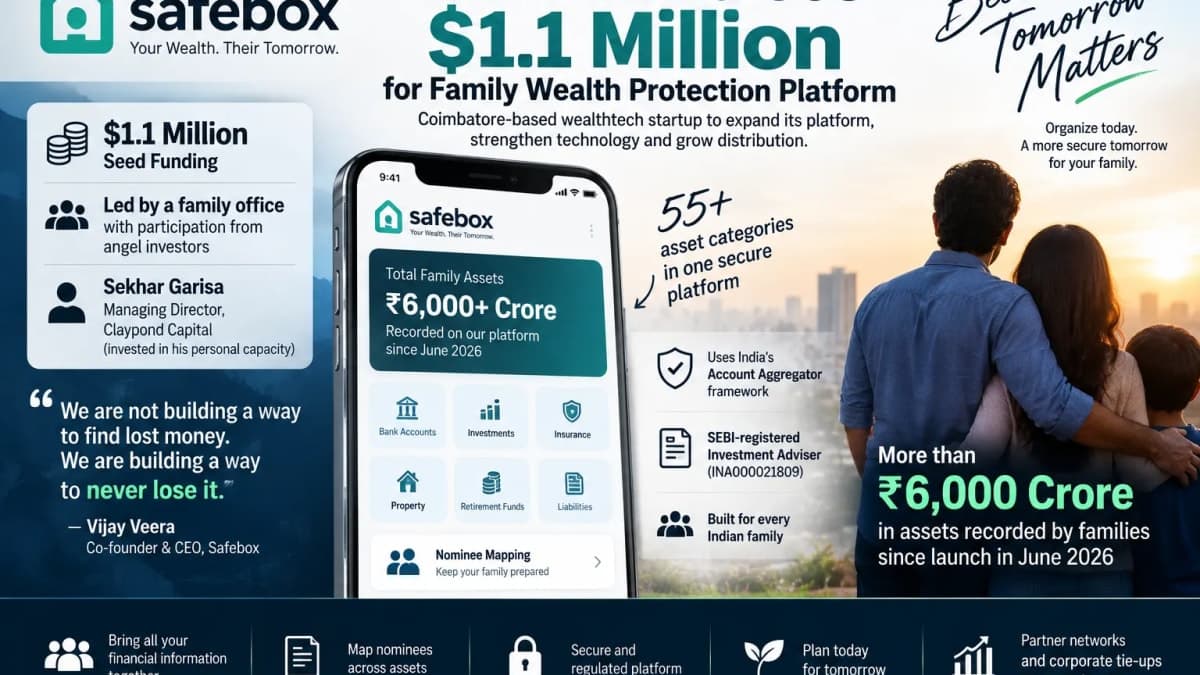
Safebox Secures $1.1 Million Seed Funding to Build Out Family Wealth Protection Business
Safebox has raised $1.1 million in seed funding as the Coimbatore-based startup looks to turn a familiar household problem into a financial technology business: families often accumulate substantial wealth without maintaining a single, reliable record of where it is held.
The round was led by a family office and included participation from angel investors. Sekhar Garisa, managing director of Claypond Capital, invested in his personal capacity.
Safebox plans to use the fresh capital to improve its technology and expand distribution through partnerships, corporate relationships and direct customer acquisition.
The company is not positioning itself primarily as another investment portfolio tracker. Its pitch is built around what happens beyond investing — whether family members know what assets exist, where the records are kept and who has been nominated to receive them.
Organising Wealth Before It Becomes Difficult to Find
For many households, financial information becomes fragmented gradually.
Bank accounts may sit with several institutions. Stocks and ETFs are held through brokers and depositories. Provident fund and NPS accounts operate separately, while insurance policies, property records and liabilities create additional layers of paperwork.
One person in a family may understand the complete picture. Others may not.
Safebox is designed to bring that information into a consolidated family record. The platform covers 55 categories, including assets, liabilities and insurance, and allows users to map nominee information alongside their financial holdings.
It also uses regulated financial infrastructure, including India's Account Aggregator framework, to help organise information.
The practical problem the startup is addressing becomes most visible when the person who managed a household's finances is no longer available to explain them. An asset may still legally belong to the family, but discovering it, locating the necessary documentation and understanding the claim process can become considerably harder.
Safebox wants that organisation to happen earlier.
Families Have Recorded More Than ₹6,000 Crore
The company publicly launched its platform in June 2026 and says users have since recorded more than ₹6,000 crore in assets across the categories it supports.
That number requires an important qualification.
It represents assets that families have recorded through Safebox. It should not be treated as ₹6,000 crore in assets under management in the conventional wealth-management sense.
Safebox is primarily providing the infrastructure to organise and plan around those holdings rather than taking custody of the entire amount.
The business operates through Beyondco Technologies Private Limited, which is registered with the Securities and Exchange Board of India as a non-individual Investment Adviser. Safebox lists its SEBI RIA registration number as INA000021809, with registration effective from February 10, 2026.
For a company asking families to consolidate sensitive information about their finances, that regulatory framework forms an important part of its proposition.
Funding Will Support Product Development and Distribution
Safebox's next phase involves both technology and reach.
The company intends to strengthen its product, integrations and user experience while building distribution through partner networks and corporate tie-ups. Part of the seed capital will also support customer acquisition.
Distribution presents a particular challenge for this category of financial product.
Investment platforms have a relatively straightforward proposition: consumers invest because they want to build wealth or earn returns. Family financial organisation is different. Its value may be substantial, but the consequences of poor record-keeping are often invisible until a death, emergency or other major event forces relatives to reconstruct someone's financial affairs.
Safebox is trying to persuade households to do that work before there is a crisis.
Co-founder and CEO Vijay Veera described the company's approach succinctly:
“We are not building a way to find lost money. We are building a way to never lose it.”
That distinction also explains why Safebox is placing nominee mapping and family access alongside conventional financial information.
India's Unclaimed Assets Show the Size of the Underlying Problem
Safebox is entering a market where the consequences of disconnected financial records are already visible.
The company has cited data showing that ₹86,917 crore in unclaimed bank deposits had been transferred to the Reserve Bank of India's Depositor Education and Awareness Fund as of June 30, 2026.
That number should not be interpreted as the addressable market for Safebox. Deposits can become unclaimed for many reasons, and better household record-keeping would not necessarily prevent every case.
It does show, however, how significant the gap can become between the existence of a financial asset and the ability of its owner or beneficiaries to access it.
The problem extends beyond deposits. A household's wealth may be divided among securities, retirement accounts, insurance policies, real estate and other assets, each with different documentation and claim procedures.
For Safebox, the commercial opportunity lies in making that fragmented picture easier for a family to understand while the information is still readily available.
A Coimbatore Startup Taking on a National Wealth Problem
Safebox was founded by Vijay Veera, Vignesh Rengasamy and Rajesh Sankarappan, serial entrepreneurs with experience building businesses in India and the United States. It is their third venture together.
The company's base in Coimbatore places it outside the Bengaluru-Mumbai-Delhi corridor that dominates much of India's fintech industry.
Its target market, though, is national.
Indian households have gained access to a much broader range of financial products over the past decade. Digital investing has made it easier to open accounts and distribute savings across different instruments. The administrative side of family wealth has not necessarily become simpler at the same pace.
That creates room for a product that treats financial organisation as part of wealth planning rather than as paperwork to be dealt with later.
Safebox's early numbers suggest that users are willing to place substantial financial information into such a system. More than ₹6,000 crore recorded within months of launch is a notable company-reported adoption metric, even though it is not equivalent to assets under management.
The $1.1 million round gives Safebox capital to find out whether that early use can develop into a larger business.
Growth will depend on more than adding users. A platform built around family financial information has to earn sustained trust, maintain strong security standards and demonstrate that people will continue updating their records after the initial setup.
If Safebox can solve that behaviour problem, its opportunity is broader than helping people track what they own. It is about making sure the knowledge surrounding family wealth survives alongside the wealth itself.