Piston Raises $15 Million to Expand Cardless Payment Network for Commercial Fleets
For commercial fleets, paying for fuel has long meant handing drivers a physical card and then trying to control what happens after it leaves the office.
Piston is building its business around removing that card altogether.
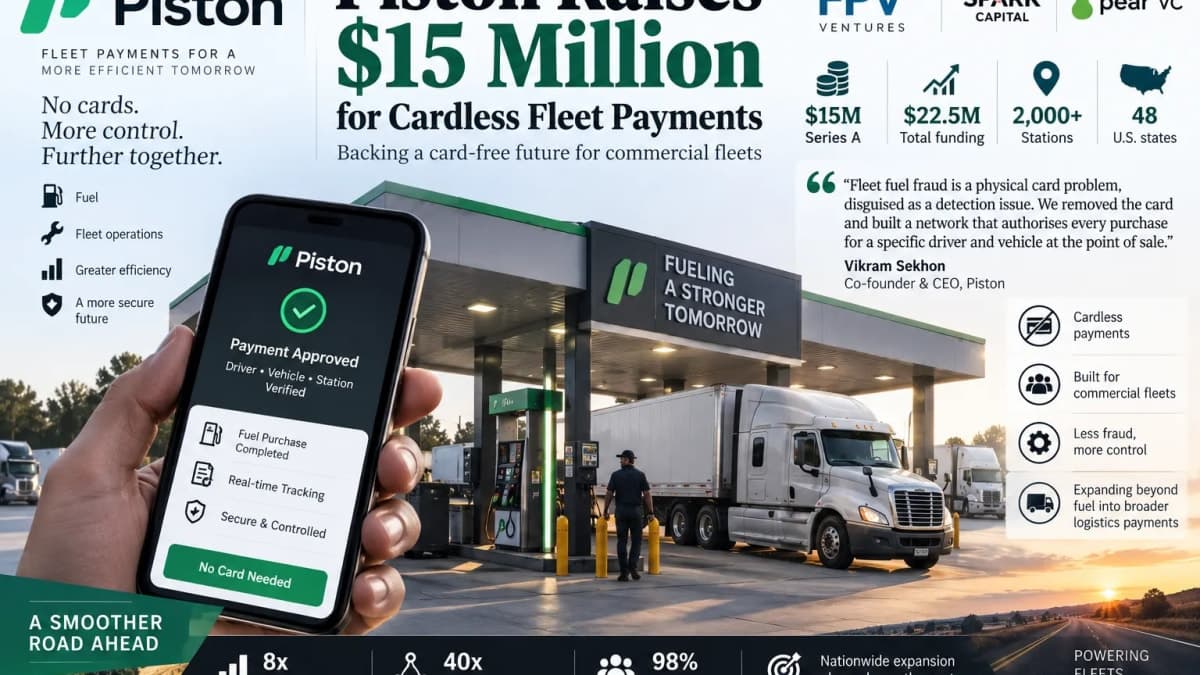
The fleet-payments startup has raised $15 million in Series A funding to expand a network that allows commercial drivers to pay at participating fuel stations through mobile authorisation linked to both the driver and vehicle.
FPV Ventures led the round, with existing investors Spark Capital and Pear VC also participating. The financing brings Piston’s total funding to $22.5 million.
The company plans to use the new capital to expand across the United States, strengthen its product and hire senior executives. Over the next 18 months, it aims to establish coverage across every U.S. region before pursuing a broader ambition: applying the same infrastructure to other logistics payments.
The Founders Started With a Problem They Had Already Experienced
Piston was not conceived simply as another fintech product looking for an industry to modernise.
Co-founders Vikram Sekhon and Shivam Shah had previously operated commercial fleets, giving them firsthand exposure to the costs and controls surrounding fuel purchases.
Fuel represented the second-largest expense in Sekhon’s fleet after payroll, according to his account. Managing physical cards added another layer of work, particularly when cards were lost, misused or shared.
That experience shaped Piston’s approach.
Rather than build another fuel card with additional fraud-detection features, the founders decided the physical card itself should disappear from the transaction.
“Fleet fuel fraud is a physical card problem, disguised as a detection issue,” Sekhon, Piston’s co-founder and CEO, said in announcing the funding.
“We removed the card and built a network that authorises every purchase for a specific driver and vehicle at the point of sale. This round lets us expand that infrastructure until no commercial driver has to ask whether a station accepts Piston.”
That final challenge, acceptance, is likely to determine whether the model can scale.
How Piston Changes a Fuel Transaction
Traditional fleet cards give companies more control than ordinary consumer credit cards, but they still depend on a physical payment credential being carried by a driver.
Piston replaces that credential with a digital authorisation process.
A transaction can be associated with a specific driver and vehicle, while fleet managers establish rules governing where purchases can occur, when they are permitted and what type of fuel can be bought.
The platform can also incorporate vehicle information and telematics data into the authorisation process.
That changes the point at which fraud controls are applied.
Instead of discovering an unusual purchase after a card has been used, Piston is designed to assess whether the circumstances of the transaction fit the fleet’s rules before or during authorisation.
For fleet operators, the system also provides real-time visibility into spending rather than leaving managers to reconcile transactions later from card statements.
Removing plastic does not eliminate every form of fraud. It does, however, allow the payment itself to be tied more closely to the driver, vehicle and location involved.
Piston Says Its Network Has Expanded Rapidly
The Series A follows a period of substantial growth, according to figures released by the company.
Piston says payment volume increased eightfold year over year, while its merchant network expanded 40-fold. It reported customer retention of 98%.
The company also says its technology is deployed at more than 2,000 fuel stations across 48 U.S. states.
Its point-of-sale integrations have been certified and deployed across systems that cover more than 95% of U.S. merchant fuel locations, according to Piston.
Those are company-reported operating figures rather than independently audited measures of market share. They nevertheless illustrate the problem Piston is now using its Series A to address.
Payments depend on acceptance.
A fleet operator may like the additional controls of a cardless system, but drivers need to know they can use it along the routes they travel. The more stations Piston adds, the more practical the service becomes for fleets.
At the same time, a larger base of fleet customers makes the network more attractive to fuel retailers.
Fuel Stations Need a Reason to Participate Too
Piston’s model therefore depends on more than convincing fleet managers.
It also has to offer value to gas stations and convenience stores.
Commercial vehicles can be desirable customers because they buy fuel frequently and often in larger quantities than individual motorists. Drivers may also purchase food, drinks and other products inside convenience stores.
Piston positions its network as a way for merchants to attract more of that commercial traffic while potentially lowering payment costs.
The company negotiates fuel discounts with participating stations that can then be offered to fleet customers. Piston advertises discounts of up to 40 cents per gallon at partner locations, although actual savings vary.
That structure gives the company a classic network challenge.
Fleets benefit from having more stations. Stations benefit from having more fleets.
Piston has to grow both sides at roughly the same time.
Fleet Payments Carry Costs Beyond Fraud
Fraud is the easiest problem to put in a headline, but physical cards create more routine administrative work as well.
Fleet operators have to issue cards, replace them when they are lost, cancel them when drivers leave and manage spending restrictions across potentially hundreds or thousands of vehicles.
Drivers can also move between vehicles and routes, complicating controls built primarily around a piece of plastic.
Digital authorisation gives operators more flexibility.
A fleet can add or remove drivers electronically and connect payment permissions to variables such as a vehicle, route, shift, geographic area or fuel type.
The system can also assess whether the vehicle is near the station and whether a proposed fuel purchase is consistent with information about that vehicle.
For operators, the value proposition is therefore broader than stopping theft. Piston is also trying to reduce the amount of manual administration attached to everyday fuel spending.
Kolkata Plays a Role in Piston’s Technology Operation
Although Piston is focused commercially on the U.S. fleet market, part of its engineering operation is based in India.
The company established an engineering centre in Kolkata in April 2023 with five employees.
That operation has since expanded to more than 25 people, according to Piston, and contributes to the technology supporting its payments network.
The company expects Kolkata to remain part of its product and engineering strategy as it expands in the United States.
For Piston, the arrangement separates where much of the product is being built from the market where the company is currently trying to achieve scale.
Fuel Could Be the Entry Point, Not the Final Market
The Series A also gives Piston room to pursue a larger opportunity.
Commercial vehicles incur costs well beyond fuel. Fleets pay for maintenance, repairs, tolls and other services as vehicles move through logistics networks.
Piston sees fuel as the starting point for infrastructure that could eventually support a wider range of those transactions.
There is a logic to beginning there.
Fuel is unavoidable, frequent and expensive. It also creates repeated interactions between drivers, fleet operators and merchants, giving Piston an opportunity to build the network relationships a broader payments business would need.
But the distinction between ambition and an established business matters.
Piston has built its current proposition around fuel payments. Extending that model across other logistics spending will require additional merchant relationships, product development and adoption.
The $15 million round provides capital for that next phase; it does not guarantee it.
Nationwide Acceptance Is the Bigger Test
Piston is entering a market where physical fleet cards already have an important advantage: drivers know where they work.
That familiarity matters when a truck or commercial vehicle is hundreds of miles from its base and needs fuel immediately.
A new payment system can offer stronger controls, better data or lower fees, but those benefits become less useful if a driver cannot reliably find somewhere to use it.
That is why Piston’s next 18 months are primarily a network-building exercise.
Its reported presence across 48 states shows geographic reach, but achieving sufficient density within those states is a different test. Fleet operators will judge the service not simply by how many stations are technically connected, but by whether those stations match the routes their vehicles actually travel.
Piston’s bet is that cardless authorisation can eventually make the physical fuel card unnecessary.
The Series A gives it $15 million more to build the coverage required to make that proposition practical.