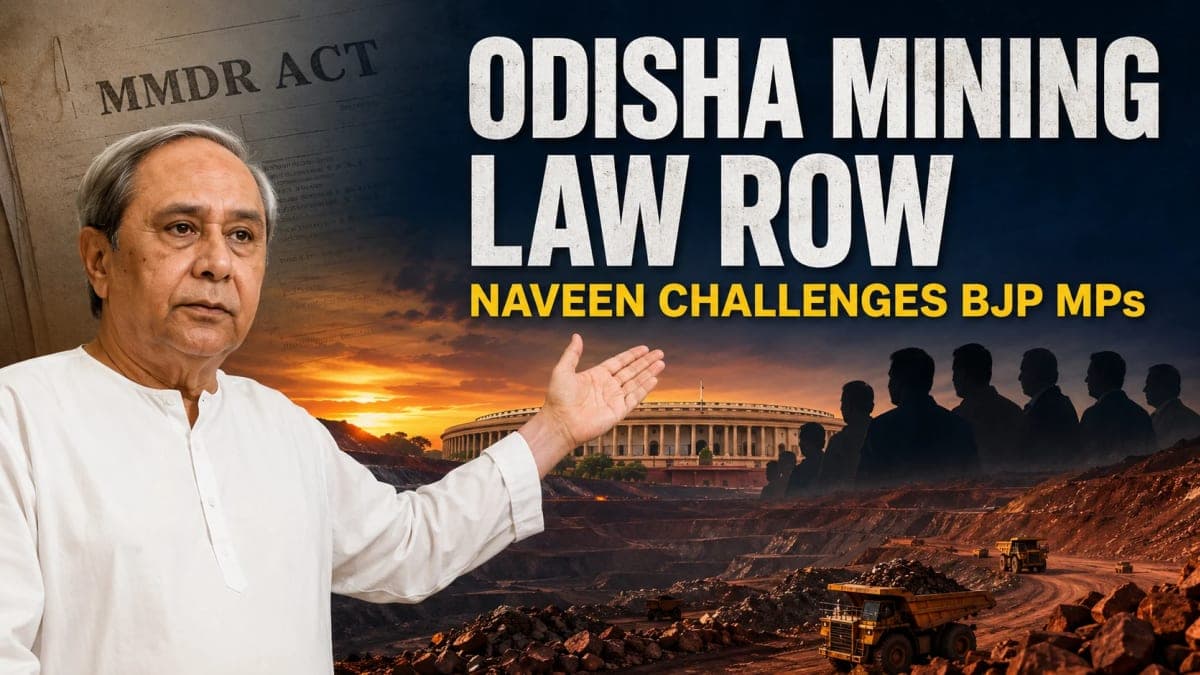
Naveen Patnaik Confronts Odisha BJP MPs Over MMDR Act Amendments
Biju Janata Dal president Naveen Patnaik has intensified his opposition to the amended mining law by directly asking Bharatiya Janata Party MPs from Odisha to demand its reversal.
In a letter addressed to the BJP parliamentarians, Patnaik argued that the changes to the Mines and Minerals (Development and Regulation) Act would restrict the state government’s ability to tax mineral rights and mineral-bearing land. He asked the MPs to consider Odisha’s long-term interests rather than follow their party’s position.
The legislation was passed by Parliament earlier in August 2026. Patnaik, who is the Leader of the Opposition in the Odisha Assembly and a former chief minister, described its passage in the Lok Sabha on August 13 as a “black day” for the state.
What Naveen Patnaik Told Odisha’s BJP MPs
Patnaik questioned why the state’s BJP representatives had supported legislation that, according to him, could have serious financial and constitutional consequences for Odisha.
He alleged that the Bill was approved in the Lok Sabha after less than ten minutes of discussion, despite dealing with the rights of mineral-producing states and the future of communities affected by mining.
Patnaik asked the MPs to push for a rollback of provisions that he believes reduce the authority of state governments. He framed the matter as a test of whether elected representatives would place Odisha’s interests above party considerations.
The BJP won 20 of Odisha’s 21 Lok Sabha seats in the 2024 election, giving its MPs a particularly important position in the dispute.
What the MMDR Amendments Change
The dispute concerns provisions expanding the Union government’s regulatory authority to cover mineral-bearing land in addition to mines and mineral development.
The amendments also prohibit state governments from imposing certain taxes, cesses or similar charges on mineral rights and mineral-bearing land. Another provision gives the Centre authority to formulate rules governing taxation connected to minerals.
These changes carry particular significance following a 2024 Supreme Court judgment that upheld the power of states to tax mineral rights and mineral-bearing land. The court also permitted states to recover certain tax dues dating back to April 1, 2005, without interest or penalties.
The 2026 legislation has consequently reopened a larger constitutional and political debate about how authority over natural resources should be divided between the Union and state governments.
Patnaik Claims Odisha Could Lose ₹12,000 Crore Annually
Patnaik has claimed that Odisha may lose more than ₹12,000 crore in annual revenue because of the amended law. He says the cumulative financial impact could eventually run into lakhs of crores.
The figure represents the BJD leader’s estimate and remains disputed by the BJP. It should therefore be treated as a political claim rather than an independently established loss.
Patnaik’s central argument goes beyond revenue. He maintains that Odisha bears the environmental and social costs associated with mining, including pollution, displacement, land degradation and pressure on local communities. In his view, limiting the state’s taxation authority would weaken its ability to use mineral income for welfare and development.
He also noted that mining revenue supports areas such as healthcare, education, infrastructure and social programmes.
Why Odisha Is Central to the Mining Debate
Odisha is one of India’s most mineral-rich states and possesses major deposits of iron ore, bauxite, chromite, coal and other resources. Its mineral sector supplies raw materials to steel, power, aluminium and infrastructure industries across the country.
Patnaik said Odisha accounts for nearly 44% of India’s mineral wealth and has contributed substantially to national industrial development. According to reported state figures, Odisha earns approximately ₹50,000 crore annually from mining-related activity.
This economic dependence means that even a limited change in the collection or distribution of mineral revenue could affect the state’s finances. It also explains why the amendment has developed into a major regional political issue rather than remaining a technical dispute over taxation.
BJP Rejects Patnaik’s Revenue-Loss Argument
BJP MP Dharmendra Pradhan rejected Patnaik’s allegations and accused him of creating unnecessary fear about the legislation.
Pradhan described the amendment as an important reform that would encourage investment, infrastructure development and industrial competitiveness. He argued that Odisha’s financial interests remain protected and that approximately 90% of mining-sector revenue would continue to flow to state governments through auction premiums, royalties and District Mineral Foundation contributions.
The BJP’s position is that limiting overlapping or excessive taxes can provide greater predictability for mineral-dependent industries without depriving states of their principal revenue streams.
Pradhan also pointed to earlier MMDR reforms introduced in 2015, including mandatory mineral-block auctions and revised royalty arrangements, which he said helped increase Odisha’s mining income.
Patnaik Previously Sought a Special Assembly Session
The letter to BJP MPs follows Patnaik’s earlier appeal to Chief Minister Mohan Charan Majhi.
On August 14, Patnaik requested a special session of the Odisha Assembly and proposed a resolution opposing the amendments. He also called for an all-party discussion to develop a common position on the state’s mineral rights and revenue interests.
By now approaching BJP MPs directly, the BJD leader has shifted the debate from an institutional disagreement between governments to a question of individual political accountability.
Why the Dispute Matters
The controversy matters for three principal reasons.
First, it concerns Odisha’s fiscal capacity. Mineral-related earnings form a significant part of the state’s revenue and help fund public services.
Second, it raises questions about Indian federalism. Natural resources are located within states, but mining regulation also involves central legislation and national economic policy. Determining which level of government may impose taxes has consequences for every mineral-producing state.
Third, mining creates both economic opportunities and significant local costs. Communities near mining areas may experience displacement, environmental damage and disruption to traditional livelihoods. The allocation of revenue therefore determines whether the regions bearing these burdens receive adequate compensation and development support.
Balanced Analysis: Revenue Protection Versus Regulatory Uniformity
Patnaik’s argument reflects a legitimate concern for state autonomy. A mineral-rich state may reasonably contend that it should retain sufficient control over revenue raised from resources located within its territory, particularly when it must address the environmental and social consequences of extraction.
The BJP’s position also presents a relevant economic consideration. Multiple taxes and overlapping regulations can increase business costs, discourage investment and create uncertainty for industries dependent on minerals. A more uniform national framework could make the sector easier to regulate.
However, the debate cannot be resolved solely through political claims. Patnaik’s projected ₹12,000-crore annual loss and the BJP’s assertion that state revenues remain protected require a detailed, publicly available fiscal assessment.
Such an analysis should explain how much Odisha currently receives through royalties, auction premiums, taxes and District Mineral Foundation payments—and how each revenue source will change under the amended law.
Conclusion
Naveen Patnaik’s challenge to Odisha’s BJP MPs has turned the MMDR amendments into a major political contest over resource ownership, revenue and federal authority.
The BJD argues that the legislation could deprive Odisha of income and weaken its control over mineral-bearing land. The BJP maintains that the reforms preserve state earnings while creating a more stable environment for industry and economic growth.
Beyond the political exchange, the central question remains unresolved: whether the new framework distributes the benefits of mining fairly among the Union government, producing states, industries and communities living near extraction sites.
This article is based on reporting published by New India Express.