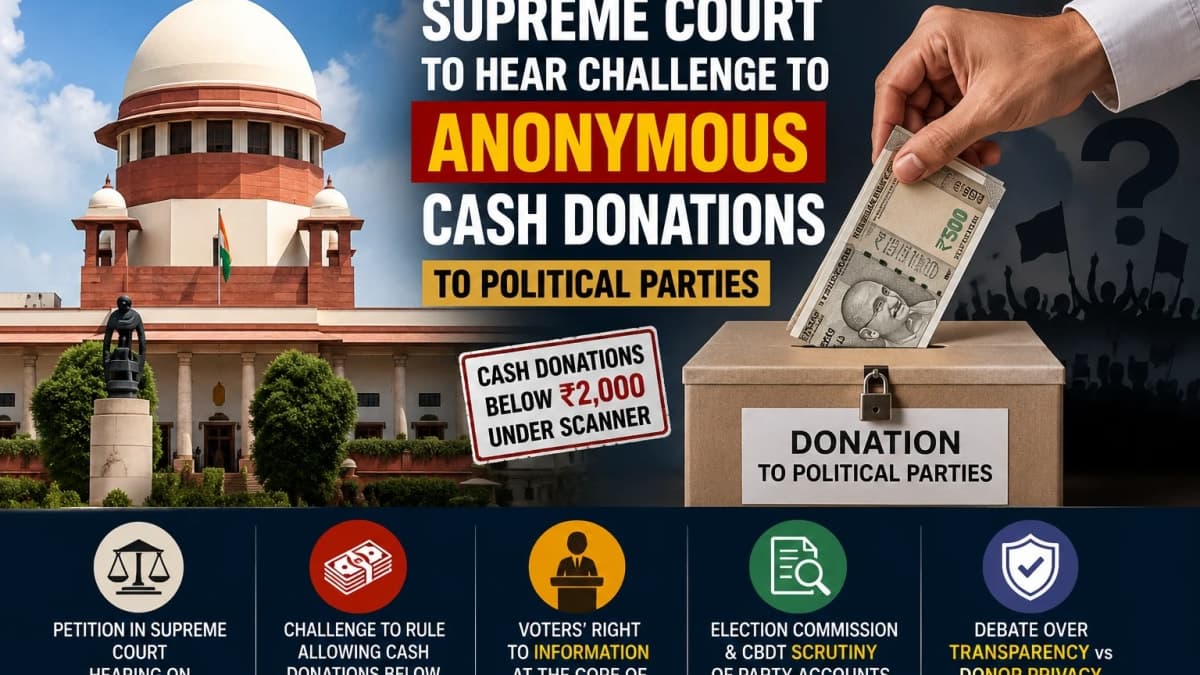
Supreme Court to Examine Anonymous Cash Donations to Political Parties
India’s political funding system is set to return to the Supreme Court spotlight, with the country’s highest court scheduled to hear a petition challenging the treatment of small cash donations received by political parties.
The matter is listed for hearing on August 31, 2026, before a bench comprising Justices Vikram Nath and Sandeep Mehta.
The petition, filed by Khem Singh Bhati, challenges a provision of the Income Tax Act that permits political parties to receive cash contributions below ₹2,000 without identifying individual donors in the manner demanded by the petitioner.
At the heart of the dispute is a larger constitutional question: how much information should voters be entitled to know about the people financing political parties?
What Is Being Challenged?
The petition targets Section 13A of the Income Tax Act, 1961, particularly the framework dealing with contributions received by political parties.
Under the existing system, the petitioner argues, cash contributions below ₹2,000 can effectively remain anonymous from the perspective of the voting public.
The challenge contends that this creates a transparency gap in political financing.
While ₹2,000 may appear to be a relatively small amount individually, the petition raises concerns about whether large amounts of political funding could potentially be divided into numerous smaller contributions.
The Supreme Court has not yet accepted these arguments as established facts. They form part of the petition that the court will consider.
Petition Links Political Funding to Voters’ Right to Information
One of the central arguments in the petition is that information about political funding can influence how citizens evaluate political parties.
Voters may want to understand who financially supports a party and whether significant financial relationships could influence political decisions.
The petition therefore connects donor disclosure with Article 19(1)(a) of the Constitution, which protects freedom of speech and expression and has also formed the basis of judicial recognition of voters’ right to relevant information in the electoral process.
According to the challenge, allowing anonymous cash contributions deprives citizens of information that could help them make informed electoral choices.
Petition Seeks an End to Cash Contributions to Parties
The case goes beyond simply asking for disclosure of donations below ₹2,000.
The petitioner has reportedly sought directions to the Election Commission of India that would effectively prevent political parties from receiving contributions in cash.
The petition wants the prohibition on cash donations to become a condition connected with political-party registration and allocation of election symbols.
If such relief were ultimately granted, it could represent a significant change in the way political parties collect smaller contributions.
Digital payments, bank transfers and other traceable mechanisms could consequently become more important in political fundraising.
Election Commission Scrutiny Also Sought
Another significant part of the petition concerns political parties’ contribution reports.
The petitioner wants the Election Commission to scrutinise Form 24A contribution reports submitted by recognised political parties.
It also seeks action where required donor information has allegedly not been provided.
The petition further asks for measures against political parties that fail to comply fully with applicable reporting requirements.
These requests demonstrate that the case is not limited to one provision of tax law.
It potentially touches several parts of India's political-finance disclosure and compliance system.
CBDT Asked to Examine Political Parties’ Tax Records
The petition also seeks directions involving the Central Board of Direct Taxes.
It wants the CBDT to examine income-tax returns and audit reports submitted by political parties during the previous five years.
Where violations are identified, the petition seeks appropriate proceedings under applicable tax and electoral laws.
Whether the Supreme Court ultimately considers such extensive directions appropriate will be one of the important aspects to watch as the litigation progresses.
Supreme Court Had Already Issued Notices
The dispute did not begin with the upcoming August hearing.
In November 2025, the Supreme Court issued notices in the matter to the Centre, Election Commission and political parties, bringing the constitutional challenge formally before the respondents.
The petition argued that India's rapid expansion of digital payment infrastructure has weakened the justification for continuing special treatment of small cash political donations.
India's UPI ecosystem and widespread availability of digital transactions form an important part of that argument.
The petitioner essentially questions whether anonymous cash remains necessary when small contributions can increasingly be made through traceable digital channels.
Electoral Bonds Judgment Provides Important Background
The latest case arrives roughly two and a half years after the Supreme Court delivered its landmark electoral bonds judgment.
In February 2024, a Constitution Bench struck down the Electoral Bond Scheme and associated legal amendments.
The judgment placed considerable emphasis on voters' interest in information about political financing while examining competing considerations such as donor privacy.
The present petition invokes that broader transparency debate, although cash donations below ₹2,000 involve a different legal mechanism.
The upcoming case therefore should not be treated as simply another electoral bonds case.
The Supreme Court will have to examine the specific statutory provisions and constitutional arguments raised in this petition.
Why Political Funding Transparency Matters
Political parties require money to operate.
Campaigns involve advertising, travel, staff, rallies, technology, research and organisational infrastructure.
Fundraising is therefore a legitimate and necessary component of democratic politics.
The controversy arises over how those funds should be collected and disclosed.
Greater transparency can help citizens identify significant financial relationships between political organisations and their supporters.
Disclosure can also make it harder to conceal questionable financial flows.
At the same time, political donations can represent an individual's political preference, raising legitimate concerns about privacy and potential retaliation.
Designing political-finance rules consequently requires balancing several competing democratic interests.
Arguments for Greater Disclosure
Supporters of stronger transparency requirements generally argue that political parties exercise enormous influence over public policy and government.
Knowing who finances them can therefore help voters assess possible conflicts of interest.
Traceable transactions can also strengthen auditing and make enforcement easier for regulators.
India's increasingly sophisticated digital payment infrastructure adds another argument.
Small-value transactions that previously might have required cash can now be completed electronically within seconds.
Critics of the existing exemption consequently question whether anonymity through cash remains necessary.
The Other Side: Privacy and Practical Access
There are also legitimate issues policymakers and courts may need to consider.
Not every small donor wants their political preferences publicly associated with their identity.
Political affiliation can be sensitive, particularly in highly competitive electoral environments.
Another consideration is accessibility.
Although digital payments have expanded enormously, cash continues to play an important role for sections of India's population.
Political parties may therefore argue that rules governing grassroots contributions should not unintentionally discourage ordinary citizens from participating financially in politics.
The key policy question may ultimately be whether traceability for regulators necessarily requires complete public disclosure of every small donor.
Those are related, but not identical, concepts.
Small Donations, Large Transparency Question
The ₹2,000 threshold makes the case particularly interesting.
The dispute is technically about relatively small individual cash contributions.
But the broader concern is whether repeated small anonymous contributions could collectively create substantial pools of money whose original sources are difficult to establish.
Any effective regulatory framework would therefore have to consider not only the size of individual donations but also record-keeping, aggregation, auditing and enforcement.
Simply changing the threshold may not resolve every potential loophole.
Case Comes Amid Wider Focus on Election Money
The hearing also arrives during renewed judicial attention to the role of money in Indian elections.
In August 2026, the Supreme Court separately issued directions aimed at combating the use of unaccounted cash to influence voters during elections.
That case concerned alleged election-related black money rather than the specific tax exemption challenged here.
Nevertheless, the proximity of the two developments highlights the judiciary's continuing engagement with questions surrounding money and electoral integrity.
Balanced Analysis: Transparency Must Also Be Enforceable
A prohibition on anonymous cash donations could theoretically improve traceability.
But legislation and court directions alone cannot guarantee transparent political financing.
Effective reform would also require reliable accounting systems, independent scrutiny, timely disclosure and meaningful consequences for non-compliance.
Otherwise, opaque funding could simply move through alternative channels.
There is also an important distinction between privacy and secrecy.
A regulatory system could potentially allow authorities to know a donor's identity while determining separately what information should be publicly disclosed.
Such approaches could become relevant when balancing voters' right to information with legitimate privacy concerns of individual political supporters.
What Happens Next?
The August 31 hearing will be an important stage rather than necessarily the final resolution of the dispute.
The Supreme Court will consider the constitutional and statutory questions raised by the petitioner along with responses from the government, Election Commission, political parties and other concerned parties.
The outcome could have implications beyond the ₹2,000 cash threshold.
At stake is a larger question about the future architecture of political fundraising in India: whether technology and changing expectations of electoral transparency require political-finance rules to evolve as well.
Whatever the eventual outcome, the case is likely to renew scrutiny of one of Indian democracy's most persistent questions — who finances political power, and how much of that information should citizens be allowed to see?
This article is based on reporting published by dailypioneer.