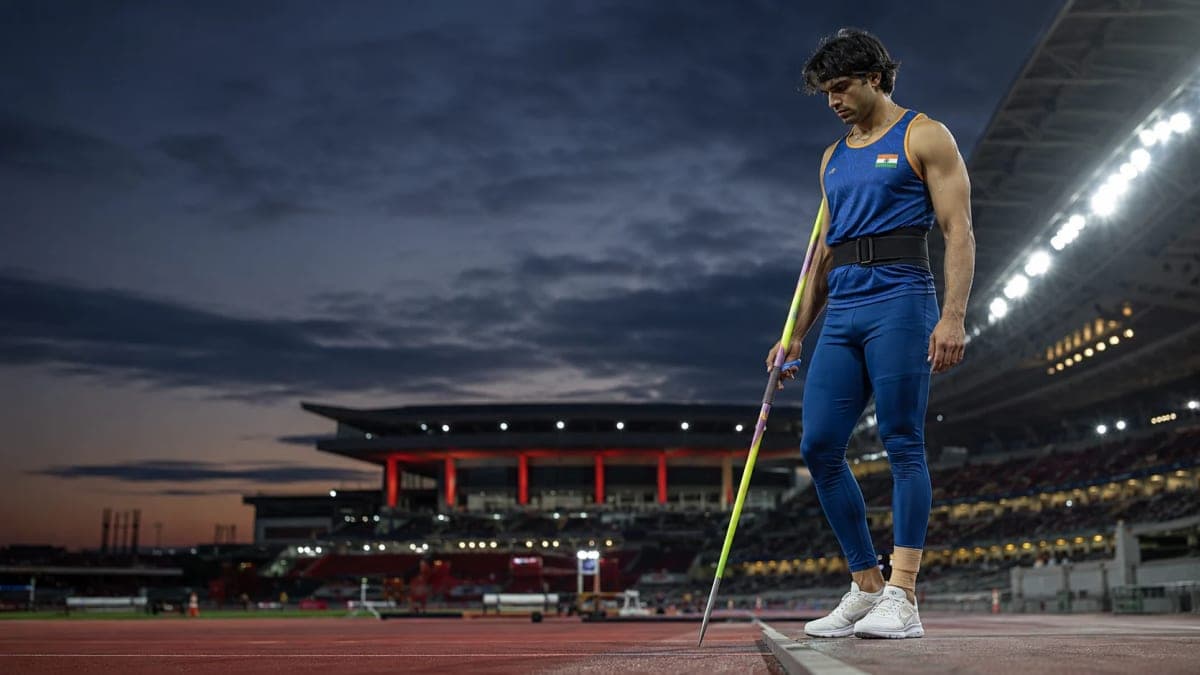
India’s medal preparations for the 2026 Asian Games have suffered a major setback after Neeraj Chopra confirmed that an ankle ligament tear has brought his season to an early end.
The 28-year-old javelin thrower sustained the injury during training shortly after finishing second at the Lausanne Diamond League, where he recorded a season-best throw of 88.05 metres. Following consultations with his doctor and support team, Chopra decided to withdraw from all remaining competitions in 2026.
The decision means he will be unavailable for both the Diamond League Final and the Asian Games in Aichi-Nagoya, Japan.
Injury Strikes as Chopra Regains Momentum
The timing of the injury makes the development particularly disappointing for Chopra and Indian athletics.
After working through physical difficulties and a delayed return to competition, the Olympic medallist had started showing encouraging signs in Lausanne. His 88.05-metre effort suggested that his rhythm and confidence were improving ahead of the season’s major events.
That progress was interrupted when he suffered a ligament tear during a subsequent training session. Chopra said the decision to end his campaign was taken after discussions with his medical and support teams, with rehabilitation now becoming the immediate priority.
Major Setback for India’s Asian Games Campaign
Chopra’s withdrawal removes one of India’s strongest individual medal contenders from the Asian Games squad.
His presence would have offered India more than a realistic opportunity in the men’s javelin competition. As one of the country’s most recognised international athletes, Chopra also brings experience, consistency and the ability to perform under the pressure of major championships.
The Aichi-Nagoya Asian Games will be staged from September 19 to October 4, 2026. The continental competition is expected to attract approximately 11,000 athletes from 45 countries and regions.
India must now reconsider its expectations in the men’s javelin event while giving its other selected throwers a greater competitive role.
Another Difficult Rehabilitation Period
The ankle problem represents Chopra’s second significant injury interruption within roughly a year.
He previously spent about nine months in rehabilitation after aggravating a disc injury in September 2025. He returned to competition in June 2026 and was gradually rebuilding his form before suffering the latest setback.
Ligament injuries require careful management, particularly for javelin throwers. The event places considerable force on the legs and ankles during the approach, blocking phase and release. Returning before the joint is fully prepared could affect technique or increase the danger of another injury.
Ending the season is therefore a significant competitive loss, but it may also be the most sensible long-term decision.
Why Neeraj Chopra’s Absence Matters
Chopra’s career has transformed expectations surrounding Indian track and field. His Olympic gold medal in Tokyo and silver medal in Paris established him as one of the country’s most successful international athletes.
His absence consequently affects India on several levels. It reduces the country’s immediate medal potential, changes the competitive balance of the men’s javelin event and removes a senior figure from the athletics contingent.
However, the withdrawal should not automatically be viewed as a broader crisis for Indian javelin. It also creates an opportunity for the country’s other throwers to compete without Chopra carrying most of the public attention.
Balanced Analysis: Recovery Must Take Priority
From a short-term perspective, the injury is unquestionably damaging. Chopra had qualified for the Diamond League Final and was regarded as a leading medal prospect for the Asian Games. Both opportunities have now disappeared from his 2026 calendar.
From a long-term perspective, protecting his fitness is more important than forcing a rushed return for a single tournament. Elite javelin throwing demands stability throughout the lower body, and an incompletely healed ankle could compromise both performance and safety.
The uncertainty now concerns the length of his rehabilitation and how quickly he can restore full competitive sharpness. No confirmed return date has been announced, making speculation about his comeback premature.
For Chopra, the remainder of 2026 will be devoted to treatment and rebuilding. For India, the Asian Games challenge becomes more difficult—but it also provides a test of whether the country’s athletics programme can produce results without depending heavily on its biggest star.
This article is based on reporting published by Indian Express.


