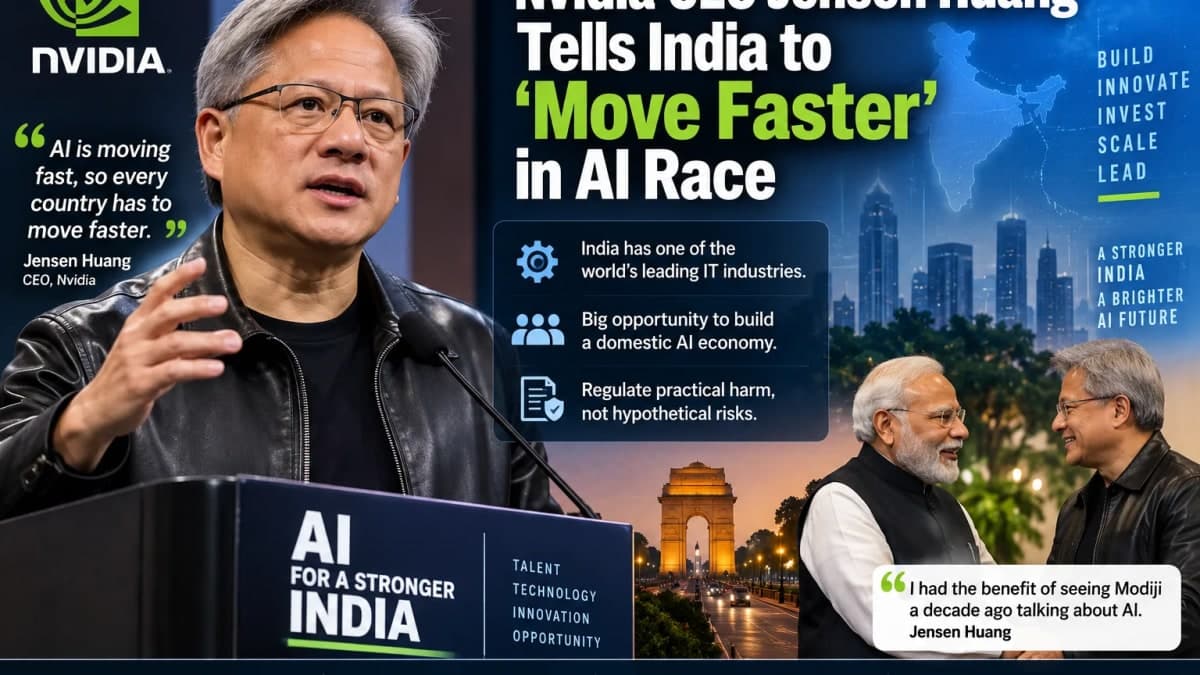
Nvidia CEO Jensen Huang has delivered a direct message to India as competition over artificial intelligence intensifies worldwide: move faster.
Huang said India's established position as a global information technology powerhouse gives the country an important opportunity to participate in the next major computing platform—not simply as a user of artificial intelligence, but as a builder of its own AI ecosystem.
Speaking around the G20 Innovation Ministerial in the United States, Huang highlighted India's technology industry, companies and startup ecosystem while arguing that the rapid development of AI means countries cannot afford to move slowly.
“AI is moving fast, so every country has to move faster,” Huang said.
‘Move Faster’: Huang's Message to India
Huang's argument centres on India's existing technology capabilities.
“India is one of the world's leading IT industries. And this is the beginning of a new IT platform,” he said.
The Nvidia chief sees artificial intelligence as the beginning of a new computing era, creating an opportunity for countries with strong technology industries to develop new businesses, infrastructure and applications.
For India, the challenge is therefore not merely adopting AI tools developed elsewhere.
Huang wants to see Indian companies and startups contribute to the technology and develop a local AI economy capable of creating value domestically.
His remarks effectively frame India's established IT strength as a starting point rather than a guarantee of leadership in the AI era.
Jensen Huang Recalls Narendra Modi Discussing AI a Decade Ago
Huang also recalled an earlier interaction with Prime Minister Narendra Modi while discussing India's position in artificial intelligence.
“I had the benefit of seeing Modiji a decade ago talking about AI,” Huang said.
He added that he was “very excited” to see Indian companies and startups taking advantage of artificial intelligence, contributing to its development and building a local AI economy.
The reference is notable because India's technology ambitions have increasingly expanded beyond its traditional strength in IT services toward areas including semiconductor manufacturing, domestic AI models, high-performance computing and AI infrastructure.
Huang's broader message is that the emergence of a new computing platform creates an opportunity for India to convert its existing technology talent and industrial base into a deeper AI ecosystem.
Why India's IT Strength Could Matter in the AI Era
India enters the global AI race with an advantage that many emerging economies do not have: an enormous technology workforce and a mature IT industry built over decades.
But the infrastructure requirements of the AI era are different from those of the traditional software-services industry.
Modern artificial intelligence requires not only programmers and software expertise but also substantial computing capacity, specialised processors, data centres, energy, data and investment.
That distinction is particularly relevant given Nvidia's position in the AI boom.
The company Huang co-founded in 1993 became widely known for graphics processors before its GPUs emerged as critical hardware for training and operating increasingly sophisticated artificial intelligence systems.
As a result, Nvidia now occupies a central position in the global expansion of AI computing infrastructure.
From IT Services to a Domestic AI Economy
Huang's comments highlight an important strategic question for India: whether the country can translate its success in information technology services into leadership in artificial intelligence.
The next phase could involve considerably more than providing technology services to companies overseas.
A stronger domestic AI economy could include Indian startups developing AI products, companies building applications for local industries, researchers creating models and businesses investing in the computing infrastructure required to operate them.
India's large domestic market could also provide opportunities to develop AI applications across multiple sectors and languages.
However, having a large pool of technology talent does not automatically translate into AI leadership. Access to advanced computing resources, capital and infrastructure can determine how quickly developers and businesses move from experimentation to large-scale deployment.
That helps explain the urgency behind Huang's “move faster” message.
AI Is Becoming Economic Infrastructure
Huang has increasingly described artificial intelligence as more than another category of software.
The Nvidia CEO argues that AI is becoming part of the infrastructure underpinning modern economies.
That shift has significant implications.
If AI becomes deeply integrated into manufacturing, healthcare, financial services, communications, transportation and government services, countries with strong domestic AI capabilities could capture a greater share of the economic value generated by the technology.
Countries that move more slowly could instead become heavily dependent on technology, models and infrastructure developed elsewhere.
Huang's message therefore extends beyond India's technology companies. It reflects the growing international competition to secure computing capacity, attract AI investment and develop domestic technology ecosystems.
Huang Also Warns Against Over-Regulating AI
Speed was not Huang's only message to policymakers.
He also cautioned governments against creating rules based primarily on theoretical risks.
“The advice that I would have is to regulate practical and actual harm and not regulate theoretical and hypothetical harm,” Huang said.
His position does not amount to arguing that AI should operate without safeguards.
Huang also stressed that companies developing the technology have responsibilities of their own.
“Every single company has to take it upon themselves to develop the technology safely,” he said.
His argument therefore combines two priorities: governments should address demonstrable risks, while technology companies should continue improving the safety and reliability of AI systems.
Safety and Innovation Remain a Difficult Balance
The regulatory debate is particularly important because governments around the world are attempting to encourage AI investment while confronting risks associated with increasingly capable systems.
Potential concerns include misinformation, deepfakes, fraud, cybersecurity threats, privacy violations and unsafe automated decision-making.
At the same time, overly restrictive regulation can potentially raise compliance costs and make experimentation more difficult, particularly for smaller companies and startups.
Huang's proposed approach prioritises intervention against identifiable harm rather than broad restrictions based on what AI might theoretically do in the future.
That remains one perspective in a wider global debate over how governments should regulate a technology whose capabilities are advancing quickly.
Why Huang's Message Matters for India
India already has many of the ingredients needed to become an important AI market: technology talent, a large digital economy, major domestic companies, a substantial startup ecosystem and hundreds of millions of potential users.
The larger question is how much of the next generation of AI technology India will build itself.
Huang's comments suggest that the opportunity extends beyond simply adopting foreign AI platforms.
Building a domestic AI economy would mean developing infrastructure, models, applications and companies capable of serving Indian requirements while potentially competing internationally.
That transformation would require investment and technological capability—but also speed.
The Bigger Picture: AI Leadership Is Becoming a Global Race
Artificial intelligence is increasingly becoming a strategic economic priority for governments and corporations.
Countries are competing for advanced chips, data centres, researchers, investment and companies capable of turning increasingly powerful AI models into commercially useful products.
India's traditional IT strength gives it a foundation from which to compete, but the AI era is creating a different technological landscape.
Huang's message ultimately comes down to timing.
India has the talent and an established technology industry. In his assessment, the opportunity now is to use those advantages to build a domestic AI economy before the next computing platform becomes firmly established elsewhere.
And with AI developing at extraordinary speed, his advice is straightforward:
Move faster.