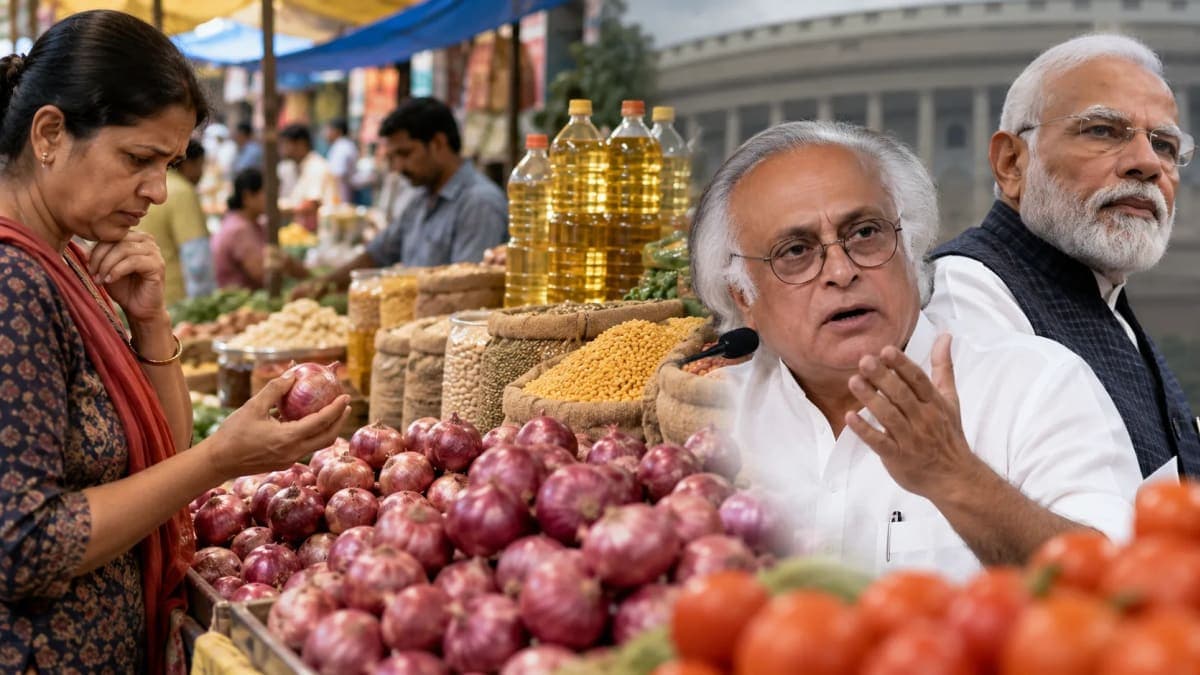
New Delhi, September 21, 2026: The Congress on Monday stepped up its attack on the Narendra Modi government over food prices, arguing that increases in the cost of everyday essentials are putting growing pressure on household budgets.
Congress general secretary in-charge of communications Jairam Ramesh invoked the famous song “Kya Hua Tera Wada” from the 1977 film Hum Kisise Kum Nahin while questioning the Prime Minister over inflation.
Ramesh cited sharp increases in the prices of several spices, pulses, cooking oils and onions and said middle- and lower-income families were bearing the brunt.
The figures were presented by Ramesh as part of his criticism of the government; they should therefore be distinguished from independently verified official inflation data.
Jairam Ramesh Says Essential Food Costs Have Surged
Sharing a media report on food prices, Ramesh claimed that rising prices of essential commodities were making everyday life increasingly difficult for ordinary consumers.
“The skyrocketing prices of food items in the country have broken the back of the middle and poor classes,” Ramesh said.
According to the figures cited by the Congress leader, several commonly used spices recorded substantial increases over the previous month.
He said green cardamom increased from ₹4,000 to ₹4,400 per kg, while black cardamom moved from ₹2,400 to ₹2,800 per kg.
Cumin, according to Ramesh, rose from ₹360 to ₹400 per kg, while mace increased from ₹2,500 to ₹3,000 per kg.
Ramesh characterised the increase in spice prices as ranging between 10% and 25% over the past month.
Congress Flags Higher Dal and Cooking Oil Prices
The Congress leader also highlighted what he said were substantial increases in pulses.
According to the prices cited in his statement:
Arhar dal: ₹100 to ₹130 per kg
Chana dal: ₹70 to ₹100 per kg
Urad: ₹120 to ₹140 per kg
Mustard oil: ₹190 to ₹210 per litre
Saffola oil: ₹240 to ₹280 per litre
Ramesh argued that increases in staples such as pulses and edible oils have a particularly direct effect on household spending because they form part of routine food consumption.
Onion Prices Become a Political Flashpoint
Onions featured prominently in the Congress attack.
Ramesh said the all-India average retail price of onions increased from ₹29.50 per kg in June to ₹53.78 per kg by September, which he calculated as an increase of 82.3% in roughly three and a half months.
Recent market reporting separately indicates that consumers in several cities have been facing elevated onion prices. For example, Bengaluru retail prices crossed ₹70 per kg earlier in September, while reported prices at the time included approximately ₹58 in Delhi, ₹53 in Mumbai and ₹63 in Chennai. The national average cited in that report was ₹50.79 per kg.
Retail prices can differ significantly between cities and markets because of factors including supply conditions, quality, transport costs and local demand.
‘Where Have Achche Din Gone?’ Congress Questions Modi
Turning the price issue into a direct political attack, Ramesh questioned Prime Minister Modi's response to inflation.
He asked where the promised “achche din” had gone and accused the government of remaining silent while households dealt with higher prices.
Ramesh then invoked the well-known Bollywood line:
“Kya hua tera vada? Woh kasam, woh irada?”
The reference comes from the song “Kya Hua Tera Wada” in the 1977 Hindi film Hum Kisise Kum Nahin.
Congress used the cultural reference to frame its broader argument that the Modi government had failed to provide adequate relief from the rising cost of essential food items.
Congress Demands Immediate Action on Prices
Ramesh called on the Centre to take immediate measures to control what he described as uncontrolled inflation and provide relief to consumers.
Congress has repeatedly used inflation and the cost of living as political issues, accusing the government of pursuing policies that hurt ordinary households.
The government has rejected opposition criticism of its economic management and has pointed to India's economic growth figures in responding to such attacks.
Political Claims and Price Data Need to Be Separated
The controversy involves two related but distinct questions: what consumers are paying for particular food products and how political parties interpret those increases.
Prices quoted by individual political leaders can reflect particular markets, periods or reports and are not automatically equivalent to the government's official inflation indicators.
Official inflation measures cover a much broader basket of goods and services and aggregate price movements across categories and locations. Individual commodities such as onions can experience much sharper short-term movements than the overall inflation rate.
That distinction is important when assessing claims from either the government or the opposition: a steep increase in one staple can put real pressure on household budgets even when the broader inflation measure moves differently.
For consumers, however, the political argument is likely to remain closely tied to a much simpler experience — how much more they have to spend when buying vegetables, pulses, spices and cooking oil.