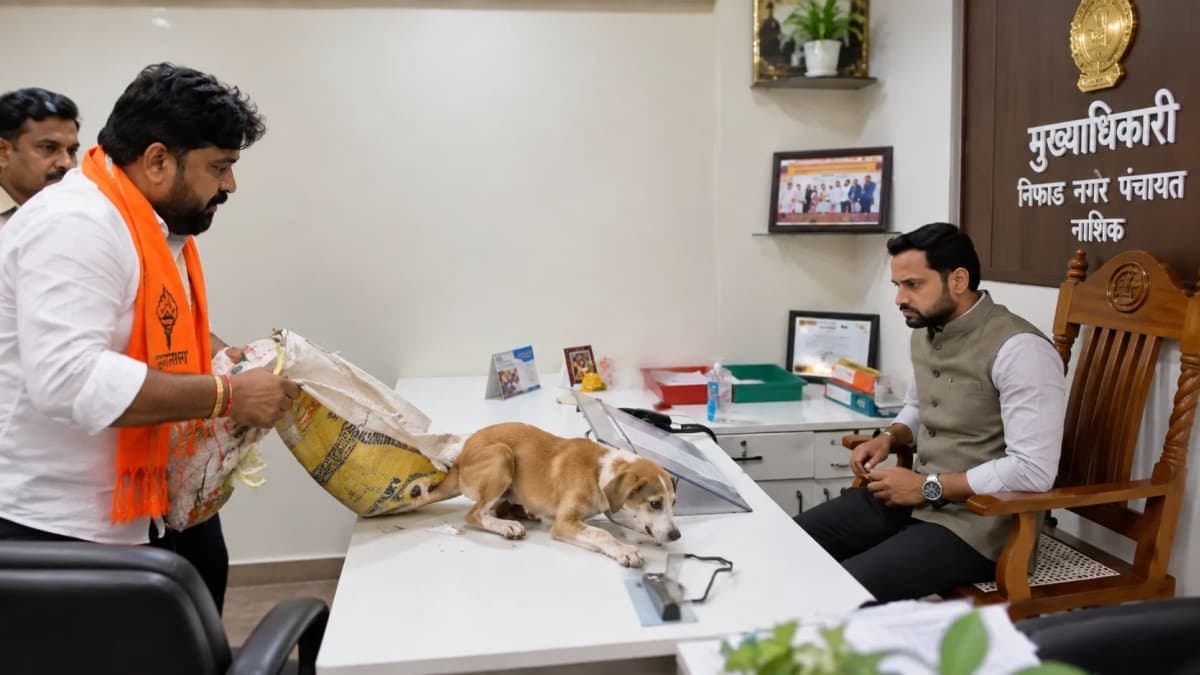
A protest over stray dogs in Maharashtra’s Nashik district took an extraordinary turn when members of the Shiv Sena (UBT)’s youth wing carried dogs into a civic office and released them on the chief officer’s table, creating a confrontation that was captured on video and quickly spread across social media.
The incident took place at the Niphad Nagar Panchayat office, where Yuva Sena (UBT) district chief Vikram Randhave and his supporters confronted Chief Officer Dheeraj Bhamre over what they alleged was prolonged inaction on complaints about stray dogs and dog-bite incidents.
Video footage from the protest shows bags being opened inside the officer’s cabin and small dogs emerging onto and around his desk. Bhamre can be seen moving his chair away as the animals move across the table and around the room. Randhave also used a garland made of currency notes during the demonstration.
The protest has drawn attention not only because of its unusual method, but also because it raises two separate questions: whether Niphad’s civic administration has responded adequately to the town’s stray-dog problem, and whether animals should have been physically used as props in a political protest.
What happened inside the Niphad civic office?
Reports differ slightly on the precise date and number of animals involved. The Indian Express reported that Randhave released four to five stray dogs during the protest, while other reports and footage prominently show two small dogs being released from sacks. PTI reported that Yuva Sena members arrived carrying two sacks.
What is clear from multiple reports and video footage is that dogs were brought into Bhamre’s office and released during a protest led by Randhave.
NDTV reported that one dog appeared frightened after being confined inside a bag and moved towards a corner after being released. Another walked across the table before moving elsewhere in the cabin. The confrontation then continued between Randhave, civic officials and other people present.
Randhave told NDTV that he had been raising the stray-dog issue with the civic administration for roughly six months. He said residents, including children and women, had been bitten or chased by dogs and claimed he had previously sent photographs and raised complaints with the chief officer. Those assertions about his previous communications remain Randhave’s account rather than independently published civic records.
How serious is Niphad’s dog-bite problem?
One of the most important pieces of information to emerge from the incident comes from the local government hospital rather than the protesters.
Dr Rajiv Tambale of Niphad Sub-District Hospital told The Indian Express that around five to six patients bitten by stray dogs come to the hospital for treatment each day. He said that translated into more than 100 dog-bite cases a month and confirmed that anti-rabies vaccine was available at the hospital.
That provides some independent support for the argument that dog bites represent a genuine local public-health concern.
However, Randhave’s separate claim that more than 400 stray dogs are roaming within Nagar Panchayat limits could not be independently verified through an official dog census available to JantaScope.
A Loksatta report gave another local indicator, reporting that around 180 anti-rabies injections are administered monthly at the sub-district hospital, while noting that figures from private hospitals were unavailable.
The broader national context is substantial. Government data presented in Parliament showed that India recorded 3,717,336 reported dog-bite cases in 2024, along with 54 suspected human rabies deaths reported by states and Union Territories under the National Rabies Control Programme. Those figures are national data and should not be treated as evidence of the current situation specifically in Niphad.
Civic body says tenders had already been floated
The allegation that the Nagar Panchayat had done nothing also requires qualification.
Chief Officer Dheeraj Bhamre said that a tender intended to address the issue had already been floated twice, according to PTI.
That distinction matters. The protesters’ case is essentially that whatever administrative steps were being taken had not translated into adequate action on the ground. The civic officer’s response indicates that the administration had at least begun a procurement process.
Publicly available reports reviewed by JantaScope do not establish why the earlier tender attempts failed to produce an operational dog-control programme, whether contractors were selected, or precisely when a sterilisation programme will begin.
Those details will ultimately be more important to residents than the viral confrontation itself.
What does Indian law require local bodies to do?
India’s framework for managing community dogs is not simply a choice between leaving dogs on streets and indiscriminately removing them.
Under the Animal Birth Control Rules, 2023, local bodies including municipalities and panchayats are responsible for Animal Birth Control programmes involving sterilisation and immunisation of stray dogs. The Centre has said ABC and anti-rabies programmes should operate together and that organisations conducting ABC work must meet Animal Welfare Board of India requirements.
The legal framework has also been shaped by subsequent Supreme Court proceedings.
In November 2025, the Supreme Court recorded directions requiring municipal authorities to continue capturing, sterilising, deworming and vaccinating stray dogs under the 2023 rules, with sterilised and immunised dogs generally returned to their original localities, while dogs infected or suspected of being infected with rabies and dogs exhibiting aggressive behaviour were treated differently. The directions were extended across states and Union Territories.
For Niphad, therefore, a sustainable response involves a functioning municipal system: identifying dogs, sterilisation, vaccination, management of aggressive or suspected-rabid animals, complaint handling and accessible medical treatment after bites.
Protest itself triggers animal-welfare and police action
The viral protest has now created another issue for its organisers.
Loksatta reported on September 17 that PETA had taken note of the footage and sought information about the dogs used in the demonstration. Randhave reportedly told the organisation that the animals had subsequently been returned safely to the location from which they had been picked up.
More significantly, the same report said Niphad police registered a case following a complaint by Chief Officer Bhamre against Randhave, his wife Rupali Randhave and three others, citing allegations related to cruelty to animals and obstruction of government work. These are allegations in a registered case; they are not findings of guilt.
That development changes the story from merely an unusual civic demonstration into one involving potential legal consequences.
The bigger issue behind a viral video
The spectacle of dogs appearing on a government officer’s desk is what pushed the Niphad dispute into national attention. But the policy question is less dramatic.
Sterilisation programmes work only when they operate consistently and at sufficient scale. Vaccination has to accompany population management, while dog-bite victims require rapid access to appropriate wound care and post-exposure rabies treatment.
For local authorities, delays in contracting, insufficient dog-catching capacity or sporadic sterilisation can leave residents feeling that complaints are disappearing into an administrative process.
At the same time, physically transporting frightened animals in sacks to stage a demonstration introduces a separate animal-welfare concern and does not itself provide a solution to the population-management problem.
Niphad’s next measurable test is therefore not whether another dramatic protest occurs. It is whether the Nagar Panchayat can move from tenders and complaints to a functioning, legally compliant sterilisation, vaccination and response programme — and publish enough information for residents to judge whether that programme is actually reducing risk.