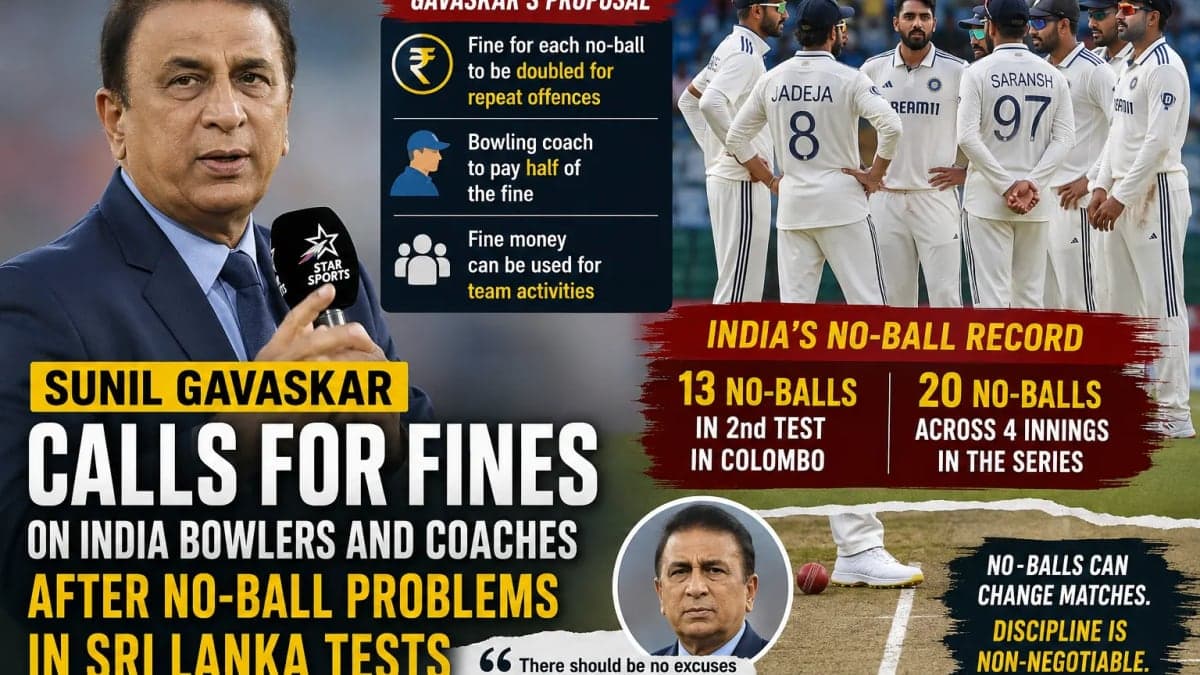
Former India captain Sunil Gavaskar has proposed a system of escalating financial penalties for bowlers who repeatedly deliver no-balls, after India's front-foot discipline became a major talking point during the team's Test series in Sri Lanka.
India won the two-match series 1-0, but their bowlers delivered 20 no-balls across Sri Lanka's four innings, including 13 in the second Test in Colombo. Ravindra Jadeja and debutant Saransh Jain combined for 11 of India's no-balls in that match.
Gavaskar believes the problem needs urgent attention because a no-ball is largely within a bowler's control and can have consequences far greater than the single extra run.
Gavaskar Proposes Escalating Fines for No-Balls
Writing in his Mid-Day column, Gavaskar argued that financial penalties could provide a stronger deterrent against repeated overstepping.
His proposed system would not stop with the first offence. Instead, the fine would increase whenever the bowler committed another no-ball.
Gavaskar suggested “a fine which gets doubled for every further transgression” and proposed that the bowling coach should also face a penalty worth half the amount imposed on the bowler.
Importantly, this is Gavaskar's proposal rather than an official Board of Control for Cricket in India or International Cricket Council rule.
Why Gavaskar Believes No-Balls Need Urgent Attention
For Gavaskar, the central issue is control.
He argued that while many events during a cricket match are unpredictable, keeping the front foot behind the line is something a bowler can directly manage.
With modern players able to measure and mark their run-ups precisely, Gavaskar said “there should be no excuses for overstepping the bowling crease.”
His concern is understandable because the damage from a no-ball can extend beyond conceding one run.
A wicket can be overturned if the delivery is illegal, the batter receives another delivery and the bowling side can lose momentum. In a closely contested Test, those seemingly small errors can become significant.
India's 20 No-Balls Put Spotlight on Bowling Discipline
India's problems became particularly visible during the second Test at the Sinhalese Sports Club in Colombo.
The visitors delivered 13 no-balls during the match, while Jadeja and Jain were responsible for 11 between them. Across the complete two-Test series, India overstepped 20 times.
Jadeja's record has attracted additional attention because this is not an entirely new problem for the experienced spinner.
Multiple reports following the Sri Lanka series noted that Jadeja has delivered more than 85 Test no-balls since 2021.
That statistic makes the discussion about front-foot discipline broader than one difficult Test in Colombo.
Gavaskar Rejects Free Hits in Test Cricket
India spin-bowling coach Sairaj Bahutule had raised the possibility — partly in jest — of using a free hit after a no-ball in Test cricket as a way of discouraging bowlers from overstepping.
Bahutule acknowledged during the series that the Indian coaching staff was working on the problem and described the number of no-balls as a concern.
Gavaskar, however, strongly disagreed with the free-hit solution.
“Please, let's not make scoring runs in Test cricket easier for batters with this penalty,” he wrote.
His argument is that Test cricket does not need another rule that shifts the balance towards batting. Instead, he wants the punishment directed at the player committing the error.
Bowling Coach Should Share Responsibility, Gavaskar Says
One of the more unusual elements of Gavaskar's proposal is his insistence that responsibility should extend to the coaching staff.
Under his suggested system, the bowling coach would pay half the amount of the fine levied against the bowler.
The idea effectively treats repeated no-balls as both an individual execution problem and a coaching issue.
That would create an incentive not only for players to correct their run-ups but also for coaches to identify recurring technical problems during practice before they affect matches.
Again, Gavaskar's suggestion remains an opinion and has not been adopted as an official disciplinary measure.
Gavaskar Has an Idea for the Fine Money Too
Gavaskar also proposed a lighter side to the punishment system.
He suggested that money collected through no-ball fines could be put towards the team's final dinner before players disperse at the end of a series.
He went further, suggesting players could collectively decide whether other avoidable mistakes — such as failing to back up a throw — deserved similar penalties.
Rather than treating every fine solely as punishment, Gavaskar suggested the system could ultimately become a team-building exercise.
Colombo Draw Adds Weight to No-Ball Debate
The discussion became more significant because India were unable to complete a series sweep in Colombo.
India had established a 213-run first-innings lead and enforced the follow-on, putting themselves in a commanding position. Sri Lanka, however, fought back to save the Test.
Sonal Dinusha played the decisive role in that resistance, scoring an unbeaten 133 as Sri Lanka prevented India from securing another victory.
India therefore finished the two-match series with a 1-0 victory, having won the opening Test in Galle by 165 runs.
The draw also had implications for India's World Test Championship campaign, adding to the scrutiny of controllable errors during the match.
Why India's No-Ball Issue Matters Beyond One Series
The debate highlights a fundamental difference between a tactical risk and an avoidable technical mistake.
A bowler can concede runs while attacking for a wicket, a batter can be dismissed while attempting to accelerate, and a captain can make a fielding decision that fails. Those outcomes are inherent to cricket's tactical uncertainty.
Repeated front-foot no-balls are different because the bowler has substantial control over where the front foot lands.
That distinction appears to be at the heart of Gavaskar's argument.
For India, reducing no-balls would not require changing the team's broader bowling strategy. It would primarily require improving execution, awareness and training discipline.
With World Test Championship points potentially determined by narrow margins, eliminating preventable mistakes could become increasingly important.
Conclusion
India left Sri Lanka with a 1-0 Test series victory, but the 20 no-balls delivered across the two matches exposed an area Sunil Gavaskar believes demands immediate attention.
Rather than introducing free hits into Test cricket, Gavaskar wants accountability placed directly on those responsible. His proposed solution involves fines for bowlers that increase with repeated offences, while also making the bowling coach financially accountable.
Whether Indian cricket authorities ever consider such a system remains uncertain. For now, it remains Gavaskar's proposed remedy rather than an official policy.
But the wider message behind his criticism is difficult to overlook: in Test cricket, where matches can turn on a single wicket or small passage of play, repeatedly giving away avoidable deliveries can become far more costly than the extra run recorded on the scoreboard.
This article is based on reporting published by The Indian Express.


