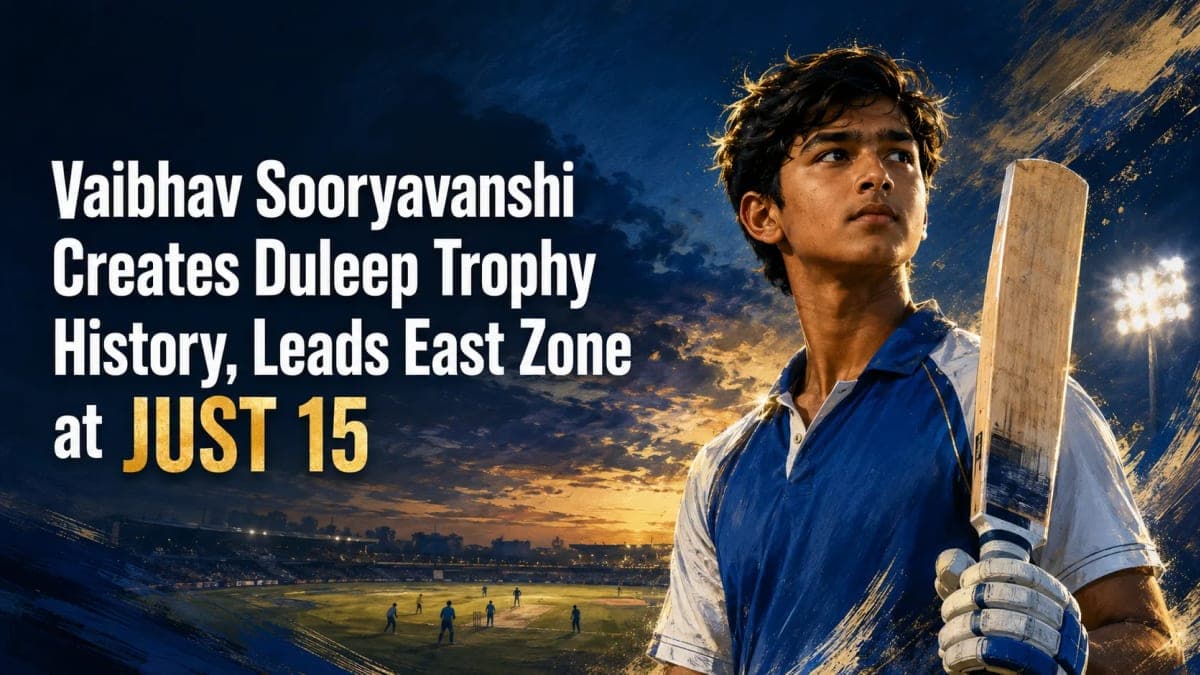
Vaibhav Sooryavanshi Creates History by Captaining East Zone at 15
Fifteen-year-old Vaibhav Sooryavanshi added another remarkable chapter to his young career when he assumed the captaincy of East Zone during the Duleep Trophy semifinal against Central Zone in Bengaluru on Sunday.
Sooryavanshi began the match as East Zone’s vice-captain. He was elevated to the leadership role in the 19th over of Central Zone’s innings after regular captain and wicketkeeper Ishan Kishan was struck on his right wrist and had to leave the field for medical attention. Kumar Kushagra subsequently took over the wicketkeeping duties.
The unexpected responsibility made Sooryavanshi one of the youngest cricketers to lead a senior side at this level of Indian domestic cricket. It was also his first experience captaining a senior men’s team.
From Vice-Captain to Leader During a Semifinal
East Zone had named Sooryavanshi vice-captain before the tournament, despite his limited first-class experience. The BCCI’s published squad confirmed Ishan Kishan as captain and the Bihar teenager as his deputy.
That decision placed Sooryavanshi next in the leadership order when Kishan was unable to continue. Instead of receiving his first captaincy opportunity in a routine fixture, the teenager was asked to manage the team in a high-pressure semifinal.
The challenge was particularly significant because the East Zone lineup included several experienced domestic and international cricketers. Leading senior players while responding to changing match conditions presented a very different test from the batting assignments for which Sooryavanshi is better known.
A Rapid Rise Through Indian Cricket
Sooryavanshi’s progress has attracted attention since his first-class debut for Bihar in the 2024 Ranji Trophy. The match against Central Zone was only his second Duleep Trophy appearance and his tenth first-class game, illustrating how early this leadership responsibility arrived in his development.
His tournament debut against North East Zone produced contrasting results. The left-handed opener scored eight runs but later contributed with his left-arm spin, taking two wickets for 11 runs in three overs. The wickets came within four deliveries as East Zone completed an innings-and-210-run victory.
That performance demonstrated an ability to influence a match even when his primary skill did not deliver the desired result. His subsequent elevation to stand-in captain added leadership to the growing list of responsibilities being entrusted to him.
Why the Captaincy Moment Matters
Age records naturally generate headlines, but the greater significance lies in the confidence East Zone’s selectors and team management have shown in Sooryavanshi.
Captaincy in first-class cricket involves more than carrying a title. A leader must set fields, rotate bowlers, communicate with senior teammates and make tactical decisions while remaining focused on personal performance. Handling those demands at 15 represents an unusual developmental opportunity.
The episode may also strengthen the argument for giving talented young players meaningful responsibility rather than limiting them to age-group competitions. Exposure to experienced teammates and demanding match situations can accelerate a player’s tactical education.
However, one emergency captaincy assignment should not be treated as proof that Sooryavanshi is already a finished leader. His first-class career remains at an early stage, and he is still building consistency as a red-ball batter. Leadership potential, like batting technique, requires time and repeated testing.
Opportunity Must Be Balanced With Patience
The attention surrounding Sooryavanshi creates both opportunity and pressure. Every new milestone raises expectations, but development in first-class cricket is rarely linear. Young players need space to experience poor innings, tactical mistakes and changes in form without every setback becoming a judgment on their long-term potential.
East Zone’s decision to appoint him vice-captain appears to have been made with future development in mind. That approach can be valuable if it is supported by experienced players and careful workload management.
The presence of established cricketers around him should help ensure that leadership becomes an educational experience rather than an excessive burden.
Another Landmark in an Unusual Career
Sooryavanshi did not enter the semifinal expecting to captain East Zone. Kishan’s injury changed the situation, and the teenager was asked to respond immediately.
Whatever the final result of the match, the sight of a 15-year-old directing a senior regional team in one of India’s major domestic competitions will remain a notable moment. It reflects both the extraordinary speed of Sooryavanshi’s rise and the considerable faith being placed in his future.
The next challenge will be turning early records and high-profile opportunities into sustained performances. His captaincy appearance is an impressive milestone, but the longer and more important story will be how patiently his all-round game develops from here.
This article is based on reporting published by Sports Ndtv.


