Sooryavanshi sets the tone in Chennai
Vaibhav Sooryavanshi did not spend long at the crease in the Duleep Trophy final, but he gave East Zone exactly the kind of start they needed.
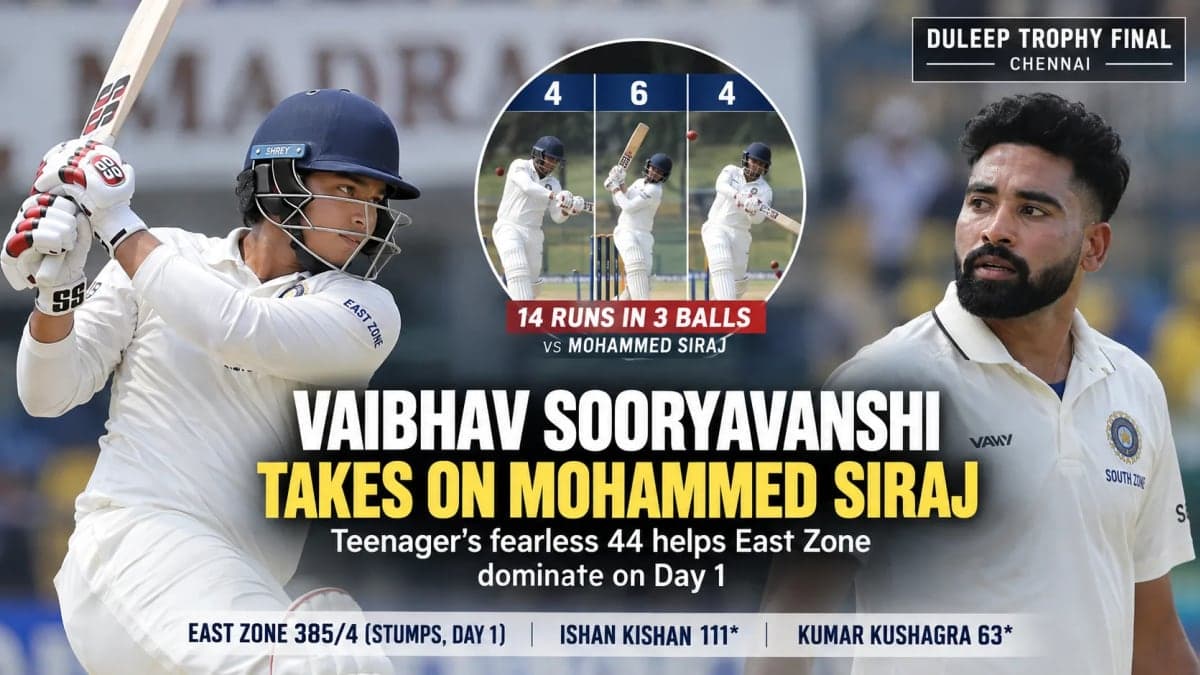
The 15-year-old opener made 44 from 37 balls against South Zone at the MA Chidambaram Stadium in Chennai, striking four fours and three sixes. More notable than the score itself was his willingness to attack Mohammed Siraj, the senior India fast bowler leading South Zone's pace challenge.
That contest produced the most eye-catching passage of Sooryavanshi's innings.
In the seventh over, the left-hander cut Siraj for four and followed it by clearing his front leg to send the next delivery over long-off for six. Siraj changed his angle and came around the wicket, but Sooryavanshi responded by driving another full ball over long-off for four.
It was a sequence of 4, 6, 4: 14 runs from three consecutive deliveries.
For a teenager playing a domestic final against an established international bowler, it was an assertive piece of batting. More importantly for East Zone, it prevented South Zone from settling into the contest with the new ball.
Siraj's opening spell comes under pressure
Siraj has built much of his international reputation on his ability to challenge batters early, particularly when there is movement available with the new ball. On this occasion, however, East Zone's opening approach forced him onto the defensive.
He conceded 41 runs from his first five overs without taking a wicket.
Sooryavanshi was central to that pressure. Rather than allowing Siraj to dictate the length and tempo of the contest, he looked for scoring opportunities whenever the bowler missed his preferred areas.
The approach carried risk, and eventually South Zone found a way to remove him.
Milind stops Sooryavanshi short of fifty
Sooryavanshi was six runs away from a half-century when left-arm pacer Chama Milind dismissed him in the 15th over. An attempted attacking shot ended with a catch at deep midwicket.
His 44 came at a strike rate of 118.91.
The dismissal prevented him from turning an entertaining start into a major first-innings contribution, an important distinction in a five-day final. But by then, East Zone had already benefited from the pace of his innings.
His role became clearer as the day developed. The early aggression gave the middle order room to build rather than repair.
Another significant innings in Sooryavanshi's Duleep Trophy campaign
The final came after a much longer contribution from Sooryavanshi in the semifinal against Central Zone.
He made 92 from 81 deliveries in that match, hitting seven fours and seven sixes. At 15 years and 157 days, he became the youngest player to register a half-century in the Duleep Trophy, breaking a record that had stood for 57 years.
That innings carried greater weight because of its size. His effort against South Zone offered a different test.
Facing a bowler of Siraj's experience in a final provided an opportunity to see whether Sooryavanshi would temper the aggressive style that has become closely associated with his rise. He did not abandon it.
There is an important balance, however, between admiring that intent and reading too much into a short innings. First-class batting demands more than the ability to dominate individual spells. Building long innings, adjusting when conditions change and finding ways to score when attacking options disappear are equally important.
His semifinal 92 offered evidence of that developing range. The 44 in Chennai showed how quickly he can alter the momentum of an innings.
Ishan Kishan converts East Zone's advantage
Sooryavanshi's dismissal did not give South Zone the opening they needed.
East Zone captain Ishan Kishan took responsibility for extending the advantage, finishing the day unbeaten on 111. Kumar Kushagra was alongside him on 63 not out as East Zone reached 385/4 at stumps.
That left South Zone with considerably more to worry about than one expensive spell from Siraj.
East Zone had lost only four wickets across the day and had a set century-maker still at the crease. The early attack had developed into sustained control, with Kishan and Kushagra ensuring the momentum created at the top of the order was not wasted.
For South Zone, the priority shifted from containing an aggressive opening partnership to finding a way through two established batters before East Zone could push the first-innings total beyond reach.
A useful test of Sooryavanshi's progress
Sooryavanshi's rapid rise has naturally placed greater attention on each of his performances, particularly when he comes up against established international players.
The exchange with Siraj will attract attention because of the contrast: a 15-year-old prospect attacking an experienced India fast bowler in a domestic final.
The more meaningful measure of his development, though, will come over a larger body of first-class cricket.
There will be innings when attacking from the outset works, and others when conditions demand patience. Learning when to switch between those approaches is part of the progression facing any young batter.
At Chepauk, Sooryavanshi's job was relatively short but effective. He put an experienced attack under immediate pressure before East Zone's middle order turned that early advantage into a commanding first day.


