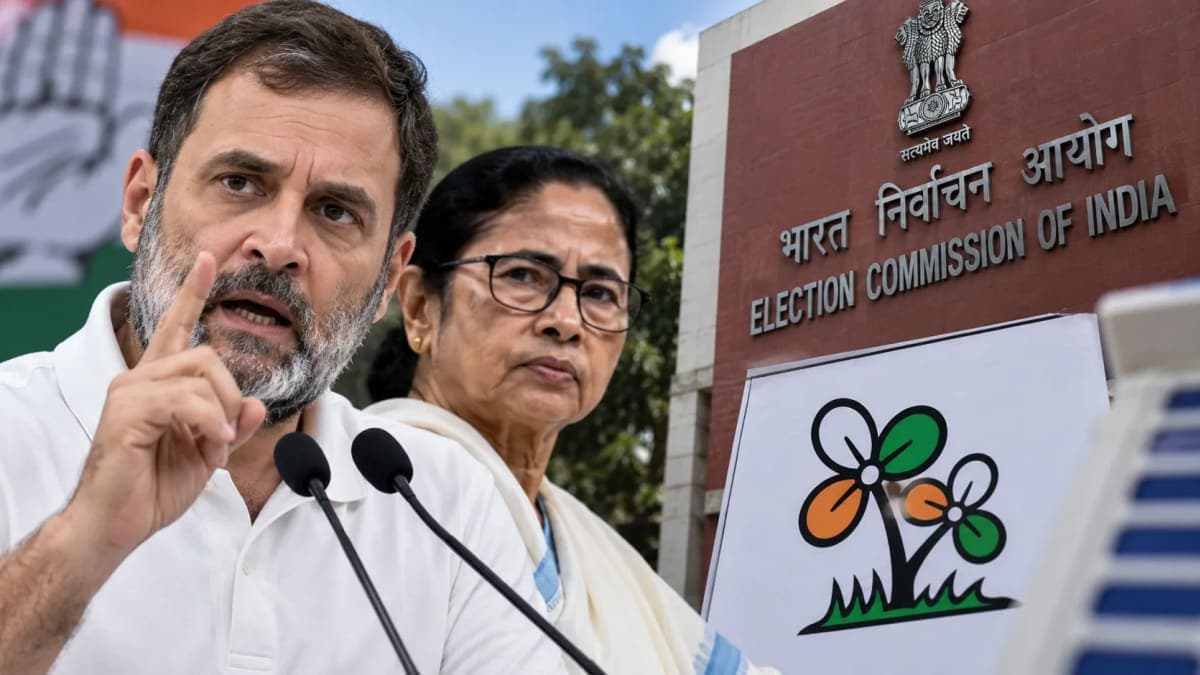
Leader of Opposition in the Lok Sabha Rahul Gandhi has sharply criticised the Election Commission of India over its decision to temporarily freeze the All India Trinamool Congress (AITC) name and its reserved “Flowers and Grass” election symbol amid an internal leadership dispute.
Gandhi alleged that the Election Commission and the BJP were working together to weaken opposition parties, drawing parallels with earlier disputes involving the Shiv Sena and Nationalist Congress Party.
The allegations are political claims made by Gandhi. The Election Commission, in contrast, has said its interim arrangement is meant to place the rival TMC factions on an equal footing and protect their respective interests while it considers their competing claims.
What Rahul Gandhi Said
In a post on X on September 18, Gandhi linked the TMC dispute to earlier splits involving the Shiv Sena and NCP.
“First Shiv Sena, then NCP, and now Trinamool Congress. Every time, the same pattern—BJP and the Election Commission join forces to split a party. Then its election symbol is snatched away,” Gandhi said.
He further described the developments as “Vote theft. Government theft. Now party theft” and argued that the controversy went beyond Mamata Banerjee or the TMC.
“This fight isn’t just Mamata Banerjee’s. It’s the fight of every political party, every voter who wants free and fair elections,” Gandhi said.
His allegations of collusion between the BJP and Election Commission are claims; the cited reporting does not establish them as findings of fact.
Why Did the Election Commission Freeze the TMC Name and Symbol?
The dispute involves competing claims to the Trinamool Congress organisation.
The Election Commission issued an interim order after hearing representatives of the rival factions. It concluded that the competing claims required a substantive determination under Paragraph 15 of the Election Symbols (Reservation and Allotment) Order, 1968.
Until that process is completed, neither faction can use the original All India Trinamool Congress name or its reserved “Flowers and Grass” symbol for the relevant by-elections.
According to the Commission, the interim arrangement was designed to put the rival groups on an “even keel” and protect their rights and interests until a final determination is made.
What Is Paragraph 15 of the Symbols Order?
Paragraph 15 provides the legal mechanism the Election Commission uses when rival groups within a recognised political party each claim to represent the original party.
The Commission can consider the available facts and circumstances, hear representatives of the competing groups and determine whether one faction—or neither—is entitled to be recognised as the original political party.
Until such a decision is reached, the Commission can make interim arrangements affecting the party name and election symbol, particularly when an election is approaching.
This distinction is important: the current freeze is an interim measure, not the Election Commission’s final determination of which TMC faction represents the original party.
Alternative Names and Symbols Allotted
Following the freeze, the Election Commission allotted alternative names and symbols to the rival factions for the upcoming by-elections.
The arrangement is intended to allow the competing groups to participate electorally without either side using the disputed original party identity while the Commission considers the larger organisational dispute.
The immediate electoral implications are particularly significant in West Bengal, where by-elections for Nandigram and Rejinagar are scheduled for October 6, 2026.
Rahul Gandhi Draws Parallel With Shiv Sena and NCP
Gandhi's criticism rests partly on his comparison of the TMC dispute with previous symbol and party-recognition battles involving the Shiv Sena and Nationalist Congress Party.
His argument is that the cases represent a broader pattern of opposition parties being divided and their established symbols becoming subject to Election Commission decisions.
That is Gandhi's political interpretation of the disputes, rather than an established finding that the cases resulted from a coordinated strategy between the BJP and the Election Commission.
Party-symbol disputes are not new to Indian politics. The Election Commission has previously been required to adjudicate competing claims involving other recognised parties, including the Samajwadi Party and AIADMK.
Rahul Gandhi Reaches Out to Mamata Banerjee
The dispute has also produced a notable political outreach between Congress and Mamata Banerjee.
Gandhi spoke with Banerjee and expressed solidarity after the Election Commission's decision. The development is politically significant because Congress and the TMC have frequently competed against each other in West Bengal despite both having participated in the INDIA opposition grouping at the national level.
The Mamata Banerjee-led faction subsequently withdrew its candidate from the Nandigram bypoll and extended support to Congress.
Mamata Banerjee Moves Supreme Court
The dispute is now also moving through the judicial process.
Mamata Banerjee has approached the Supreme Court challenging the Election Commission's decision preventing her faction from using the original TMC name and symbol while the rival claims are being examined.
That means the controversy is unfolding on several fronts simultaneously: an internal TMC organisational dispute, proceedings before the Election Commission, opposition criticism of the poll body, electoral preparations for the October bypolls and a legal challenge before the Supreme Court.
Why the TMC Symbol Dispute Matters
An election symbol carries particular importance in Indian elections because it provides voters with a consistent visual identity for a political party and its candidates.
The immediate issue before the Election Commission, however, is narrower than the broader political accusations surrounding the controversy: it must determine which, if either, of the competing groups should ultimately be recognised as the original Trinamool Congress under the Symbols Order.
Until that determination is made, the original TMC name and symbol remain unavailable to the rival factions under the interim arrangement.
Rahul Gandhi has turned that procedural dispute into a broader argument about the independence of electoral institutions and the treatment of opposition parties. The Election Commission's stated position is that its interim action is intended to preserve parity between the competing factions while their claims are adjudicated.